

Scaler / Scabbler
A scaler or scabbler is a pneumatic demolition tool that uses multiple reciprocating needles or pistons to impact and fracture concrete surfaces, remove coatings, or prepare substrates. These air-powered tools deliver rapid, concentrated blows to chip away material without cutting or grinding. The equipment is essential for concrete rehabilitation, surface texturing, and coating removal across construction and maintenance applications.
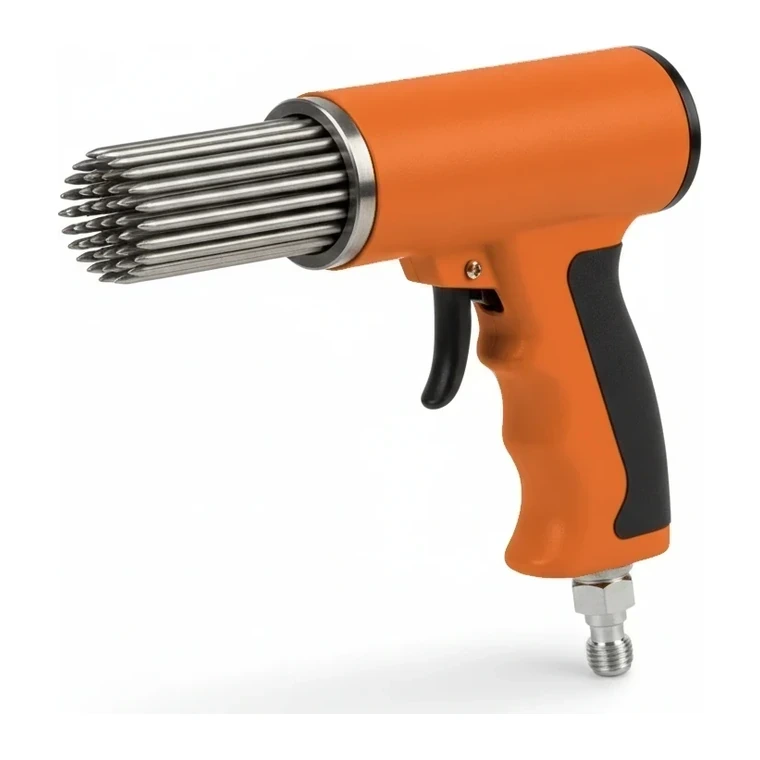
Cómo funciona
Compressed air drives an array of hardened steel needles or pistons in rapid reciprocating motion, typically at several thousand impacts per minute. Each needle strikes the work surface independently, creating a chipping action that fractures and removes material through repeated impact rather than abrasion. The operator guides the tool across the surface while maintaining contact, with the impact pattern controlled by the needle configuration and air pressure. Needle scalers feature bundles of pointed steel rods that vibrate at high frequency, ideal for coating removal and light surface preparation. Scabblers use larger pistons with carbide or steel tips arranged in a grid pattern, delivering heavier blows for concrete surface removal and texturing. Both types exhaust air through the tool body and require connection to an appropriately sized air compressor with adequate CFM delivery.
Tipos y variantes
- Needle Scaler
- Features a bundle of 15-40 thin steel needles for surface cleaning, rust removal, and light coating stripping with minimal substrate damage
- Pistol-Grip Scabbler
- Handheld configuration with pistol grip for vertical surfaces, detail work, and areas requiring precise control
- Inline Scabbler
- Straight-body design with multiple heavy pistons for horizontal concrete texturing and surface removal applications
- Multi-Head Scabbler
- Wide-head configuration with multiple piston assemblies arranged in rows for increased coverage on large horizontal surfaces
- Rotary Scabbler
- Features rotating drum with impact pistons for continuous forward motion during concrete surface preparation
Especificaciones clave
| Especificación | Rango típico | Qué significa |
|---|---|---|
| Air Pressure Requirement | 90 PSI | Standard operating pressure for most pneumatic scalers and scabblers, matching typical compressor output |
| Air Consumption | 8-25 CFM | Volume of compressed air required for continuous operation, determining minimum compressor capacity needed |
| Piston/Needle Count | 3-40 units | Number of impact elements; needle scalers use many thin needles while scabblers use fewer heavy pistons |
| Impact Rate | 2,000-4,500 BPM | Blows per minute delivered to the work surface, affecting material removal speed and surface finish |
| Tool Weight | 5–20 lbs (2.3–9.1 kg) | Operating weight affecting operator fatigue and suitability for vertical versus horizontal applications |
Cómo la industria lo dimensiona
The scaler/scabbler equipment class is not sized by capacity bands because one tool configuration serves each distinct application: the physical size and piston/needle arrangement does not scale to create different capability tiers. Selection is based on the specific task: needle scalers for coating removal and surface cleaning, pistol-grip scabblers for vertical and detail work, and inline or multi-head scabblers for horizontal concrete texturing. The industry differentiates models by piston count, impact head width, and handle configuration rather than by graduated size categories.
Aplicaciones
- Concrete surface preparation and texturing prior to overlay or coating application
- Removal of paint, epoxy, and protective coatings from steel and concrete structures
- Bridge deck rehabilitation and roadway surface roughening for bonding layers
- Rust and scale removal from structural steel, tanks, and metal fabrications
- Creation of non-slip surfaces on walkways, ramps, and industrial flooring
- Repair preparation by removing deteriorated concrete to sound substrate
Seguridad y operación
- Hearing protection required due to high-frequency impact noise often exceeding 100 dBA
- Hand-arm vibration exposure managed through periodic work breaks and anti-vibration gloves to prevent HAVS
- Eye and face protection necessary to guard against flying concrete chips, coating fragments, and debris
- Dust control measures including ventilation or dust extraction to minimize silica exposure during concrete work
- Secure air hose connections and proper pressure regulation to prevent whipping hoses and tool malfunction
Normas y certificaciones
- OSHA · 29 CFR 1926.302
- Requirements for pneumatic power tools including guarding, safe operating procedures, and compressed air pressure limits
- OSHA · 29 CFR 1926.1153
- Respirable crystalline silica standard governing dust control during concrete scabbling operations
- ANSI · B186.1
- Safety standard for portable pneumatic tools covering design, maintenance, and operational safety requirements
- ISO · 5349
- Measurement and evaluation of human exposure to hand-transmitted vibration from pneumatic impact tools
Preguntas frecuentes
What distinguishes a scaler from a scabbler?
What size air compressor is needed for scabbler operation?
How does scabbling compare to grinding for concrete surface preparation?
What determines needle or piston replacement intervals?
Equipos relacionados
Explorar por fabricante
Fuentes
Cada especificación se verifica con los datos publicados por el fabricante, con la fuente enlazada como referencia.
Todos los modelos
2 modelos · Cada especificación citada a la fuente