

Rock Saw / Rockwheel
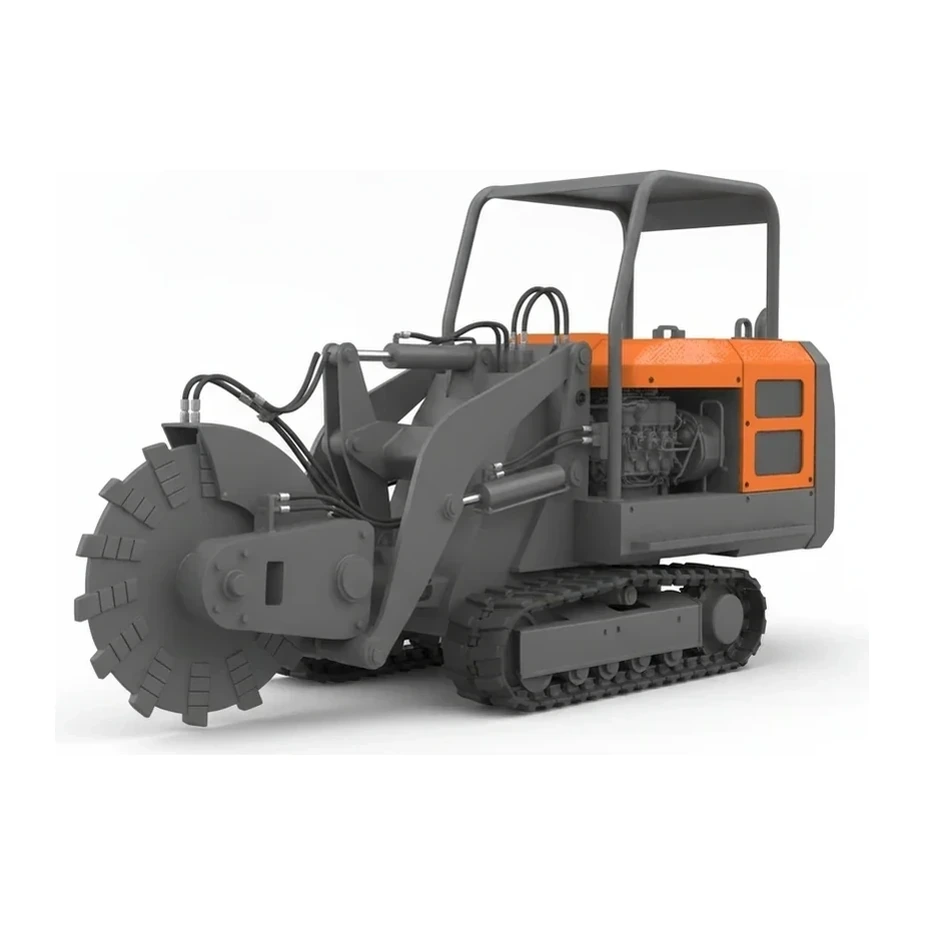
A rock saw, also known as a rockwheel or trench saw, is a specialized trenching machine that uses a large-diameter carbide-tipped cutting wheel to slice through solid rock, reinforced concrete, asphalt, and frozen ground. Unlike chain trenchers that struggle or fail in hard substrates, rock saws deliver clean, narrow trenches with minimal ground disturbance. They are essential for utility installation in consolidated geology and urban environments where subsurface obstructions and hardscape are common.
Cómo funciona
The rock saw employs a circular cutting wheel studded with industrial carbide or diamond segments that rotates perpendicular to the direction of travel. As the machine advances, the wheel plunges into the substrate, grinding and fracturing material along a narrow kerf. Hydraulic systems control wheel rotation speed, down-pressure, and cutting depth, while water injection suppresses dust and cools the cutting surface. Most rock saws are mounted on tracked carriers or skid steers, providing stability during high-torque cutting operations. The cutting wheel operates at controlled speeds—typically slower than masonry saws—to manage heat buildup and maximize segment life. Spoil is continuously ejected from the trench or removed by vacuum systems in confined applications.
Tipos y variantes
- Wheel Trencher (Dedicated)
- Purpose-built tracked machines with integrated rock saw assemblies, designed for continuous trenching in challenging ground conditions.
- Skid Steer Attachment
- Rock saw heads that mount to skid steers or compact track loaders, offering versatility for smaller projects and tighter site access.
- Excavator-Mounted Saw
- Hydraulic rock saw attachments for excavators, enabling precise depth and angle control on steep or irregular terrain.
- Concrete/Asphalt Saw Trencher
- Lighter-duty units optimized for cutting pavement and roadway surfaces, often used for utility repairs in urban rights-of-way.
- Deep-Cut Rock Saw
- Heavy-duty machines with extended cutting depth capacity for deep utility mains and large-diameter pipe installation in solid rock.
Especificaciones clave
| Especificación | Rango típico | Qué significa |
|---|---|---|
| Cutting Depth | Up to 36 in and greater | Maximum vertical trench depth achievable; smaller saws handle pavement and shallow utilities, while deep-cut models trench through bedrock for mains. |
| Cutting Width (Kerf) | 4–12 in (10.2–30.5 cm) | Width of the trench produced by the wheel; narrower kerfs reduce spoil volume and backfill requirements. |
| Wheel Diameter | 36–60 in (91.4–152 cm) | Diameter of the cutting wheel; larger wheels enable deeper cuts and sustained performance in hard rock formations. |
| Engine Power | 75–300 hp | Horsepower required to drive hydraulics and maintain cutting torque under load in dense substrates. |
| Cutting Speed | 10–100 ft/hr | Rate of forward progress through the substrate; varies widely with rock hardness, depth, and wheel condition. |
Cómo la industria lo dimensiona
Rock saws are sized primarily by maximum cutting depth, measured in inches, which determines the range of utility installation and ground conditions the machine can address. Cutting depth typically ranges from shallow pavement cuts up to 36 inches for standard utility trenching, with deep-cut models exceeding 36 inches for large mains and challenging bedrock applications. Wheel diameter, kerf width, and machine weight class further refine selection based on substrate hardness, trench width requirements, and site access constraints.
Aplicaciones
- Installation of water, sewer, and gas lines through rock and hardpan soils
- Fiber optic and telecommunications cable trenching in urban environments with existing pavement
- Electrical conduit and duct bank trenching in consolidated or frozen ground
- Drainage and irrigation system installation where chain trenchers cannot penetrate
- Demolition and removal of reinforced concrete slabs and footings
- Roadway and pavement repair requiring precise, minimal-disturbance cuts
Seguridad y operación
- Operators must maintain safe distance from the rotating cutting wheel and ensure bystanders are clear of the ejection path for spoil and debris.
- Water suppression systems should be active during cutting to control silica dust and prevent respiratory hazards.
- Subsurface utility locates are mandatory before trenching to avoid striking pressurized gas, electrical, or communication lines.
- Machine stability must be verified on slopes and uneven terrain to prevent tipping during high-torque cutting operations.
- Carbide and diamond segments require periodic inspection for wear and secure attachment to prevent ejection during operation.
Normas y certificaciones
- OSHA · 29 CFR 1926 Subpart P
- Excavation and trenching safety standards, including protective systems and spoil placement requirements.
- ANSI · B7.1
- Safety requirements for the use, care, and protection of abrasive wheels used in cutting operations.
- OSHA · 29 CFR 1926.1153
- Respirable crystalline silica standard for construction, mandating dust control during rock and concrete cutting.
- EPA · Tier 4
- Emission standards for off-road diesel engines powering rock saw equipment.
Preguntas frecuentes
What distinguishes a rock saw from a chain trencher?
How is cutting depth determined for a given application?
What factors affect rock saw productivity?
Are rock saws suitable for all soil conditions?
Equipos relacionados
Explorar por fabricante
Fuentes
Cada especificación se verifica con los datos publicados por el fabricante, con la fuente enlazada como referencia.
Todos los modelos
1 modelos · Cada especificación citada a la fuente