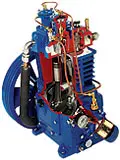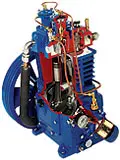

High-Pressure Air Compressor
A high-pressure air compressor delivers compressed air at pressures beyond the standard shop and jobsite band, for tools, testing and processes that need more force per square inch than a typical compressor supplies. These are specialized machines: listed models in this class report drive powers of 10-60 hp. Applications include pipeline and system pressure testing, blasting support and industrial process air.
Fonctionnement
High pressure is reached by compressing air in stages: each stage squeezes the air further and passes it through an intercooler before the next, because single-stage compression to elevated pressures would overheat the machine and waste power. Multi-stage reciprocating designs dominate the class, with booster configurations taking already-compressed shop air and raising it further. Every downstream component, hoses, fittings, receivers, gauges, must be rated for the full delivery pressure, and pressure relief valves protect each stage. Controls hold the target pressure and unload the compressor when demand stops.
Types et variantes
- Multi-stage reciprocating units
- Piston compressors with two or more stages and intercooling, the standard architecture for reaching above-shop pressures.
- Booster compressors
- Units that take feed air from a standard compressor and raise it to higher pressure, used where only part of a system needs elevated pressure.
- Engine-driven high-pressure units
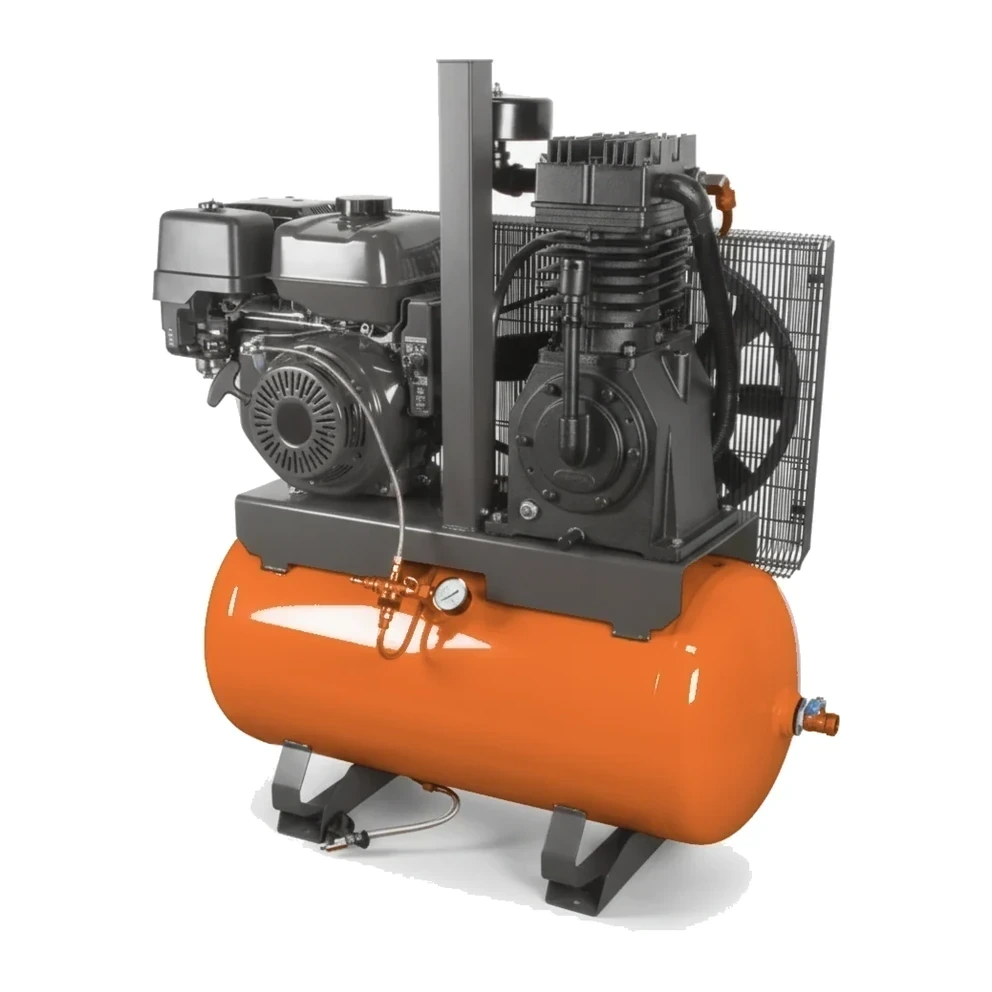
- Self-contained packages for field pressure-testing and remote work; listed drive powers in the class span 10-60 hp.
Spécifications clés
| Spécification | Plage typique | Signification |
|---|---|---|
| Drive power | 10-60 hp across listed models | Sets how much air the unit can compress to elevated pressure and how quickly it recovers a test system or receiver. |
| Operating pressure | Above the standard shop band; varies by model | The defining spec of the class: the exact rating on the specific unit governs every hose, fitting and vessel connected to it. |
| Compression stages | Multi-stage with intercooling; varies by model | More stages reach higher pressures efficiently and keep discharge temperatures manageable. |
Comment l'industrie le dimensionne
High-pressure compressors are selected by required pressure first and flow second: the process or test sets the target pressure, and the compressor must reach it with margin, after which the needed recovery rate determines the flow and drive power: listed models span 10-60 hp. Because published ratings vary widely across the 9 listed models, matching starts from the tool or process specification rather than from a standard size band.
Applications
- Pipeline and piping system pressure testing
- High-pressure blasting and surface preparation support
- Industrial process air at elevated pressures
- Charging receivers and accumulators for specialized equipment
- Well service and drilling support work
- Heavy equipment tire and suspension service
Sécurité et opération
- Every component downstream of a high-pressure compressor must be rated for the full delivery pressure; a standard shop hose on a high-pressure circuit is a failure waiting to happen.
- Stored energy in high-pressure receivers and test systems is severe; systems are depressurized and verified at zero before fittings are broken.
- Pressure relief valves are fitted at each stage and never blanked, adjusted or bypassed.
- Pressure testing is conducted with exclusion zones, since a failing test piece releases stored energy violently.
Normes et certifications
- OSHA · 29 CFR 1926.302(b)
- Compressed air equipment requirements for construction, including hose and fitting security.
- ASME · Boiler and Pressure Vessel Code Section VIII
- Governs pressure vessels, including high-pressure receivers and separators.
- CAGI · Compressed Air and Gas Institute guidance
- Industry reference for compressor performance reporting and installation practice.
Questions fréquentes
What makes a compressor high-pressure rather than standard?
How is the right unit selected?
Can ordinary air hoses and fittings be used?
Comparer les modèles populaires
Chercher par spécification →Normalisé aux mêmes unités. Un tiret signifie que la valeur n'a pas été publiée.
| Modèle | Débit d’air libre | Pression max | Puissance moteur |
|---|---|---|---|
| Atlas Copco LTB 300 | - | - | 20 hp |
| Quincy QR-25 Model 390 | 30 cfm | 500 psi | 14 hp |
Équipements connexes
Parcourir par fabricant
Sources
Chaque spécification est vérifiée par rapport aux données publiées par le fabricant, avec la source liée pour référence.
Tous les modèles
9 modèles · Chaque spécification citée à la source