

Spider Crane
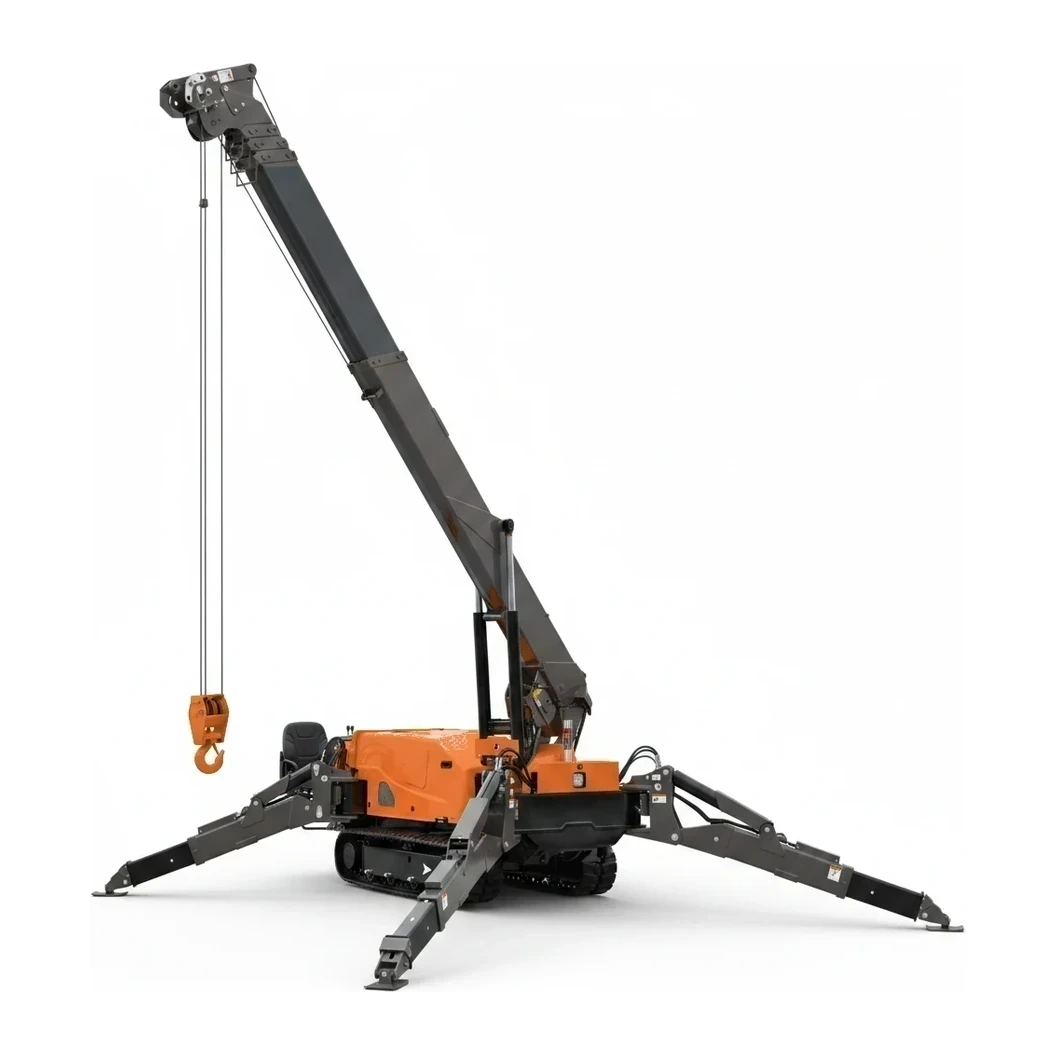
A spider crane is a compact crawler crane mounted on extendable, articulating outriggers that resemble spider legs, designed to navigate through narrow openings and operate in confined spaces. These machines are purpose-built for interior work, finished buildings, and locations inaccessible to conventional mobile cranes. The rental industry classifies them by lifting capacity in tons, typically ranging from sub-1-ton models to machines exceeding 3 tons.
Fonctionnement
Spider cranes operate on tracked undercarriages that provide stability and maneuverability on smooth surfaces, allowing them to traverse finished floors, ramps, and even fit into standard elevators. The characteristic outriggers extend outward and downward like spider legs, creating a stable footprint that can be adjusted asymmetrically to accommodate tight spaces or obstacles. Operators control boom extension, slewing, and load handling from either a pendant control station or an onboard cab, depending on the model. The compact design incorporates telescoping or folding booms that achieve significant reach relative to the machine's transport dimensions. Many models feature radio remote controls, allowing operators to position themselves for optimal visibility in confined environments. The tracked base distributes ground pressure broadly, protecting delicate finished flooring while maintaining lifting capacity.
Types et variantes
- Mini Spider Crane (0-3 tons)
- Ultra-compact models designed to fit through standard doorways (typically 36 inches) and into freight elevators, ideal for interior glazing, atrium work, and lifting within finished buildings.
- Heavy Spider Crane (3+ tons)
- Larger capacity tracked cranes for exterior curtain wall installation, glass façade work, and jobsites where truck cranes cannot access or position safely.
- Telescopic Boom Spider Crane
- Models equipped with telescoping boom sections for variable reach, offering flexibility in confined spaces and adjustable working radius.
- Lattice Boom Spider Crane
- Features lattice-style boom construction for maximum reach and capacity, typically used in larger spider crane configurations for exterior building envelope work.
- Electric Spider Crane
- Battery-powered variants designed for indoor use where emissions must be eliminated, common in occupied buildings and sensitive environments.
Spécifications clés
| Spécification | Plage typique | Signification |
|---|---|---|
| Lifting Capacity | 0.5 to 6+ tons | Maximum rated load varies by model and configuration; industry sizes spider cranes by this metric in tons. |
| Transport Width | 30 to 50 inches | Collapsed width determines ability to pass through doorways, hallways, and elevator doors; critical for interior access. |
| Outrigger Spread | 8 to 20 feet | Fully extended stabilizer footprint provides rated capacity; many models offer variable spread for asymmetric positioning. |
| Maximum Hook Height | 40 to 100+ feet | Vertical reach at maximum boom extension and angle; determines ability to service upper floors and tall atriums. |
| Ground Bearing Pressure | 50 to 200 psi | Pressure exerted on flooring with outriggers deployed; tracked base distributes load to protect finished surfaces. |
Comment l'industrie le dimensionne
The rental industry sizes spider cranes by lifting capacity in tons. Models under 3 tons are typically specified for interior work where doorway access and elevator transport are required, with transport widths narrow enough to navigate standard commercial building infrastructure. Machines above 3 tons represent the larger end of the class, deployed for exterior curtain wall installation, façade work, and situations requiring greater capacity or reach but still demanding the access advantages of a compact crawler crane. Capacity ratings assume full outrigger extension; manufacturers provide load charts showing derated capacities at reduced outrigger spreads.
Applications
- Interior glazing and glass installation in atriums, lobbies, and multi-story commercial buildings
- Curtain wall and building envelope installation on high-rise construction where access is constrained
- HVAC equipment placement in mechanical rooms, rooftops, and areas inaccessible to conventional cranes
- Renovation and retrofit projects within occupied or finished buildings requiring zero-emissions electric models
- Architectural feature installation including sculptures, chandeliers, and structural glass in museums and public spaces
- Rooftop equipment setting in urban environments with narrow site access or street closure restrictions
Sécurité et opération
- Load charts must account for outrigger configuration; asymmetric outrigger deployment significantly affects rated capacity and requires careful chart interpretation
- Floor loading analysis is critical for interior work; structural engineers should verify that floors, elevated slabs, and substructures can support combined machine weight and imposed loads
- Operators require specialized training in confined-space crane operation, including spatial awareness for overhead clearances, wall proximity, and pedestrian traffic in occupied buildings
- Outrigger pad placement and size must distribute loads appropriately; inadequate bearing area can damage finished floors or penetrate elevated slabs
- Power source selection matters for indoor use; diesel-powered models produce exhaust and carbon monoxide unsuitable for enclosed spaces without ventilation
Normes et certifications
- ASME B30.5 · Mobile and Locomotive Cranes
- Establishes safety standards for mobile crane construction, inspection, testing, maintenance, and operation applicable to crawler-mounted spider cranes.
- OSHA · 29 CFR 1926 Subpart CC
- Federal crane and derrick regulations governing operator qualification, signal person requirements, and ground condition assessments for construction applications.
- ANSI/ITSDF B56.6 · Rough Terrain Forklift Trucks
- Some compact spider cranes fall under industrial truck standards when used primarily for material handling rather than hoisting operations.
- CSA B167 · Overhead Cranes, Gantry Cranes, and Hoists
- Canadian standard applicable to spider crane operations in Canadian jurisdictions, covering inspection and maintenance requirements.
Questions fréquentes
What distinguishes a spider crane from a conventional crawler crane?
Why are spider cranes commonly called Maeda cranes in the industry?
How is lifting capacity affected when outriggers cannot fully extend?
What floor loading considerations apply when operating spider cranes indoors?
Équipements connexes
Parcourir par fabricant
Tous les modèles
5 modèles · Chaque spécification citée à la source