Hydronic Ground Heater
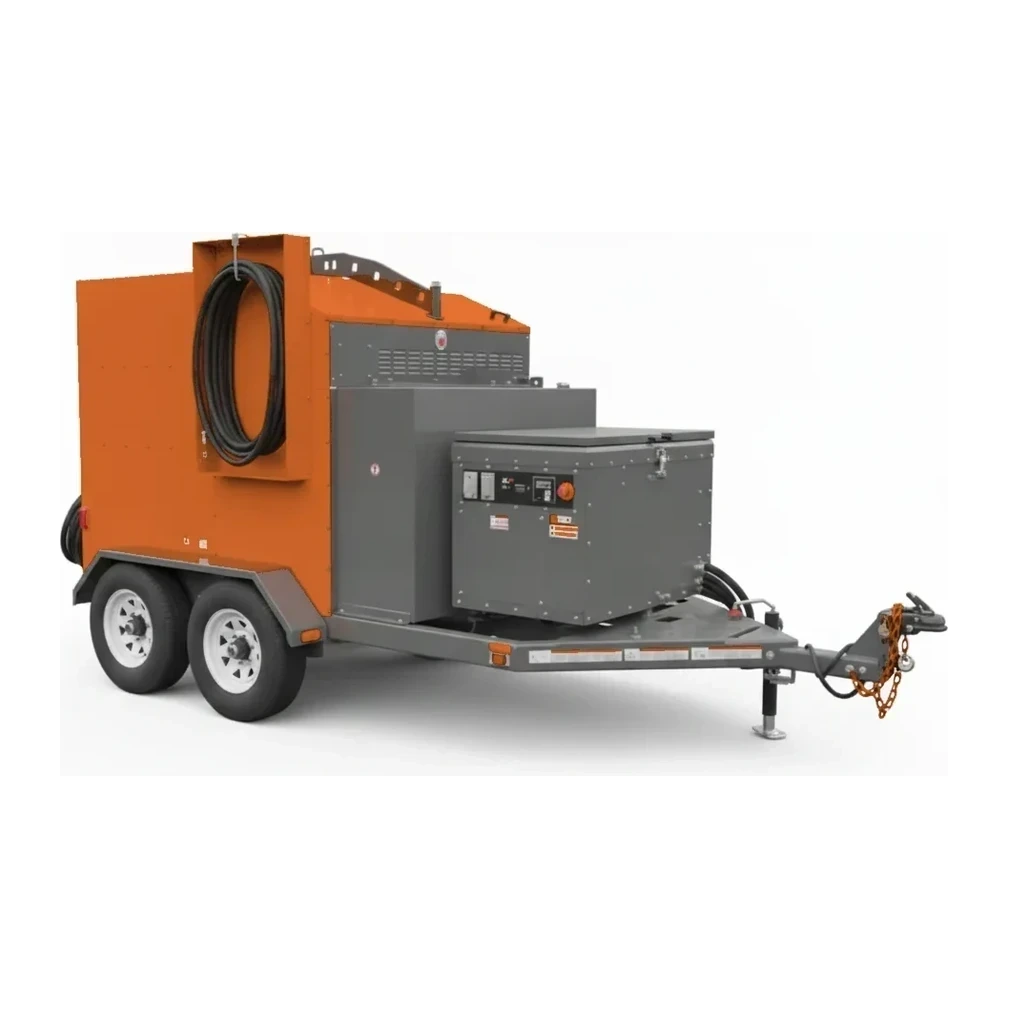
A hydronic ground heater is a portable heating system that circulates heated glycol or water through a closed-loop hose network to transfer thermal energy into soil or concrete. These units enable excavation and concrete work in freezing conditions by thawing frozen ground or maintaining optimal curing temperatures for fresh concrete pours. The equipment consists of a fuel-fired boiler, circulating pump, fluid reservoir, and distribution hoses laid across the work area.
Fonctionnement
The unit burns diesel or propane fuel to heat a glycol-water mixture in an insulated boiler vessel, typically maintaining fluid temperatures between 120°F and 180°F. A circulating pump drives the heated fluid through supply hoses to the work area, where it flows through ground mats or loops of flexible hose laid directly on or buried in soil, transferring heat through conduction. The cooled fluid returns through dedicated hoses to the heater for reheating, creating a continuous closed-loop circulation system. Operators connect multiple parallel hose circuits to the heater's manifold, with typical installations running 1,000 to 6,000 feet of hose depending on the area and depth of thaw required. Ground temperature sensors and flow controls allow adjustment of output to match job requirements, with thaw rates varying based on soil conditions, ambient temperature, and hose spacing.
Types et variantes
- Portable Skid-Mount Units
- Self-contained systems on steel skids with integrated fuel tanks, common for jobsite mobility and mid-range BTU outputs from 150k to 400k.
- Trailer-Mounted Heaters
- Larger capacity units on wheeled chassis for highway transport between sites, typically offering 300k BTU or greater output with extended fuel capacity.
- Compact Ground Thaw Units
- Smaller footprint heaters under 150k BTU designed for tight access areas, footing work, and single-circuit applications with reduced hose requirements.
- Dual-Circuit Systems
- Units equipped with independent manifolds and pumps to serve two separate thaw or cure zones simultaneously at different flow rates or temperatures.
- High-Efficiency Condensing Models
- Advanced heaters achieving 85%+ efficiency through exhaust heat recovery, reducing fuel consumption on extended-duration concrete curing operations.
Spécifications clés
| Spécification | Plage typique | Signification |
|---|---|---|
| Heat Output | 50k-400k+ BTU/hr | Primary sizing metric determining the area of ground that can be thawed or the volume of concrete that can be cured simultaneously. |
| Thawing Capacity | 2,500-6,000 sq ft | Manufacturer-rated surface area the unit can effectively thaw under standard conditions, varying with soil type and ambient temperature. |
| Frost Prevention Capacity | 3,750-9,000 sq ft | Larger coverage area achievable when maintaining above-freezing temperatures rather than deep-thawing already frozen ground. |
| Fuel Tank Capacity | 50-220 gal | Onboard diesel or propane storage determining runtime between refueling, critical for overnight and remote site operations. |
| Heater Efficiency | 83-87% | Percentage of fuel energy converted to usable heat in the glycol fluid, affecting operating cost and emissions. |
| Operating Weight | 3,775-9,290 kg (8,300-20,500 lb) | Total unit weight including fuel and fluid, determining lifting and transportation requirements. |
Comment l'industrie le dimensionne
The industry sizes hydronic ground heaters by heat output in thousands of BTU per hour (K BTU). Units up to 50k BTU handle small footings and localized thaw patches. The 50k-150k BTU range serves as the entry level for general ground thaw and single-pour concrete curing with moderate hose runs. Mid-range 150k-400k BTU heaters represent the industry standard for winter construction, supporting several thousand feet of hose across typical excavation and foundation work. Contractors match heater capacity to project requirements by calculating the surface area to be heated, depth of frost penetration, soil thermal properties, and duration of heating needed to achieve target ground or concrete temperatures.
Applications
- Thawing frozen ground to depth for excavation of footings, trenches, and utility lines during winter construction
- Maintaining concrete curing temperatures for slabs, footings, and foundations poured in freezing conditions
- Preventing frost heave and ground freezing around active construction sites in cold climates
- Thawing equipment yards, parking areas, and access roads to enable vehicle movement and material staging
- Preheating soil prior to asphalt paving or underground utility installation in frozen conditions
- Emergency thaw operations for frozen pipes, culverts, and underground infrastructure
Sécurité et opération
- Heaters must be positioned on stable, level ground with adequate ventilation and clearance from combustible materials per manufacturer specifications
- Glycol concentration requires monitoring and adjustment to prevent freezing in supply lines during extremely cold ambient conditions
- Fuel systems demand regular inspection for leaks, with proper grounding and bonding during refueling operations to prevent static discharge
- Hot supply hoses and manifolds present burn hazards; insulation and warning signage protect workers in traffic areas
- Carbon monoxide and exhaust gases require proper dispersion away from enclosed spaces and occupied structures
Normes et certifications
- ASME · CSD-1
- Controls and Safety Devices for Automatically Fired Boilers governs burner controls and safety interlocks on hydronic heaters.
- NFPA · 31
- Standard for the Installation of Oil-Burning Equipment establishes fuel system requirements for diesel-fired units.
- OSHA · 1926.154
- Temporary heating devices standards address ventilation, clearances, and refueling procedures on construction sites.
- EPA · Tier 4
- Engine emissions standards apply to newer models with integrated diesel engines, requiring particulate and NOx controls.
Questions fréquentes
What determines thaw depth and time for frozen ground?
How does hydronic heating differ from direct-fired ground thawing?
What glycol-to-water ratio is standard for these systems?
How is coverage area calculated for a given BTU output?
Comparer les modèles populaires
Chercher par spécification →Normalisé aux mêmes unités. Un tiret signifie que la valeur n'a pas été publiée.
| Modèle | Débit d’air | Capacité de carburant |
|---|---|---|
| Wacker Neuson E 1250 | - | 71.1 gal |
| Wacker Neuson HSH3000 | - | 220.1 gal |
| Wacker Neuson E3000 | - | - |
Équipements connexes
Parcourir par fabricant
Sources
Chaque spécification est vérifiée par rapport aux données publiées par le fabricant, avec la source liée pour référence.
Tous les modèles
23 modèles · Chaque spécification citée à la source