

Pavement Breaker
A pavement breaker is a pneumatic percussion tool designed to break up concrete, asphalt, and other hardscape materials through rapid, repetitive impact. Commonly known as a jackhammer or paving breaker, it converts compressed air into downward striking force delivered through interchangeable steel bits or chisels. This equipment class serves as the primary hand-operated demolition tool for road repair, site preparation, and concrete removal across construction and municipal maintenance operations.
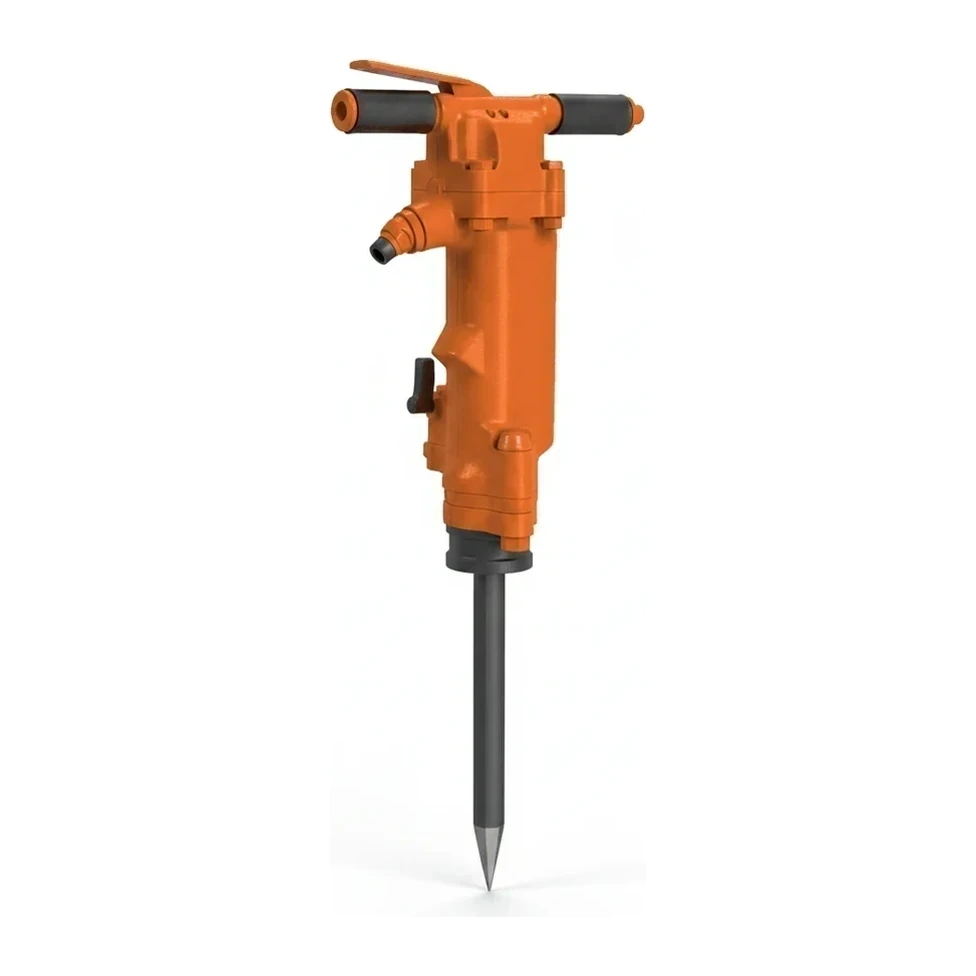
How it works
Compressed air enters the tool's cylinder and drives a hardened steel piston in a reciprocating motion, typically at 1,000-1,800 blows per minute. Each stroke accelerates the piston downward to strike the bit shank, transferring kinetic energy through the chisel point into the pavement surface. The operator guides the tool by its handles while the tool's weight and impact energy fracture the material; no downward force from the operator is required beyond controlling position and angle. The exhaust air vents through ports in the handle or body, while a throttle trigger controls operating speed. Bit retention systems, either spring-loaded or screw-threaded, secure various chisel profiles (moil points, spade bits, asphalt cutters) to match material hardness and breaking task.
Types & variants
- Light Breaker (30-40 lb)
- Compact tools for sidewalk repair, thin slab removal, and patch work where maneuverability and extended operation by a single operator are priorities.
- Medium Breaker (40-70 lb)
- General-purpose units balancing impact energy and handling for standard road and slab breaking tasks; the most common size across the industry.
- Heavy Breaker (70-100 lb)
- High-impact tools for thick concrete, reinforced slabs, and foundation demolition where maximum breaking force is required despite increased operator effort.
- Vertical Breaker
- Standard configuration with handles positioned for downward breaking into horizontal surfaces such as roads, floors, and pavements.
- Horizontal Breaker
- Handle arrangement designed for lateral work into vertical surfaces, walls, or overhead applications, though less common in pavement-focused fleets.
Key specifications
| Specification | Typical range | What it means |
|---|---|---|
| Tool Weight | 30–100 lb (13.6–45.4 kg) | Primary sizing metric determining impact energy and operator handling requirements; heavier units deliver greater breaking force. |
| Operating Weight | 1,052–3,688 lb (477–1,673 kg) | Total system weight including compressor, hoses, and accessories for transportation and setup planning. |
| Air Pressure Requirement | 90-110 psi | Minimum compressed air pressure needed to achieve rated impact energy and blow frequency. |
| Air Consumption | 60-100 CFM | Volumetric airflow demand that determines minimum compressor capacity required for sustained operation. |
| Blow Rate | 1,000-1,800 BPM | Impacts per minute delivered to the bit; higher frequencies suit asphalt while lower rates favor thick concrete. |
| Bit Shank Size | 7/8" × 3¼" to 1⅛" × 6" hex | Standardized shank dimensions that define compatible chisel and bit accessories for the tool class. |
How the industry sizes it
The industry sizes pavement breakers primarily by tool weight measured in pounds, which directly correlates to impact energy and breaking capacity. Light breakers (30-40 lb) handle sidewalk and patch work with ease of handling for all-day operation. Medium breakers (40-70 lb) represent the general-purpose category for standard road and slab demolition. Heavy breakers (70-100 lb) deliver maximum impact for reinforced concrete and thick pavement. Compressor pairing considers air consumption (CFM) and pressure (PSI) requirements, with heavier breakers demanding proportionally larger air volumes and compressor capacities to maintain performance.
Applications
- Concrete and asphalt pavement removal for road repair and resurfacing
- Sidewalk, curb, and driveway demolition in municipal maintenance
- Foundation breaking and footing removal in building demolition
- Trench cutting through hardscape for utility installation
- Slab breaking for site preparation and grading
- Reinforced concrete demolition in structural teardown projects
Safety & operation
- Hearing protection is mandatory; pavement breakers generate sound levels typically exceeding 100 dBA at the operator position.
- Anti-vibration gloves and adherence to hand-arm vibration exposure limits reduce risk of vibration-induced injury during extended operation.
- Eye protection and respiratory equipment protect against flying debris and silica dust generated during concrete breaking.
- Proper lifting technique and two-person handling for heavy units prevent back and musculoskeletal injuries during setup and positioning.
- Hose whip restraints and secure couplings prevent injury from pressurized air line disconnection during operation.
Standards & certifications
- OSHA · 29 CFR 1926.302(b)
- Covers pneumatic power tool safety requirements including proper guarding, air pressure limits, and hose specifications for construction operations.
- ANSI · B186.1
- Standard for portable pneumatic tools establishing design, performance, and safety requirements for air-powered equipment including breakers.
- OSHA · 29 CFR 1926.52
- Occupational noise exposure limits applicable to pavement breaker operation, requiring hearing conservation programs in most use scenarios.
Frequently asked
How is pavement breaker size matched to breaking tasks?
What compressor capacity do pavement breakers require?
What distinguishes air-powered breakers from electric and hydraulic models?
How do bit selection and maintenance affect breaking performance?
Compare popular models
Find by spec →Normalised to the same units. A dash means the figure was not published.
| Model | Free air delivery | Max pressure | Engine power |
|---|---|---|---|
| Multiquip HHN31V | - | - | 31 hp |
| Multiquip HHN34TVD | - | - | 34 hp |
| Multiquip HHXD-5 | - | - | - |
| Multiquip HHXDF5 | - | - | - |
| Multiquip HHXG5 | - | - | - |
| Multiquip HHN34 | - | - | - |
Related equipment
Browse by manufacturer
All models
33 models · Every spec cited to source