

Rough Terrain Forklift
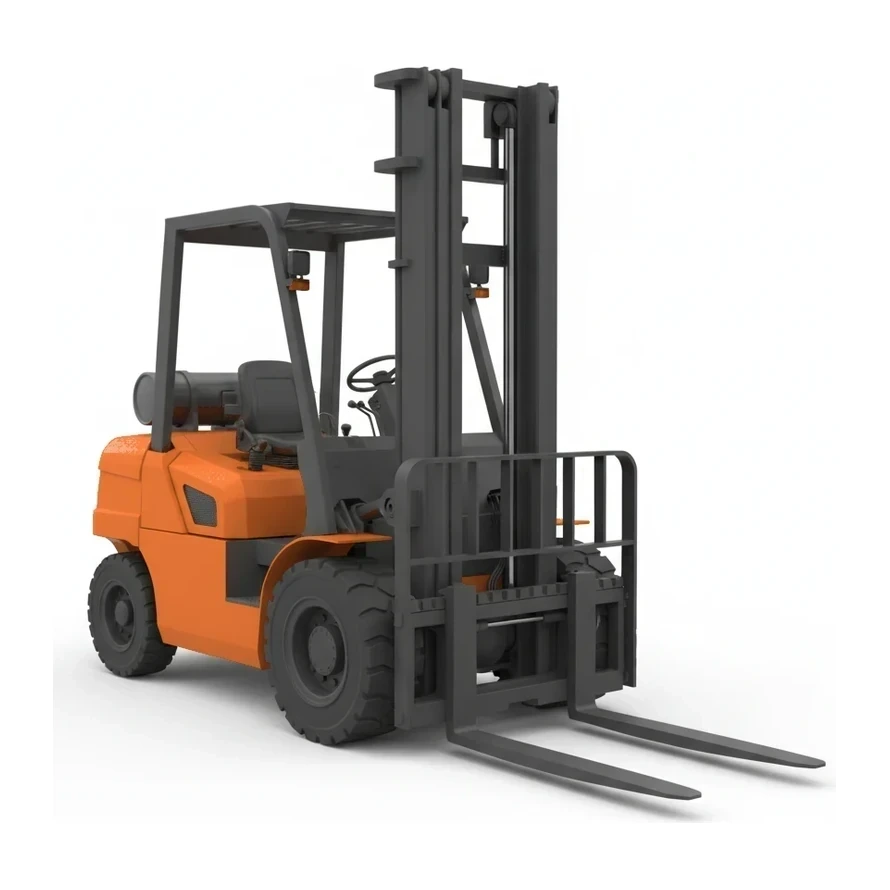
A rough terrain forklift is a four-wheel-drive, straight-mast forklift designed to operate on unimproved ground, mud, gravel, and slopes where conventional warehouse forklifts cannot travel. Also known as RT forklifts, all-terrain forklifts, or masonry forklifts, these machines combine the vertical lifting profile of a standard forklift with the traction and ground clearance needed for outdoor construction sites. They are commonly used to unload and place palletized masonry, lumber, and heavy material packages directly on rough jobsite terrain.
How it works
Rough terrain forklifts use a vertical mast and fork carriage system similar to warehouse forklifts, but mount this assembly on a reinforced chassis with four-wheel drive, larger pneumatic tires, and increased ground clearance. The drive system delivers power to all four wheels to maintain traction on soft, uneven, or sloped surfaces. Operators control lift, tilt, and drive functions from an enclosed or open cab, with the straight mast providing better forward visibility and a smaller turning radius compared to telescopic handlers. The hydraulic lift system raises and lowers the forks along the vertical mast, while tilt cylinders allow the mast to angle forward or back to stabilize loads or assist with load pickup. Counterweight at the rear of the machine balances the load on the forks, and stabilization systems help maintain safe operation on grades and uneven ground.
Types & variants
- Light-Capacity RT Forklift
- Models rated under 6,000 lb, designed for navigating tight jobsites with palletized block, brick, and bagged materials on soft or sloped ground.
- Standard-Capacity RT Forklift
- 6,000–10,000 lb machines that handle the majority of jobsite material handling, including masonry cubes, lumber packs, and general palletized construction materials.
- Heavy-Capacity RT Forklift
- Over 10,000 lb capacity units for large material packages, roof trusses, steel bundles, and other heavy loads on unimproved terrain.
- Enclosed Cab RT Forklift
- Machines with fully enclosed operator stations for weather protection and comfort during extended outdoor operation in harsh conditions.
- Open-Frame RT Forklift
- Models with overhead guard but no full cab enclosure, offering lighter weight and better all-around visibility in fair weather.
Key specifications
| Specification | Typical range | What it means |
|---|---|---|
| Load Capacity | 6,000–10,000 lb standard range | Maximum weight the forklift can safely lift at a specified load center, determining suitability for masonry cubes, lumber packs, and other materials. |
| Lift Height | Varies by model and mast configuration | Maximum vertical reach of the forks, dictating ability to stack materials or load onto elevated surfaces. |
| Drive Type | 4x4 (four-wheel drive) | All-wheel drive provides traction on mud, gravel, slopes, and other challenging jobsite conditions where two-wheel-drive units would fail. |
| Tire Type | Pneumatic, heavy-tread | Air-filled tires with aggressive tread patterns designed for off-road traction and shock absorption on rough ground. |
How the industry sizes it
The rental industry sizes rough terrain forklifts by load capacity in pounds, with the standard jobsite range falling between 6,000 and 10,000 lb. Light-duty models under 6,000 lb suit smaller material packages and confined sites with soft ground, while heavy-capacity machines above 10,000 lb are specified for trusses, steel bundles, and large material loads on unimproved terrain. Capacity ratings assume a standard load center (typically 24 inches), and actual lifting capacity decreases as load center distance or lift height increases.
Applications
- Unloading and placing palletized masonry materials (block, brick, pavers) on muddy or unpaved construction sites
- Distributing lumber packs and building materials across rough jobsite terrain where wheeled loaders or warehouse forklifts cannot operate
- Handling roof trusses, steel bundles, and heavy material packages on unimproved ground during structural construction
- Transferring materials from delivery trailers to staging areas on gravel, slopes, or soft soil conditions
- Placing equipment and supplies in remote or difficult-access areas of large construction projects
- Supporting site development and grading operations where material handling must occur before ground improvement
Safety & operation
- Operators must be trained and evaluated for rough terrain forklift operation, as stability and handling differ significantly from warehouse forklifts due to uneven ground and outdoor conditions
- Load capacity charts must be consulted before each lift, as capacity decreases with increased lift height, load center distance, and mast tilt angles
- Operating on slopes requires awareness of grade limits and load positioning; loads should be carried uphill and backing downhill maintains stability
- Ground conditions must be assessed continuously, as soft soil, ruts, and obstacles can cause tipping or loss of control even on four-wheel-drive machines
- Overhead hazards including power lines, tree branches, and structures require vigilance due to the vertical mast extension and outdoor operating environment
Standards & certifications
- OSHA · 29 CFR 1910.178
- Powered industrial truck standard governing operator training, maintenance, and safe operation of forklifts including rough terrain models.
- ANSI · B56.6
- Safety standard for rough terrain forklift trucks, addressing design, operation, and maintenance specific to off-road material handling.
- ASME · B56 series
- Safety standards for powered industrial trucks covering stability, capacity ratings, and operator controls applicable to RT forklifts.
- EPA · Tier emissions standards
- Emissions regulations governing diesel engines in off-road equipment including rough terrain forklifts, with tier levels defining permissible exhaust outputs.
Frequently asked
How does a rough terrain forklift differ from a telehandler?
What ground conditions can rough terrain forklifts operate on?
How is a rough terrain forklift sized for a specific job?
What operator qualifications are required for rough terrain forklifts?
Related equipment
Browse by manufacturer
Sources
Every specification is verified against the manufacturer's published data, with the source linked for reference.
All models
2 models · Every spec cited to source