

Magnetic Drill
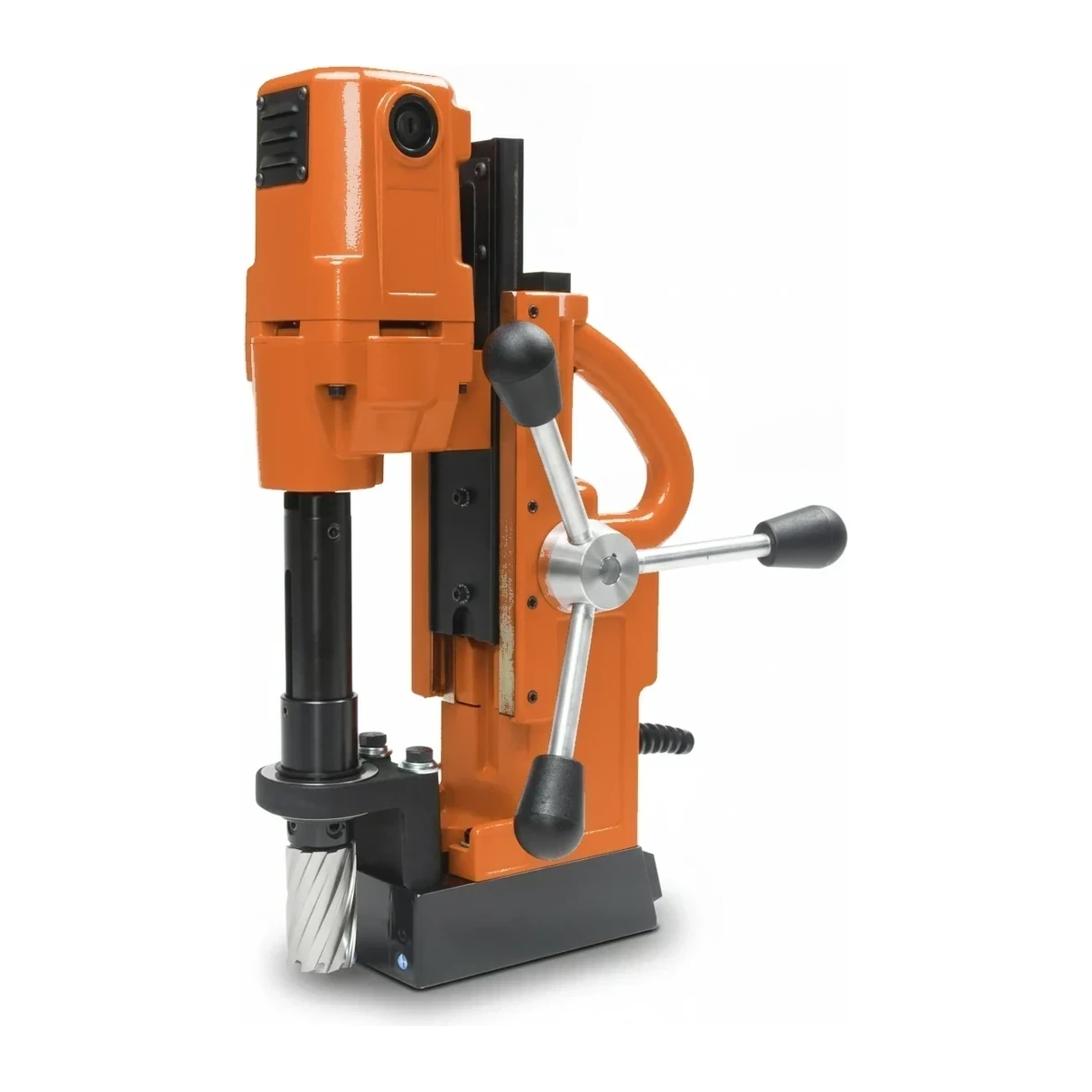
A magnetic drill is a portable drill press whose electromagnetic base clamps directly onto steel so precise holes can be cut in place. It brings shop-quality hole-making to structural steel that cannot be moved to a machine.
How it works
The operator positions the tool on a steel workpiece and energizes the electromagnet, which locks the base with far more force than hand pressure could resist. A motor-driven arbor, usually fitted with an annular cutter, is fed into the work by a handle-operated slide. Annular cutters remove only the ring of material around a slug, so a mag drill cuts large holes with a fraction of the power a twist bit would need.
Types & variants
- Compact mag drills
- Light units around 27 lbs for field work on beams and overhead positions.
- Standard mag drills
- Mid-weight machines balancing capacity and portability for fabrication work.
- Large-capacity mag drills
- Heavier presses up to about 112 lbs for deep, large-diameter holes.
- Cordless mag drills
- Battery-powered units for sites without reliable mains power.
Key specifications
| Specification | Typical range | What it means |
|---|---|---|
| Tool weight | 27–112 lbs (12.2–50.8 kg) | Lighter units are practical for overhead and vertical work; heavier ones carry more cutting capacity. |
| Cutter capacity | Varies by model | The largest annular cutter diameter and depth the arbor and motor can drive. |
| Magnet holding force | Varies by model | Must exceed cutting thrust with margin; thin plate reduces effective holding force. |
How the industry sizes it
Selection turns on cutter capacity and working position. Compact models are chosen for overhead and vertical holes where the operator supports the tool during setup, while larger presses run deep, big-diameter holes in heavy sections at ground level.
Applications
- Drilling bolt holes in structural beams and columns in place
- Steel fabrication and bridge or plant maintenance work
- Enlarging or correcting misaligned holes in erected steel
- Tapping and countersinking with arbor-mounted accessories
Safety & operation
- A power loss releases the magnet, so a safety strap or chain around the workpiece is mandatory, especially overhead or on vertical faces.
- The magnet holds rated force only on clean, flat steel of sufficient thickness; scale, paint, and thin plate all reduce grip.
- Hot, sharp slugs eject when the cutter breaks through; keep hands and people clear below the work.
Standards & certifications
- OSHA · 29 CFR 1926.302(a)
- Electric tool grounding or double insulation requirements apply.
- UL · UL 62841
- Safety standard covering transportable motor-operated electric tools.
Frequently asked
Why use an annular cutter instead of a twist bit?
Will a mag drill hold on thin sheet?
Is a safety strap really necessary?
Related equipment
Browse by manufacturer
Sources
Every specification is verified against the manufacturer's published data, with the source linked for reference.
All models
18 models · Every spec cited to source