

Powder-Actuated Tool
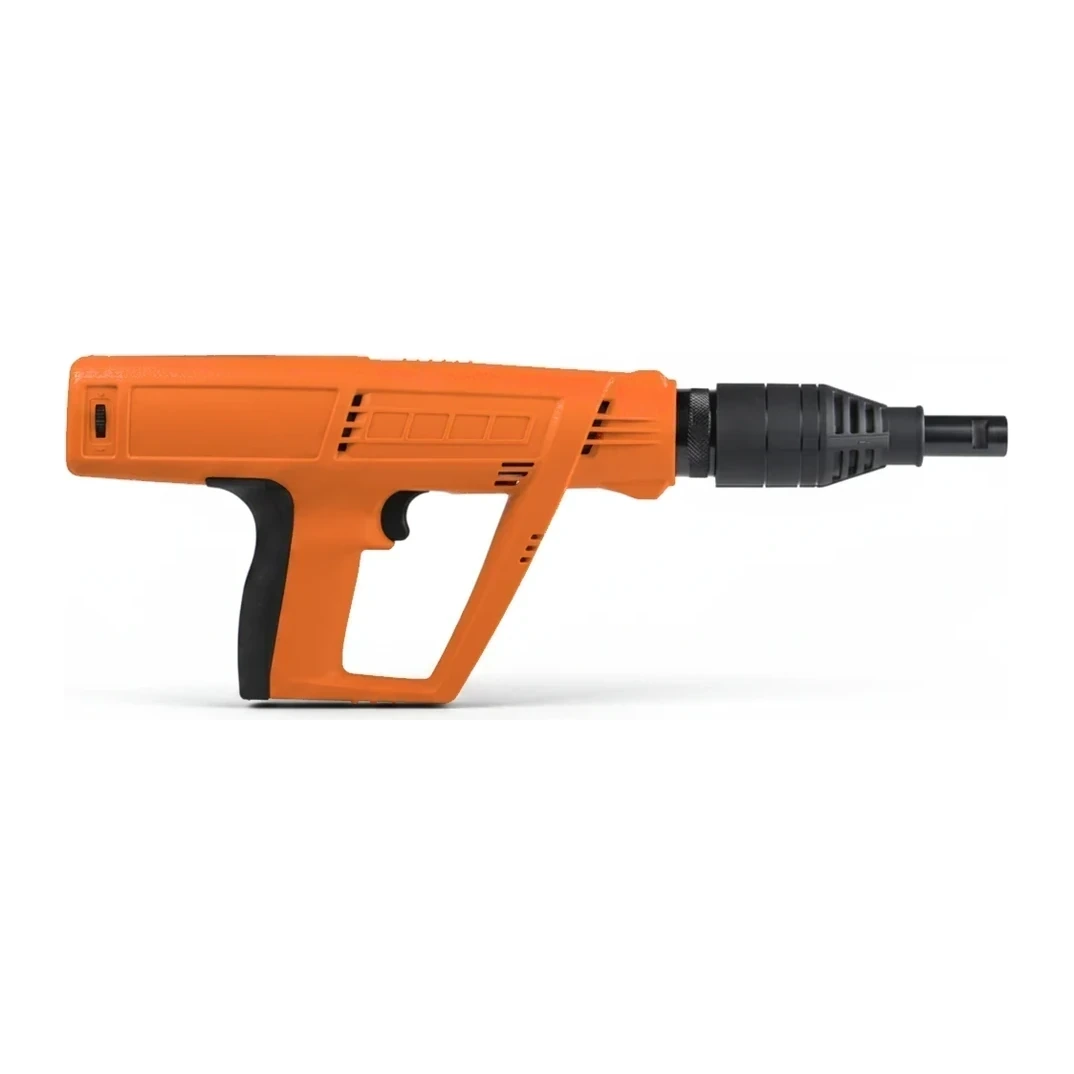
A powder-actuated tool (PAT) is a fastening device that uses controlled explosive charges to drive hardened steel pins, studs, or fasteners into concrete, steel, and masonry substrates. These tools employ individual powder loads, similar in principle to firearm cartridges, to generate the kinetic energy required for penetration. The equipment class serves as the primary method for attaching structural elements, track, and fixtures to hard base materials where conventional drilling and anchoring would be impractical.
How it works
The tool operates by placing a powder load (cartridge) into the firing chamber and positioning a hardened fastener at the barrel tip. When the operator triggers the mechanism, a firing pin strikes the primer of the powder load, igniting the propellant charge. The resulting gas expansion drives a piston that propels the fastener through the tool barrel and into the substrate at controlled velocity. Powder loads are color-coded by strength level, typically ranging from light-duty (yellow or gray) through heavy-duty (purple or red), allowing operators to match driving force to substrate hardness and fastener size. Direct-drive models contact the work surface directly, while indirect-drive models use a separate piston to transfer energy, reducing recoil and allowing angled installations.
Types & variants
- Low-Velocity Direct-Drive
- Piston directly strikes the fastener; lower velocity for lighter-duty applications in concrete and wood; simpler mechanism with fewer moving parts
- High-Velocity Indirect-Drive
- Separate piston transfers energy to fastener through a controlled chamber; higher velocity for structural steel applications; reduced recoil and noise
- Single-Shot Manual
- Requires manual cocking and individual load insertion for each fastener; most economical configuration for occasional use
- Semi-Automatic
- Magazine-fed powder loads with automatic ejection and reset; increases productivity on high-volume applications
- Fully-Automatic Strip-Feed
- Continuous strip magazines of loads and fasteners enable rapid sequential firing; used for repetitive installations such as ceiling track
Key specifications
| Specification | Typical range | What it means |
|---|---|---|
| Drive Type | Direct or Indirect | Determines whether piston contacts fastener directly or through transfer chamber; affects velocity, recoil, and substrate compatibility |
| Fastener Capacity | 1/4" to 3/4" diameter pins and studs | Range of fastener sizes the tool can accommodate; larger diameters require heavier powder loads and stronger tool construction |
| Feed System | Single-shot, magazine, or strip-feed | Method of loading powder charges and fasteners; impacts cycle time and suitability for production work |
| Powder Load Range | Color-coded levels 1-6 or equivalent | Available charge strength range; operators select load level based on substrate hardness and fastener penetration requirements |
How the industry sizes it
The powder-actuated tool class is not differentiated by size bands, as all models perform the same core function: driving pins and fasteners into concrete and steel. Power output is determined by the powder load selected rather than tool capacity, with loads purchased as consumables separate from the tool itself. The industry distinguishes models by drive type (direct vs. indirect), feed mechanism (single-shot, magazine, or strip), and the range of fastener sizes each accepts. Tool selection depends on application substrate, fastener diameter, and productivity requirements rather than dimensional or power classifications.
Applications
- Fastening bottom plates and sill tracks to concrete slabs in metal stud framing
- Attaching electrical conduit clips and hangers to concrete or structural steel
- Securing furring strips and drywall track to masonry and concrete walls
- Installing suspended ceiling grid track and acoustical anchors to overhead concrete
- Anchoring steel columns, brackets, and equipment bases to concrete foundations
- Attaching metal decking and roofing accessories to structural steel members
Safety & operation
- Tools must never be loaded until positioned against the work surface; muzzle awareness and never pointing at persons or unintended surfaces is critical
- Hearing and eye protection are mandatory; powder loads generate noise levels exceeding 140 dB and create shrapnel hazards from fastener impact
- Hard substrates require testing with progressively stronger loads to prevent fastener ricochet, tool damage, or over-penetration in thin materials
- Operators must be trained and certified according to manufacturer protocols and regulatory requirements specific to explosive-actuated devices
- Work area inspection for hidden utilities, rebar, and post-tensioned cables prevents dangerous penetrations and structural damage
Standards & certifications
- OSHA · 29 CFR 1926.302(e)
- Establishes mandatory operator training, testing of tool-fastener-load combinations, and prohibited use conditions for powder-actuated tools in construction
- ANSI · ANSI A10.3
- Safety requirements for explosive-actuated fastening tools including design, testing, operation, and protective measures for users
- ICC · ICC-ES Evaluation Reports
- Evaluates and certifies specific tool and fastener combinations for structural load applications in building code compliance
- ATF · Bureau of Alcohol, Tobacco, Firearms and Explosives
- Regulates storage, transportation, and record-keeping for powder loads classified as low explosives under federal law
Frequently asked
What distinguishes a powder-actuated tool from a pneumatic concrete nailer?
Why does the industry refer to these tools as 'Ramset' or 'Hilti DX'?
How are powder load strengths standardized across manufacturers?
What certifications or licensing do operators need to use powder-actuated tools?
Related equipment
Browse by manufacturer
All models
19 models · Every spec cited to source