

Air Handler
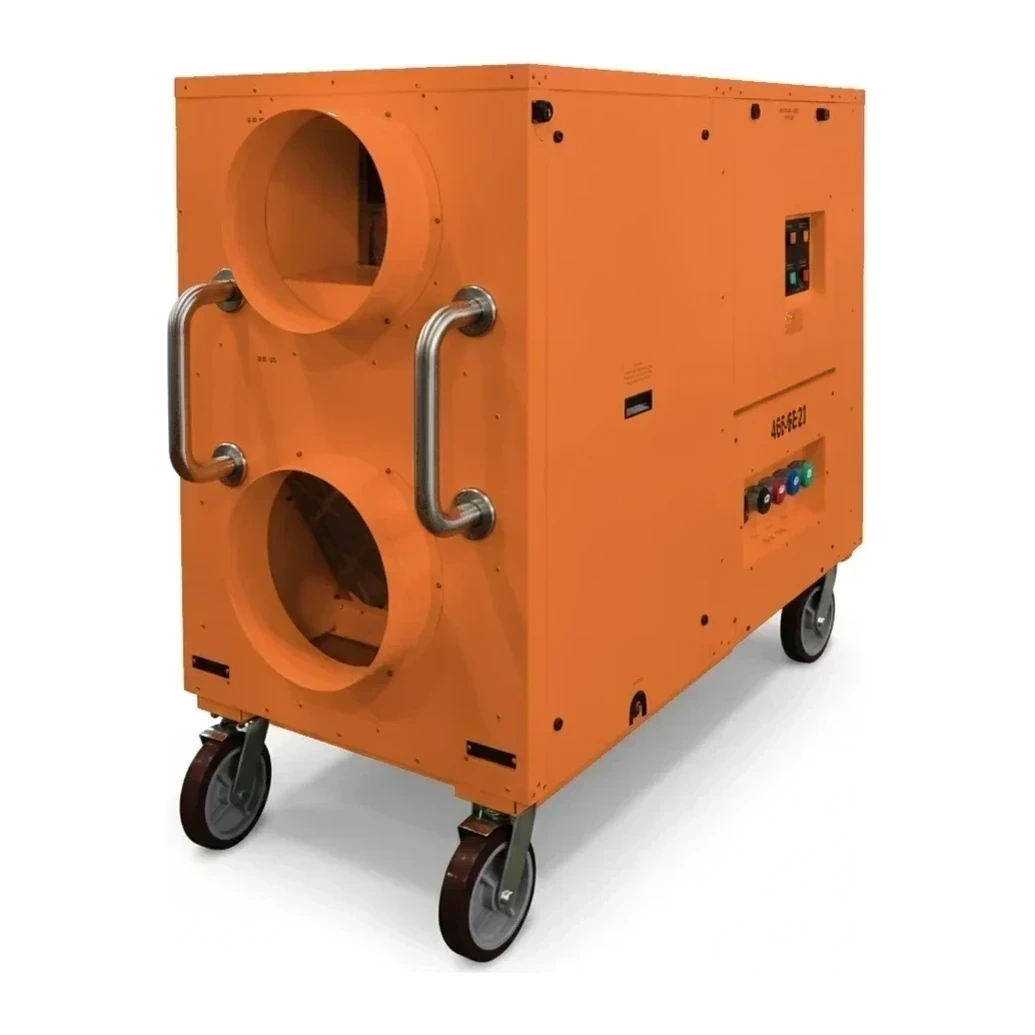
An air handler is the fan-and-coil assembly that moves conditioned air through a building: a blower drives air across heating or cooling coils and filters, into ductwork. It pairs with condensing units, heat pumps, chillers or hydronic plants rather than generating heating or cooling itself. The catalog lists 91 models from brands including Goodman, Carrier, Trane, Lennox, McQuay and Johnson Controls.
How it works
Return air enters through filters, passes across a coil, refrigerant evaporator, chilled water or hot water, and the blower delivers it to supply ductwork. Electric heat strips can back up heat pump coils. Condensate from cooling coils drains through a trapped line with overflow protection. Larger commercial handlers are built in sections: mixing boxes blending return and outside air, filter banks, coils, and fan sections, assembled to the project's airflow and ventilation specification.
Types & variants
- Residential and light commercial fan-coil units
- Matched indoor units for split systems and heat pumps.
- Modular commercial air handlers
- Sectional units built up from mixing, filter, coil and fan modules.
- Makeup air units
- Handlers that condition outside air to replace exhausted building air.
- Temporary and portable handlers
- Units deployed with temporary chillers and heat sources on projects and recovery work.
Key specifications
| Specification | Typical range | What it means |
|---|---|---|
| Capacity | Sized by ton across cataloged models | Tonnage determines heating or cooling delivery matched to the space load. |
| Airflow | Typically 400 cfm per ton of cooling | Delivered air volume matched to load and duct design. |
| Coil type | Refrigerant, chilled water or hot water | Coil type determines which plant the handler pairs with. |
| External static pressure | Varies by model and fan selection | The duct resistance the blower can overcome while delivering rated airflow. |
How the industry sizes it
Air handlers are sized by cooling or heating capacity in tons, then matched to airflow in cfm against the space's load and the duct system's static pressure. The industry pairs handlers with the plant: refrigerant, chilled water or hot water source. Coil rows, filter depth and fan curves are selected from manufacturer data for the design conditions. A 0-10 ton handler blows chilled water cooling into one room or a small office suite and pairs with a 10 to 20 ton chiller. A 10-25 ton unit conditions a floor, a large tent, or a production area off a mid-size chiller. A 25-50 ton handler serves a large open space, warehouse, hangar, or process area, on a single chilled water loop. Units above 50 tons provide building-scale air handling; several units are usually fed from one large chiller.
Applications
- Central air distribution for residential and commercial systems
- Chilled and hot water air distribution in hydronic plants
- Makeup air for kitchens, labs and industrial exhaust
- Temporary conditioned air on construction and restoration projects
- Ventilation air delivery in commercial buildings
Safety & operation
- Fan sections are locked out before any coil, filter or belt work: blowers start on remote calls.
- Condensate drains are trapped and tested; overflowing pans above ceilings are a major water damage source.
- Refrigerant coil connections are serviced only by EPA Section 608 certified technicians.
- Access doors on pressurized sections are latched; an open door on a running fan section is a projectile hazard.
Standards & certifications
- AHRI · 430
- Performance rating of central station air handling units.
- ASHRAE · 62.1
- Ventilation for acceptable indoor air quality: governs outside air delivered by handlers.
- UL · 1995
- Safety standard for heating and cooling equipment.
Frequently asked
What is the difference between an air handler and a furnace?
How is an air handler matched to a condensing unit?
Why does static pressure matter?
Browse by manufacturer
Sources
Every specification is verified against the manufacturer's published data, with the source linked for reference.
All models
91 models · Page 1 of 2 · Every spec cited to source