

Pole Saw
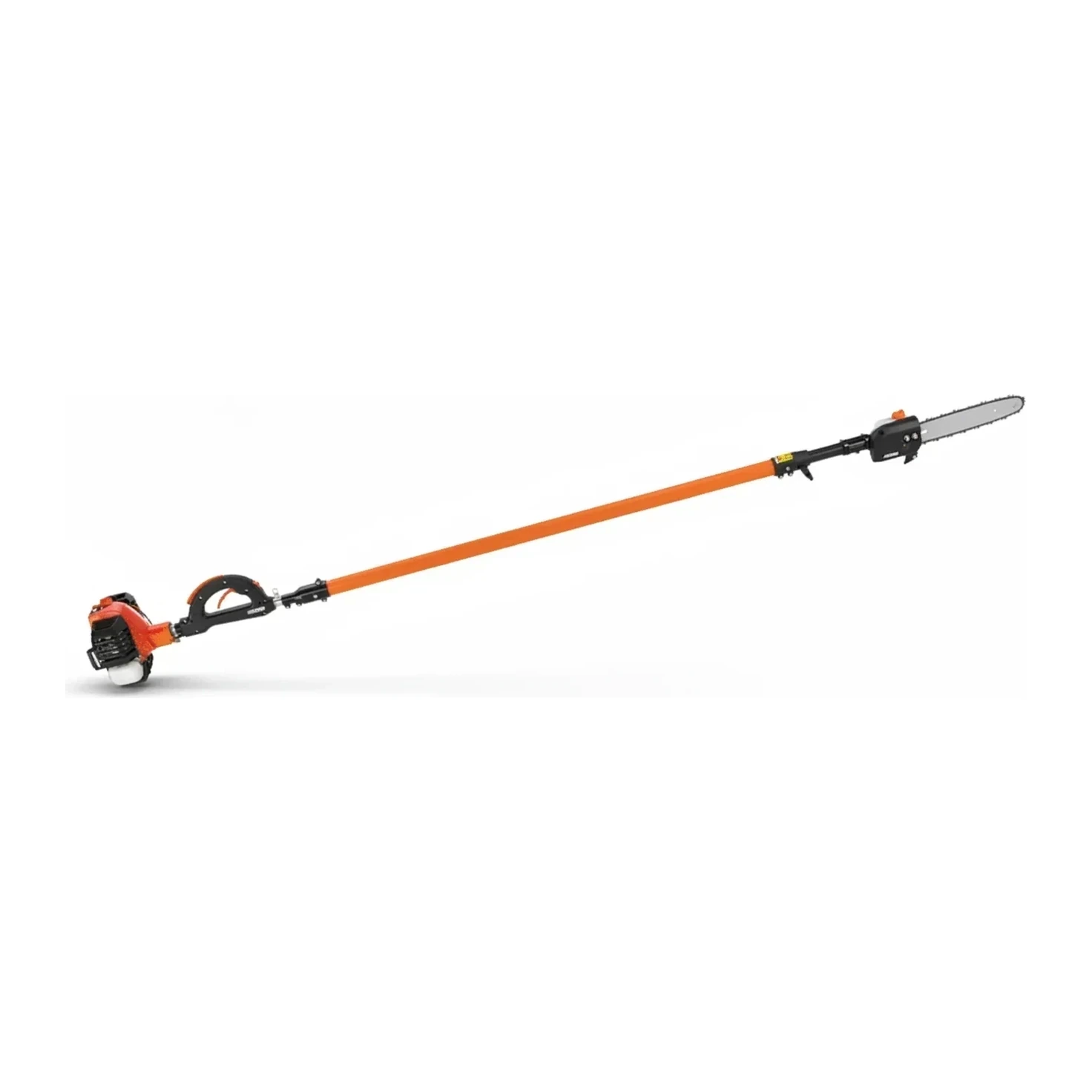
A pole saw is a cutting tool consisting of a pruning saw or chainsaw head mounted on an extension pole, designed to trim and remove tree branches overhead without requiring a ladder or lift. It serves as a primary ground-based solution for residential tree maintenance, orchard work, and utility line clearance. The class spans manual and powered variants, commonly sized by maximum reach in feet.
How it works
The operator positions the cutting head at the end of a rigid or telescoping pole, guiding the blade or chain into contact with the target branch from ground level. Manual pole saws use a pull-stroke blade that cuts on the downward motion, while powered models employ a small chainsaw head driven by gasoline engine, battery, or electric motor. Telescoping designs allow adjustment of pole length to match branch height, with locking mechanisms securing the pole at the desired extension. Powered pole saws route engine or motor vibration through the pole shaft to the cutting bar and chain, which operates similarly to a standard chainsaw but in an overhead orientation. Trigger controls mounted at the base of the pole allow the operator to engage the cutting mechanism while maintaining balance and visibility of the work area. Handles and harness attachment points distribute the weight of extended configurations during operation.
Types & variants
- Manual Pole Saw
- Rigid or telescoping pole with a fixed curved saw blade; relies on operator force for cutting, typically lightest configuration.
- Gas-Powered Pole Saw
- Two-stroke engine mounted at pole end or base, driving a chain bar; offers maximum cutting power for thick limbs and extended use.
- Battery-Powered Pole Saw
- Cordless electric design with lithium-ion battery pack; balances portability with sufficient power for light to moderate branch diameter.
- Corded Electric Pole Saw
- Mains-powered motor eliminates runtime limits; suited to residential work within extension cord range.
- Telescoping Pole Saw
- Adjustable-length pole with locking sections; extends working reach and collapses for transport and storage.
Key specifications
| Specification | Typical range | What it means |
|---|---|---|
| Reach (ft) | 0-16+ ft | Maximum vertical distance from ground to cutting head; defines the height of branches accessible without ladder or lift. |
| Engine Power | 0.8-2.5 hp (handheld models) | Output of gasoline or electric motor; higher power enables cutting through thicker branches and hardwoods. |
| Operating Weight | 14.8–33.1 lb (6.7–15 kg) | Total mass of pole saw assembly; lighter weights reduce operator fatigue during extended overhead work. |
| Fuel Capacity | 12.8-20.6 oz | Volume of gasoline tank on two-stroke models; determines runtime between refueling. |
How the industry sizes it
The rental industry sizes pole saws primarily by reach in feet, representing the maximum pole extension from ground level to the cutting head. Entry-level models in the 0-12 ft range address light residential pruning of low-hanging branches. The 12-16 ft band represents standard pole reach for most ground-based limb work around homes and small properties. Pole saws extending beyond 16 ft feature telescoping shafts to access tall limbs, utility line clearance zones, and orchard canopies. Power source (manual, gas, battery, electric) and bar length further differentiate models within each reach class.
Applications
- Residential tree pruning and limb removal from ground level
- Orchard maintenance and fruit tree canopy shaping
- Utility and communications line clearance trimming
- Storm damage cleanup of hanging or broken branches
- Park and municipal tree care along trails and recreation areas
- Property boundary and fence line vegetation management
Safety & operation
- Inspect cutting chain tension and sharpness before each use; dull chains increase kickback risk and operator fatigue.
- Maintain stable footing and clear workspace radius; overhead cutting alters center of gravity and falling debris creates ground hazards.
- Wear head, eye, and hearing protection; falling branches and powered models present impact and noise exposure.
- Assess branch tension and binding before cutting; limbs under load may snap or pivot unexpectedly when severed.
- Keep bystanders outside the fall zone; branches may deflect unpredictably off other limbs or structures during descent.
Standards & certifications
- ANSI · Z133.1
- Safety requirements for arboricultural operations, including pole pruner use and overhead cutting practices.
- OSHA · 1910.266
- Logging operations standard; addresses chainsaw and pole saw operation, personal protective equipment, and work-positioning systems.
- EPA · Tier emissions
- Emissions standards for small off-road engines; govern two-stroke gasoline engines commonly used in powered pole saws.
- CSA · Z62.3
- Canadian standard for chain saws; includes provisions for pole-mounted chainsaw configurations and safe operation.
Frequently asked
How is pole saw reach measured?
What branch diameter can a pole saw cut?
What differentiates a pole saw from a pole pruner?
Are telescoping pole saws more difficult to control?
Compare popular models
Find by spec →Normalised to the same units. A dash means the figure was not published.
| Model | Engine power | Operating weight | Fuel capacity |
|---|---|---|---|
| Stihl HT 56 C-E | 1 hp | 15.4 lb (7 kg) | - |
| Sennebogen 718 E | 165 hp | 47,179 lb (21,400 kg) | - |
| Sennebogen 728 E | 188 hp | 95,901 lb (43,500 kg) | - |
Related equipment
Browse by manufacturer
Sources
Every specification is verified against the manufacturer's published data, with the source linked for reference.
All models
55 models · Page 2 of 2 · Every spec cited to source