

Wheelbarrow
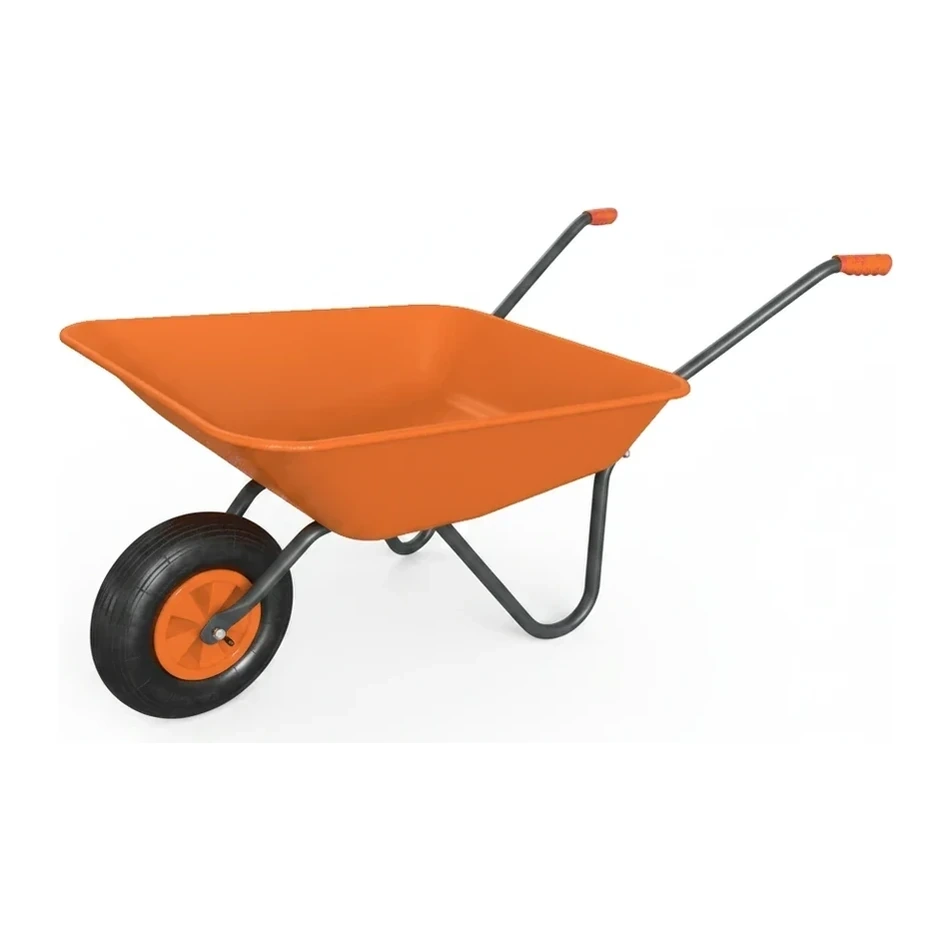
A wheelbarrow is a hand-propelled cart with one or two wheels, designed to transport landscape materials, construction debris, and bulk goods across job sites. It consists of a container (tray or bucket), handles, and wheel assembly that allows a single operator to move loads that would be difficult to carry. Wheelbarrows are fundamental tools in landscaping, construction, and general material handling operations.
How it works
The operator lifts the handles to tip the load onto the wheel(s), raising the container off the ground and transferring most of the weight to the axle. This mechanical advantage allows movement of heavy materials with minimal lifting effort. The operator then pushes or pulls the wheelbarrow to the destination, where the load can be dumped by tilting the container forward or lifting it from the rear. Single-wheel models offer greater maneuverability in tight spaces and over uneven terrain, pivoting easily around the central wheel. Two-wheel configurations provide enhanced stability for heavy or liquid loads, distributing weight across a wider footprint and reducing the risk of tipping on slopes or rough ground.
Types & variants
- Single-Wheel Contractor Barrow
- The industry standard with a steel or poly tray and single pneumatic tire; highly maneuverable for concrete, gravel, and demolition debris in construction applications.
- Two-Wheel Wheelbarrow
- Dual-wheel configuration offering superior stability for heavy or liquid loads; easier to balance when stationary and less prone to tipping on slopes.
- Poly Tray Barrow
- Lightweight polymer tray resistant to rust and corrosion; common in nursery and landscape maintenance where contact with fertilizers and moisture is frequent.
- Steel Tray Barrow
- Heavy-duty steel construction for concrete, masonry, and sharp debris; durable against impacts and abrasion in demanding construction environments.
- Flat-Free Tire Barrow
- Equipped with solid or foam-filled tires that eliminate puncture risk; preferred on sites with debris, thorns, or sharp materials that would damage pneumatic tires.
- Oversize Utility Barrow
- Large-capacity models (7+ cu ft) with extended trays for bulk lightweight materials such as leaves, mulch, compost, and bagged goods.
Key specifications
| Specification | Typical range | What it means |
|---|---|---|
| Tray Capacity | 3-10 cu ft | Volume measurement determining load size; 6 cu ft is the contractor standard for concrete and aggregate. |
| Tray Material | Steel or poly | Steel offers durability for abrasive loads; poly provides corrosion resistance and lighter weight. |
| Wheel Configuration | Single or dual wheel | Single-wheel designs prioritize maneuverability; dual-wheel models enhance stability and balance. |
| Tire Type | Pneumatic or flat-free | Air-filled tires absorb shock and traverse rough terrain; flat-free eliminate puncture downtime. |
| Load Capacity | 200–400 lb (90.7–181 kg) | Maximum weight rating including material and tray; varies with frame construction and wheel assembly. |
How the industry sizes it
The rental industry sizes wheelbarrows by cubic feet of tray capacity. Light-duty models (0-5 cu ft) serve garden and yard applications with soil, mulch, and plants. The 6 cu ft contractor barrow represents the industry workhorse, built for concrete, gravel, and demolition debris in commercial construction. Oversize barrows (7+ cu ft) accommodate bulky, lightweight materials such as leaves, mulch, and bagged goods where volume rather than weight drives capacity requirements.
Applications
- Concrete and mortar transport on construction and masonry sites
- Landscape installation: soil, mulch, gravel, and plant material distribution
- Demolition debris removal and material staging
- Nursery and greenhouse operations for potting mix and plant handling
- Property maintenance: leaf collection, compost hauling, and yard cleanup
- Agricultural and farm material transport over short distances
Safety & operation
- Inspect wheel and axle assembly before use; damaged or worn components increase tipping risk and operator strain
- Load material evenly in the tray with weight centered over the wheel to maintain balance and reduce handle torque
- Avoid overloading beyond rated capacity; excessive weight can cause loss of control, frame failure, or operator injury
- Use proper lifting technique when raising handles: bend knees and keep back straight to prevent strain
- Exercise caution on slopes and uneven terrain; two-wheel models offer greater stability on inclines and rough ground
Standards & certifications
- ANSI · ANSI/ISEA 121
- Dropped Object Prevention Solutions standard applicable to job sites where wheelbarrows transport overhead hazards.
- OSHA · 29 CFR 1926.602
- Material handling equipment standards covering safe operation practices and load securing on construction sites.
- ASTM · ASTM F1166
- Human engineering design standard for operator-propelled equipment including handle design and force requirements.
- ISO · ISO 11228-1
- Ergonomics standard for manual handling; informs load limits and operator posture guidance for hand-propelled equipment.
Frequently asked
What is the difference between a single-wheel and two-wheel wheelbarrow?
How is wheelbarrow capacity measured?
What tire type is appropriate for different job sites?
Why are steel and poly trays suited to different applications?
Related equipment
Browse by manufacturer
All models
51 models · Page 1 of 2 · Every spec cited to source