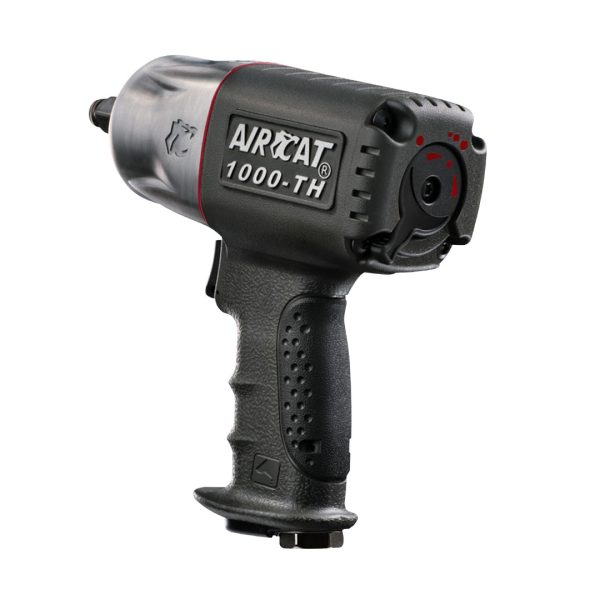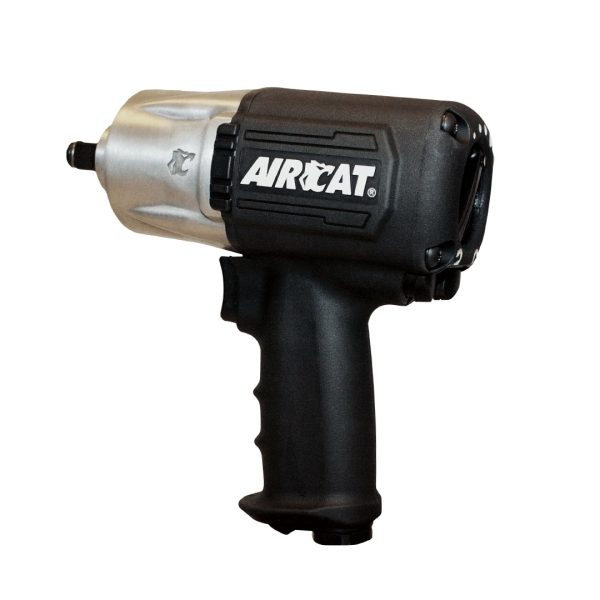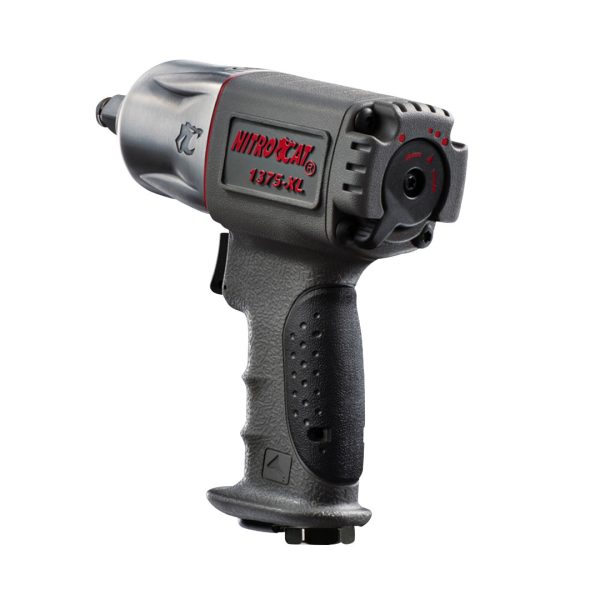

Air Impact Wrench
An air impact wrench uses compressed air to deliver high torque in rapid rotational hammer blows, loosening and tightening fasteners that hand tools cannot move efficiently. It is the standard tool for lug nuts, equipment fasteners and seized threads. Listed models run free speeds of 5,500-12,000 rpm and draw 3-12 cfm of air.
Cómo funciona
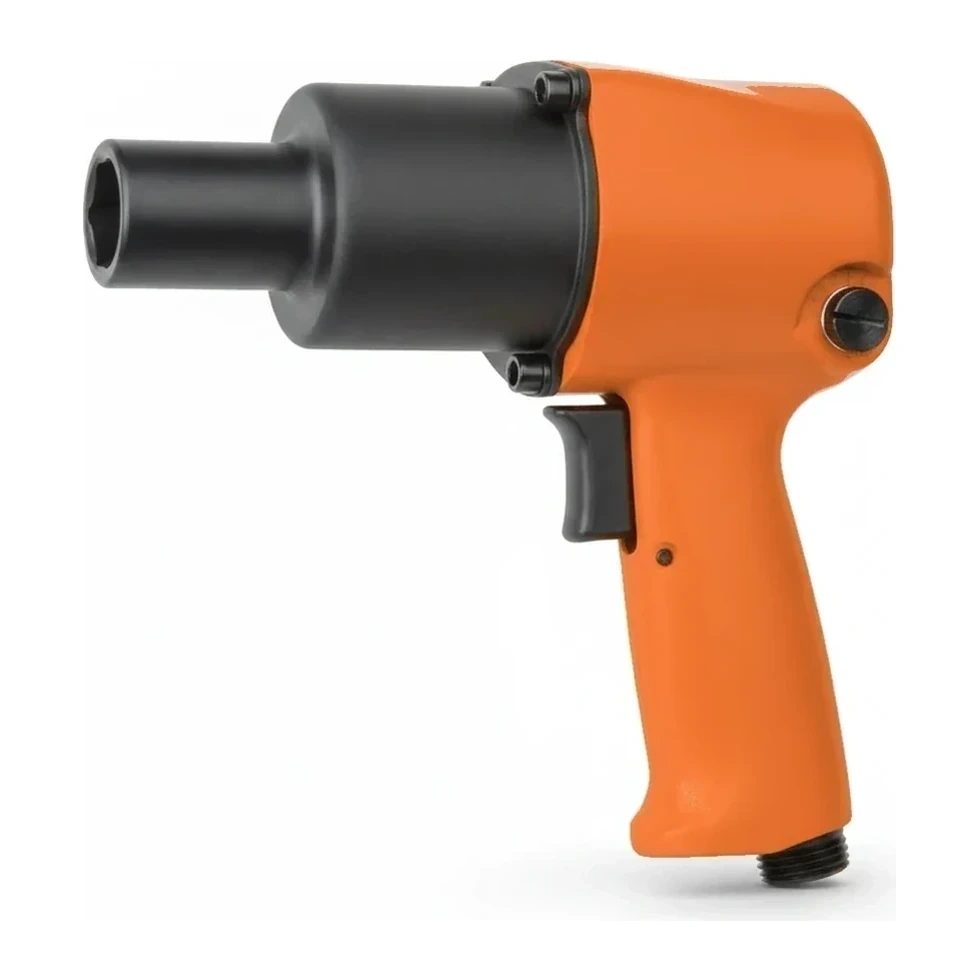
An air motor spins a rotating mass, the hammer, which periodically engages an anvil connected to the square output drive. Each engagement delivers a sharp torque impulse, so the tool applies far more breakaway torque than its size suggests, without transmitting that torque back into the operator's wrist. Free speed, 5,500-12,000 rpm across listed models, is how fast the tool spins a fastener once it is loose; breakaway torque is a separate figure set by the hammer mechanism. The air supply governs real-world performance: listed tools draw 3-12 cfm, and a compressor that cannot sustain the draw lets the tool bog down and lose torque mid-fastener. Sockets must be impact-rated, since ordinary chrome sockets can shatter under hammer loading.
Tipos y variantes
- Pistol-grip impact wrenches
- The standard general-duty format for automotive, fleet and equipment fastener work.
- Compact and stubby impacts
- Short-body tools for tight clearances where a full-length tool cannot fit.
- Heavy-duty large-drive impacts
- Larger square drives and hammer mechanisms for structural bolting and heavy equipment fasteners.
- Angle-head impacts
- Right-angle drives for fasteners that cannot be reached in line.
Especificaciones clave
| Especificación | Rango típico | Qué significa |
|---|---|---|
| Free speed | 5,500-12,000 rpm across listed models | How fast the tool spins a fastener once torque has broken it loose; it does not indicate breakaway torque. |
| Average air consumption | 3-12 cfm across listed models | The sustained supply the compressor must hold; an undersized supply lets the tool bog down and lose torque under load. |
| Drive size | Square drive; size varies by model | The industry sizing convention: larger square drives carry heavier sockets and higher torque classes. |
Cómo la industria lo dimensiona
Impact wrenches are sized by square drive size: the drive dictates the socket range and the torque class the tool is built for, with small drives for light fastening and progressively larger drives for lug nuts, equipment fasteners and structural bolting. Within a drive size, free speed, 5,500-12,000 rpm on listed models, and air draw of 3-12 cfm differentiate tools, and the compressor's sustained output must cover the draw for the tool to reach its rated performance.
Aplicaciones
- Automotive wheel and lug nut service
- Undercarriage and suspension bolt work
- Equipment maintenance and fastener servicing
- Fleet and trailer repair
- General shop and garage assembly
- Structural bolting on job sites
Seguridad y operación
- Only impact-rated sockets and accessories are used; standard chrome sockets can shatter under hammer loading.
- Impact wrenches are not precision torque tools: critical fasteners are finished and verified with a calibrated torque wrench.
- Hose couplings carry whip restraints, and the line is depressurized before sockets are changed.
- Sustained use is noisy and transmits vibration; hearing protection and exposure management apply.
Normas y certificaciones
- OSHA · 29 CFR 1926.302(b)
- Pneumatic tool requirements, including securing hoses and attachments.
- ANSI · ANSI B186.1
- Safety code for portable air tools, covering impact tool design and safe use.
- ISO · ISO 28927 series
- Hand-arm vibration measurement standard used to compare impact tool vibration exposure.
Preguntas frecuentes
Does higher rpm mean more torque?
What air supply does an impact wrench need?
How is the right size impact chosen?
Can an impact wrench set final torque on critical bolts?
Equipos relacionados
Explorar por fabricante
Fuentes
Cada especificación se verifica con los datos publicados por el fabricante, con la fuente enlazada como referencia.
Todos los modelos
21 modelos · Cada especificación citada a la fuente