

Air Ratchet Wrench
An air ratchet wrench is a compact pneumatic tool that spins nuts and bolts through a ratcheting head, doing the work of a hand ratchet at air-tool speed. Its defining virtue is clearance: the low-profile head works in engine bays, machinery frames and structural pockets where neither a hand wrench's swing arc nor an impact wrench's body will fit.
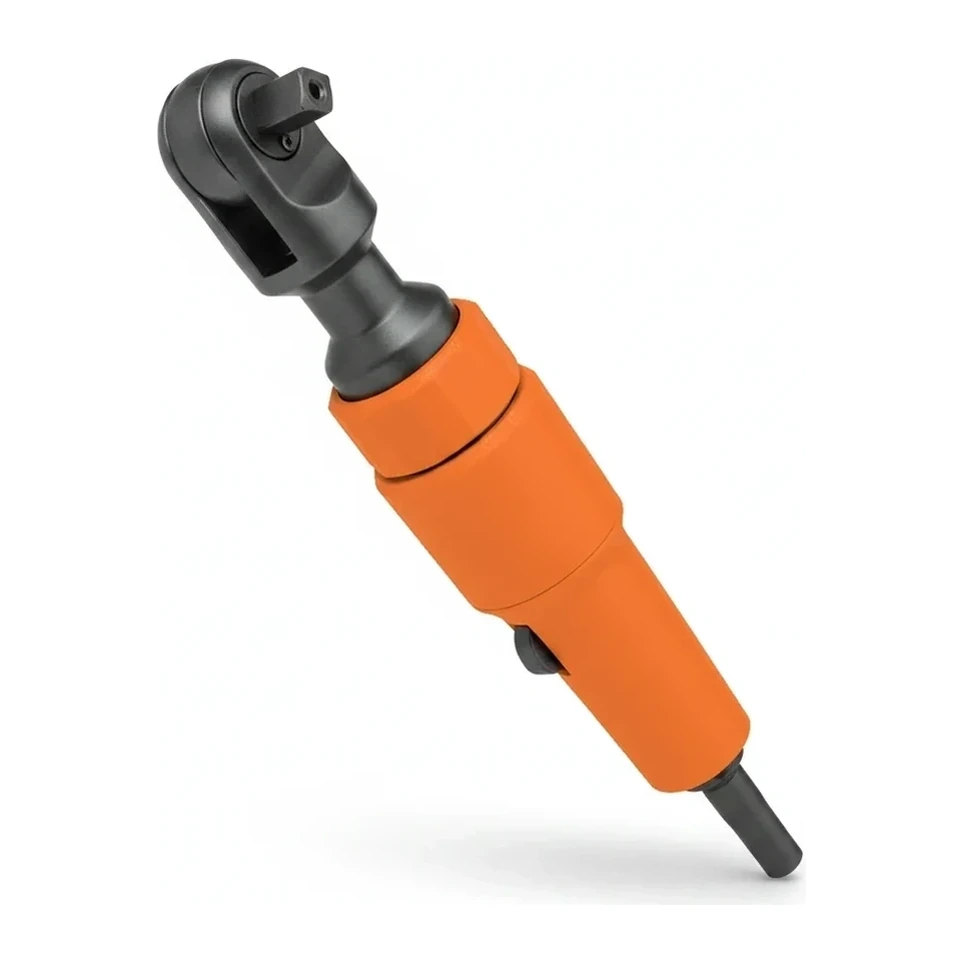
Cómo funciona
An air motor in the handle drives the ratchet head through a crank and yoke mechanism, producing continuous rotation at the square drive while the head itself stays as slim as a hand ratchet. A trigger meters air to control speed, and the ratcheting mechanism lets the operator finish or break fasteners by hand with the same tool when clearance is too tight even to run the motor. Unlike an impact wrench, an air ratchet transmits its torque reaction into the operator's hand: when a fastener seats or breaks loose, the tool body kicks. That is why the class is used for running fasteners quickly rather than for final torque on critical joints.
Tipos y variantes
- Standard air ratchets
- Full-length handles with general-purpose drive sizes for maintenance and assembly work.
- Stubby and compact ratchets
- Shortened bodies for the tightest clearances, trading leverage for access.
- High-torque ratchets
- Reinforced heads and mechanisms at the top of the class for heavier fastening work.
Especificaciones clave
| Especificación | Rango típico | Qué significa |
|---|---|---|
| Drive size | Square drive; size varies by model | The sizing convention for the class: drive size sets the socket range and the fastener sizes the tool suits. |
| Free speed | Varies by model; not published across listed units | How fast the head spins an unloaded fastener; higher speeds clear long threads faster. |
| Air supply requirement | Compressed-air feed; rated draw varies by model | The compressor and line must sustain the tool's rated draw at working pressure for it to hold speed under load. |
Cómo la industria lo dimensiona
Air ratchets follow the square-drive sizing convention: drive size sets the socket range and the fastener class the tool is meant for, with smaller drives for light assembly and larger drives for heavier fastening. Beyond drive size, the choice is body format, standard length for leverage, stubby for the tightest access, matched to the clearance the work actually offers.
Aplicaciones
- Automotive and equipment maintenance in tight bays
- Removing and installing fasteners in engine compartments
- Assembly work on machinery with limited clearance
- Fastening in confined structural and frame spaces
- General repair work where a hand wrench has no room to swing
Seguridad y operación
- Torque reaction feeds back into the operator's hand when fasteners seat or break loose; grip and body position anticipate the kick.
- Air ratchets are not torque-controlled: critical fasteners are finished and verified with a calibrated torque wrench.
- The line is depressurized before sockets are changed, and hose couplings carry whip restraints.
- Eye protection applies; spinning sockets in confined spaces flick debris unpredictably.
Normas y certificaciones
- OSHA · 29 CFR 1926.302(b)
- Pneumatic tool and hose requirements for construction use.
- ANSI · ANSI B186.1
- Safety code for portable air tools, covering ratchet and assembly tool provisions.
Preguntas frecuentes
When is an air ratchet the right tool over an impact wrench?
Can an air ratchet set final torque on critical fasteners?
How are air ratchets sized?
Equipos relacionados
Explorar por fabricante
Todos los modelos
2 modelos · Cada especificación citada a la fuente