

Reversible Plate Compactor
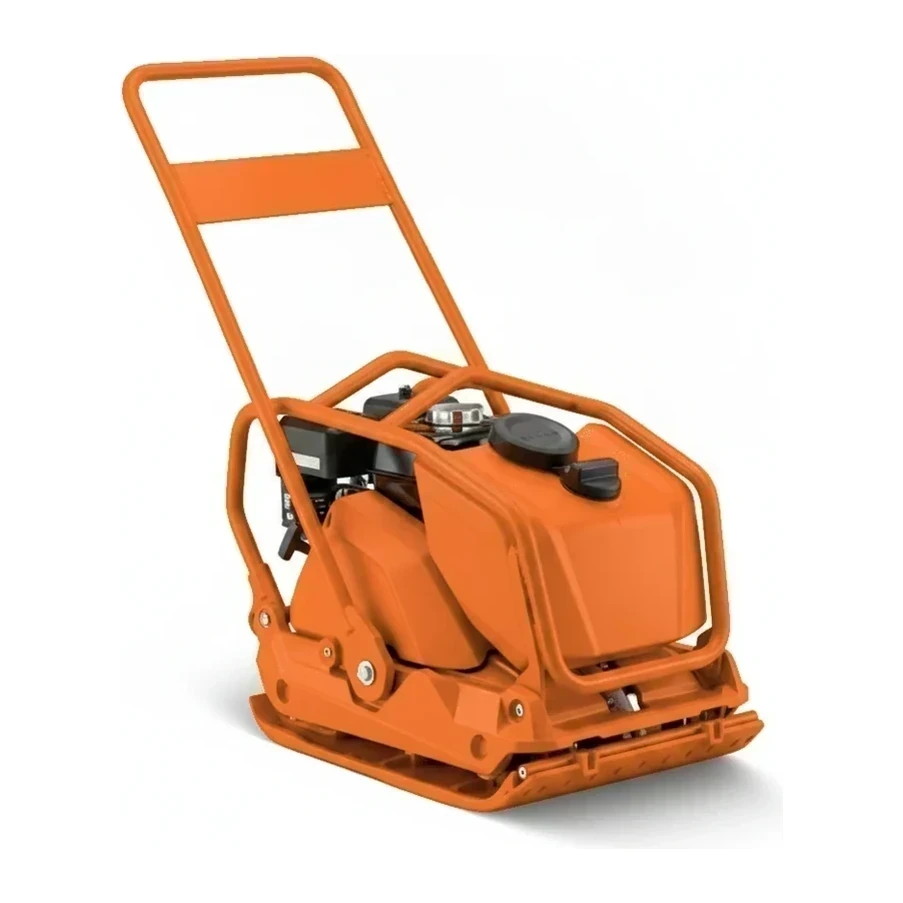
A reversible plate compactor is a vibratory plate whose thrust direction can be shifted, letting it travel forward, hold on the spot or back out of a cut without turning around. Heavier than standard forward plates, reversible units bridge the gap between light plates and ride-on rollers on granular base and backfill work.
Cómo funciona
Two counter-rotating eccentric shafts under the base plate generate vibration; shifting the phase angle between them tilts the resultant force vector, which drives the plate forward, holds it vibrating in place or pulls it in reverse. Held stationary, the plate concentrates compaction on one spot: useful for deep granular lifts. Compared with a single-eccentric forward plate, a reversible unit is heavier, delivers more centrifugal force and never needs room to turn: the deciding advantage inside trenches and against structures. Against a rammer, it favors granular material and coverage; the rammer keeps the edge in cohesive clay and the narrowest cuts.
Tipos y variantes
- Mechanical-shift reversible plate
- Lever-operated phase shifting on lighter units; simple and field-serviceable.
- Hydraulic-shift reversible plate
- Hydraulic control of travel direction and speed, standard on mid and heavy units.
- Diesel heavy reversible plate
- The heaviest hand-guided format, used for thick granular lifts where a roller cannot access.
- Remote-controlled reversible plate
- Radio-controlled operation that takes the operator's hands off the machine entirely, cutting vibration exposure and keeping crews out of trenches.
Especificaciones clave
| Especificación | Rango típico | Qué significa |
|---|---|---|
| Operating weight | Varies by model: no verified range is on file for this class | Heavier plates compact deeper lifts but demand mechanical loading and more room to maneuver. |
| Plate width | Varies by model: no verified range is on file for this class | Sets coverage per pass and whether the machine fits the trench or working lane. |
| Centrifugal force | Varies by model: no verified range is on file for this class | Higher force keys together dense or thick granular material in fewer passes. |
Cómo la industria lo dimensiona
Reversible plates are sized by operating weight, plate width and centrifugal force, with weight as the leading indicator of how thick a granular lift the machine can close. Because no verified specification ranges are recorded for this class, machine selection should be grounded in the individual model's data sheet, matched against trench width, lift thickness and loading equipment available on site.
Aplicaciones
- Trench backfill on utility and pipe work
- Deep granular base compaction for driveways and lanes
- Sub-base preparation for interlock, pavers and slabs
- Backfill against foundations and retaining structures
- Granular fill compaction on grading jobs
Seguridad y operación
- Reverse travel moves the machine toward the operator: the crush hazard between plate and trench wall, formwork or structure is the class's defining risk, and operating position must always leave an escape path.
- Hand-arm vibration accumulates over a shift on handle-guided plates; remote-controlled units remove the exposure entirely.
- Engine exhaust in trenches and deep cuts calls for ventilation or carbon monoxide monitoring before compaction starts.
- Trench work proceeds only inside sloped, shored or shielded excavations as depth requires.
Normas y certificaciones
- CEN · EN 500-4
- European safety requirements for compaction machines, including reversible vibratory plates.
- ISO · ISO 5349-1
- Measurement and evaluation of hand-transmitted vibration from handle-guided machines.
- OSHA · 29 CFR 1926 Subpart P
- Excavation protective system requirements governing compaction inside trenches.
Preguntas frecuentes
What makes a reversible plate different from a standard plate?
Reversible plate or jumping jack for trench backfill?
Why hold a reversible plate on one spot?
Comparar modelos populares
Buscar por especificación →Normalizado a las mismas unidades. Un guion significa que el valor no fue publicado.
| Modelo | Peso operativo | Potencia del motor |
|---|---|---|
| Multiquip SP2S20H20A | 443 lb (201 kg) | 20 hp |
| Multiquip SP2S13H20A | 280 lb (127 kg) | 13 hp |
Equipos relacionados
Explorar por fabricante
Fuentes
Cada especificación se verifica con los datos publicados por el fabricante, con la fuente enlazada como referencia.
Todos los modelos
5 modelos · Cada especificación citada a la fuente