

Low-Level Access Lift
A low-level access lift is a compact mobile elevated work platform designed to lift personnel and tools to working heights typically between 8 and 13 feet. These units serve as mechanized alternatives to ladders and scaffolding in indoor applications where space is limited and standard scissor lifts cannot maneuver. The equipment class is characterized by its ability to fit through standard doorways and operate on finished floors without surface damage.
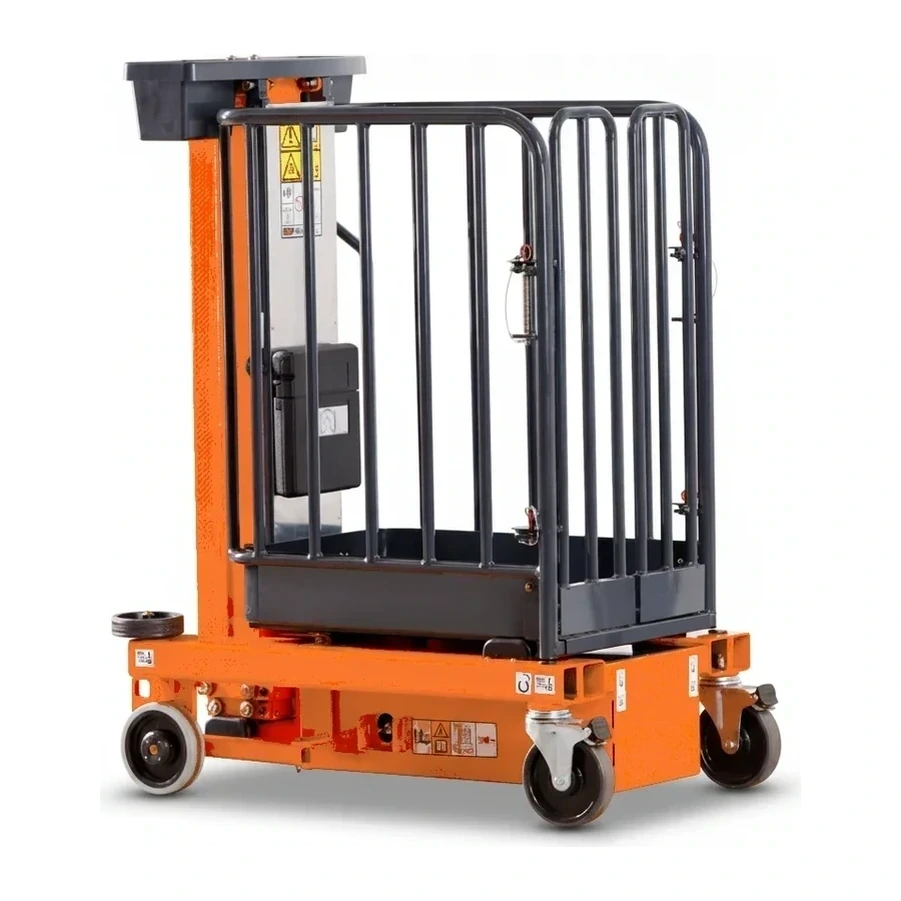
Cómo funciona
Low-level access lifts employ a vertical mast mechanism or compact scissor stack to raise a small platform. Most models feature electric or manual hydraulic actuation, with controls located both on the platform and at ground level. The narrow base and compact footprint allow the unit to be manually pushed or self-propelled through doorways and tight aisles. The platform elevates vertically with minimal horizontal displacement, providing stable overhead access in confined areas. Outriggers or a widened base provide stability during elevation, and most units lock wheels automatically when the platform is raised. Battery-powered models dominate the segment due to zero-emission requirements for indoor work.
Tipos y variantes
- Manual Push-Around Lift
- Manually propelled units with hydraulic or winch elevation, requiring no power source for movement between work areas.
- Self-Propelled Low-Level Lift
- Battery-powered drive and lift systems, allowing single-operator positioning and elevation from the platform.
- Micro Scissor Lift
- Compact scissor-stack design resembling traditional scissor lifts but scaled for doorway passage and low-ceiling environments.
- Vertical Mast Lift
- Single or dual-mast configuration lifting a small platform vertically with minimal footprint, often with fold-down railings.
- Pop-Up Lift
- Ultra-compact units with collapsible platforms and masts, designed for storage in service vehicles and retail stockroom use.
Especificaciones clave
| Especificación | Rango típico | Qué significa |
|---|---|---|
| Platform Height | 8–13 ft (2.4–4.0 m) | Maximum elevation of the work platform, determining overhead reach for maintenance and installation tasks. |
| Platform Capacity | 567-2268 kg (1250-5000 lbs) | Maximum combined weight of personnel, tools, and materials the platform can safely support during operation. |
| Stowed Width | 28–36 in (71.1–91.4 cm) | Width of the unit in transport configuration, critical for passage through standard 36-inch doorways and narrow aisles. |
| Platform Dimensions | 24 x 36 to 30 x 48 in | Working area available on the platform, determining space for operators and material handling. |
| Overall Height (Stowed) | 5–7 ft (1.5–2.1 m) | Collapsed height affecting clearance through doorways, loading into vehicles, and storage requirements. |
Cómo la industria lo dimensiona
The industry sizes low-level access lifts by platform height in feet, with the market divided into two functional bands. Units reaching 0-12 feet represent the core stepladder-replacement category, designed to pass through standard 36-inch doorways and work on finished floors in occupied spaces. The 12-13+ foot segment represents the tallest micro-lifts, bridging the gap between stepladders and full-size scissor lifts for retail fit-out, drop ceiling work, and warehouse maintenance where overhead access is needed but facility constraints prevent larger equipment deployment. Unlike larger MEWPs, these units are often specified by doorway-passage capability and floor-loading characteristics rather than pure reach.
Aplicaciones
- Retail store maintenance and display installation in tight aisles and showroom floors
- Commercial building drop ceiling work, lighting replacement, and HVAC filter changes
- Warehouse stockroom inventory access and low-bay lighting maintenance
- Facility maintenance in hospitals, schools, and offices with finished floors and occupied spaces
- Manufacturing and assembly operations requiring overhead access without large equipment footprint
- Residential construction finish work including trim installation and cabinet mounting
Seguridad y operación
- Door and aisle clearances must be verified before moving elevated platforms through openings to prevent collision with frames or operators
- Floor load capacity and surface conditions require assessment, as some models concentrate weight on small outrigger pads
- Platform guardrails must remain in place and locked during operation; collapsible rail models require confirmation of proper engagement
- Operators must maintain three-point contact when entering or exiting elevated platforms and avoid overreaching beyond guardrails
- Battery charge levels and emergency lowering procedures must be confirmed before beginning work in areas where power access is limited
Normas y certificaciones
- ANSI · A92.3 / A92.6
- Mobile elevating work platforms and self-propelled elevating work platform standards covering design, testing, and safe use requirements.
- CSA · B354.1 / B354.6
- Canadian standards for mobile work platforms and self-propelled elevating work platforms, harmonized with ANSI requirements.
- OSHA · 1926.453
- Aerial lift regulations governing operator training, fall protection, and equipment maintenance for construction applications.
- IPAF
- International Powered Access Federation provides operator training standards and technical guidance for powered access equipment.
Preguntas frecuentes
What distinguishes a low-level access lift from a standard scissor lift?
Why are these lifts often called micro scissors, pop-up lifts, or pecolifts?
What platform capacity range is typical for low-level access lifts?
Can low-level access lifts operate on sensitive finished flooring?
Comparar modelos populares
Buscar por especificación →Normalizado a las mismas unidades. Un guion significa que el valor no fue publicado.
| Modelo | Altura de trabajo | Capacidad de plataforma |
|---|---|---|
| JLG EcoLift 50 | 10.9 ft (3.3 m) | 331 lb (150 kg) |
| JLG EcoLift 70 | 13.2 ft (4.0 m) | 331 lb (150 kg) |
Equipos relacionados
Explorar por fabricante
Fuentes
Cada especificación se verifica con los datos publicados por el fabricante, con la fuente enlazada como referencia.
Todos los modelos
31 modelos · Cada especificación citada a la fuente