
Push-Around Personnel Lift
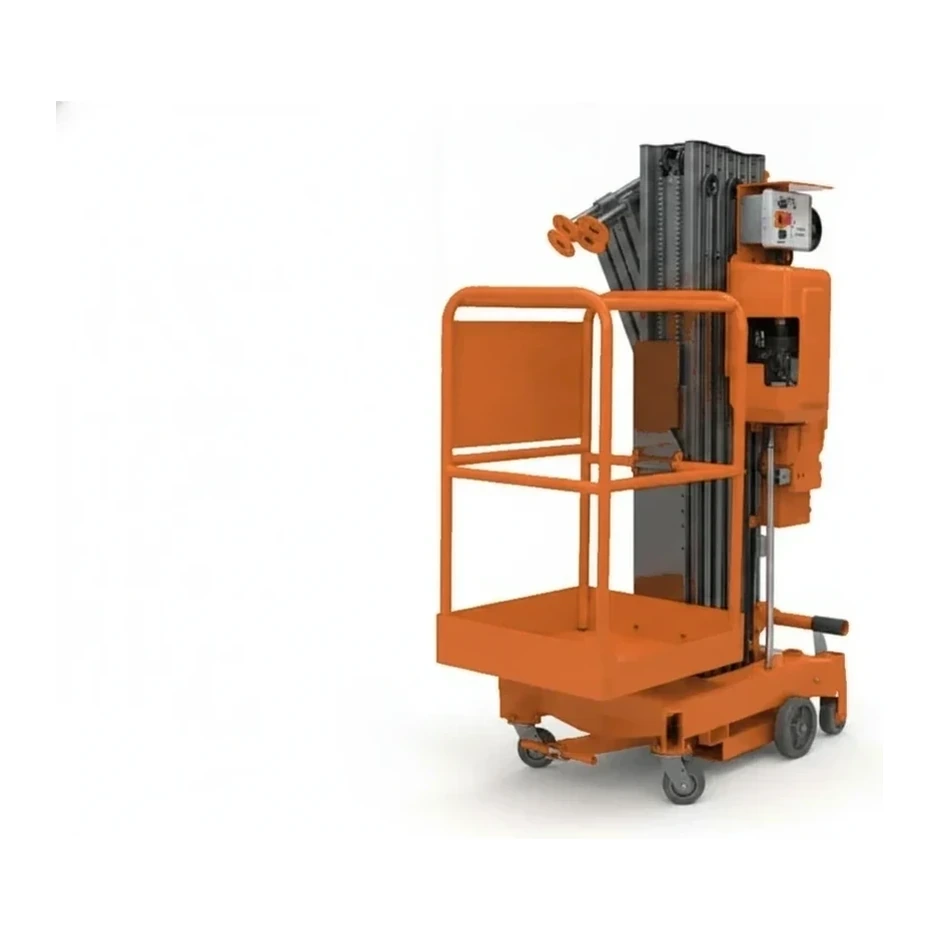
A push-around personnel lift is a manually positioned mobile elevated work platform featuring a vertical mast that elevates a single operator to working heights typically between 4.9 and 21.0 feet. Unlike powered MEWPs, these units require manual positioning and setup, making them ideal for indoor maintenance tasks in confined or occupied spaces. The equipment class is also referred to as AWP (aerial work platform), manual lift, or single man lift within the industry.
Cómo funciona
The operator manually pushes or rolls the unit into position using a compact wheeled base, then deploys stabilizing outriggers or a widened base for support. Vertical elevation is typically achieved through a manual or electric mast mechanism that raises the platform straight upward along guide rails. The operator ascends with the platform and performs work from the elevated position, with all horizontal repositioning requiring the platform to be lowered and the unit pushed to a new location. Most units feature a compact footprint designed to pass through standard doorways and fit into elevators, with non-marking tires suitable for finished floors. Setup and takedown typically require only minutes, and the absence of engine or hydraulic systems allows operation in noise-sensitive and indoor environments without emissions concerns.
Tipos y variantes
- Manual Mast Lift
- Entirely manual operation with hand-crank or winch elevation system; zero emissions and silent operation for sensitive environments
- Electric Mast Lift
- Battery-powered elevation with manual push positioning; faster vertical travel while maintaining emissions-free indoor use
- Vertical Mast AWP
- Narrow-profile design optimized for passing through doorways and working in tight aisles or between equipment
- Fixed Outrigger Model
- Integrated stabilization system that deploys outriggers for a secure base; common in taller working height models
- Compact Base Model
- Ultra-small footprint with integrated stability design; used where outrigger deployment space is limited
Especificaciones clave
| Especificación | Rango típico | Qué significa |
|---|---|---|
| Working Height | 4.9–21 ft (1.5–6.4 m) | Maximum height at which an operator can work, measured from ground level to platform plus reach; defines the range of accessible tasks |
| Platform Height | 3–19 ft (0.9–5.8 m) | Actual elevation of the standing platform; working height typically adds 6 feet for operator reach above the platform surface |
| Platform Capacity | 250–350 lb (113–159 kg) | Maximum combined weight of operator and tools; single-person lifts typically rated for one worker with standard hand tools |
| Stowed Width | 28–36 in (71.1–91.4 cm) | Width of the unit in transport configuration; determines ability to pass through standard doorways and navigate interior spaces |
| Overall Weight | 200–600 lb (90.7–272 kg) | Total unit weight affecting manual positioning effort and floor load requirements; lighter models offer easier repositioning |
Cómo la industria lo dimensiona
The industry sizes push-around personnel lifts primarily by working height measured in feet, which represents the maximum elevation at which an operator can perform tasks. Models are commonly grouped into ranges: compact units under 15 feet for basic maintenance like bulb changes and signage, mid-range 15-20 foot models for sprinkler heads and high-bay lighting in occupied buildings, and taller units approaching or exceeding 20 feet for atrium and warehouse ceiling work. Platform capacity, stowed width, and overall weight serve as secondary classification factors, particularly when determining suitability for specific facility constraints such as doorway clearance or elevator transport.
Aplicaciones
- Interior lighting maintenance including bulb changes, fixture cleaning, and ballast replacement in commercial and institutional facilities
- Signage installation and maintenance in retail environments, airports, and convention centers where quiet operation is required
- HVAC system service including filter changes, ductwork inspection, and diffuser adjustment in occupied buildings
- Electrical work such as conduit installation, junction box access, and low-voltage wiring in sensitive environments
- Ceiling tile replacement, suspended grid repair, and overhead inspection tasks in finished interior spaces
- Warehouse and industrial facility tasks including sprinkler head servicing, high-bay lighting, and overhead equipment maintenance
Seguridad y operación
- Outriggers or stabilizing base must be fully deployed and verified before elevation; uneven deployment creates tip hazard
- Floor surface must be level, solid, and free of debris; wheels should be locked or chocked during elevated operations
- Platform must be lowered to minimum height before any horizontal repositioning; moving while elevated presents severe tip risk
- Operator must maintain three-point contact and avoid overreaching beyond platform rails; lateral forces increase instability
- Load capacity includes operator weight plus all tools and materials; exceeding rated capacity compromises stability and structural integrity
Normas y certificaciones
- ANSI · A92.3
- American National Standard for manually propelled elevating aerial platforms; covers design, testing, and safe use requirements
- OSHA · 1926.453
- Occupational Safety and Health Administration regulations for aerial lifts in construction; defines training and operational safety requirements
- CSA · B354.1
- Canadian Standards Association standard for manually propelled elevating work platforms; parallel requirements for Canadian operations
- IPAF
- International Powered Access Federation provides operator training standards and safety guidance recognized across the MEWP industry
Preguntas frecuentes
What distinguishes a push-around personnel lift from a scissor lift?
How does working height differ from platform height?
Can push-around personnel lifts be used on sloped surfaces?
What determines whether a facility needs a manual versus electric mast model?
Comparar modelos populares
Buscar por especificación →Normalizado a las mismas unidades. Un guion significa que el valor no fue publicado.
| Modelo | Altura de trabajo | Capacidad de plataforma |
|---|---|---|
| JLG SSV-10 | 16 ft (4.9 m) | - |
| Ballymore PS-15 | 21 ft (6.4 m) | - |
Equipos relacionados
Explorar por fabricante
Fuentes
Cada especificación se verifica con los datos publicados por el fabricante, con la fuente enlazada como referencia.
Todos los modelos
7 modelos · Cada especificación citada a la fuente