Cómo funciona
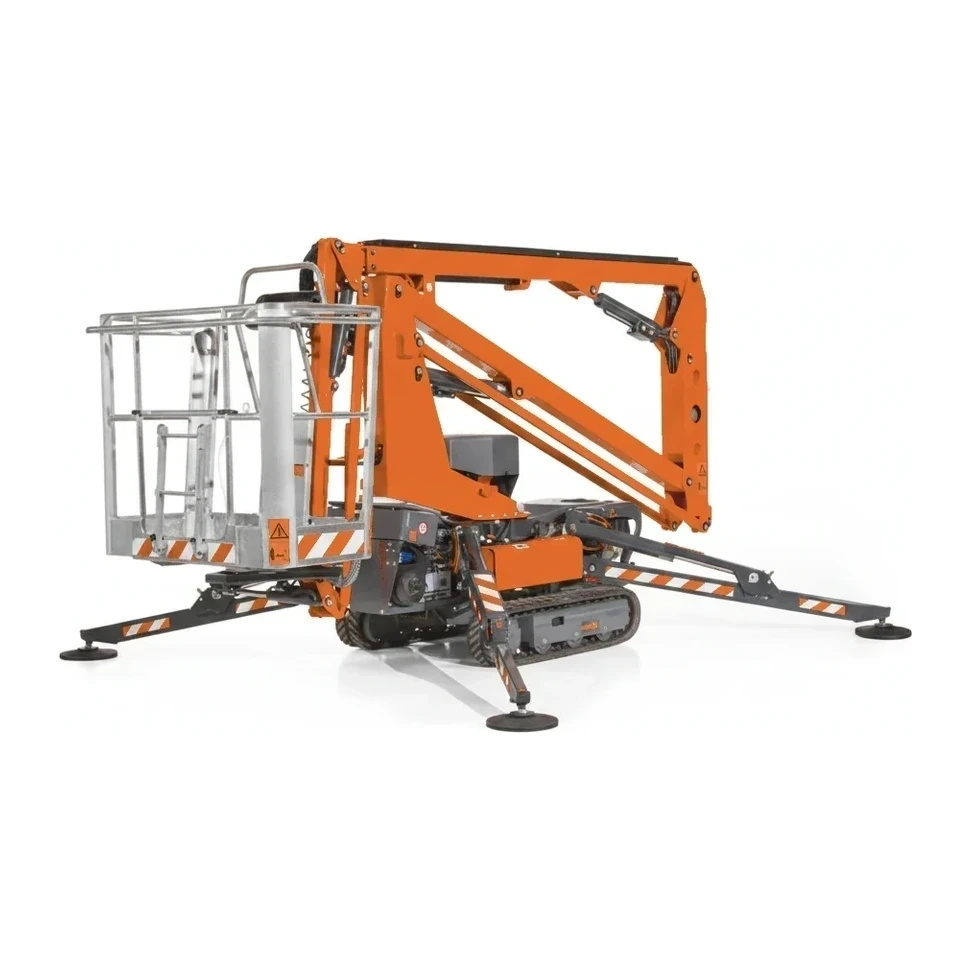
Atrium and spider lifts utilize articulating or telescoping booms mounted on compact, tracked chassis to deliver vertical and horizontal reach in restrictive environments. The tracks or wheels distribute weight across a larger surface area, minimizing ground pressure and protecting sensitive flooring such as tile, wood, and turf. Stabilizing outriggers extend from the base to level the machine and create a stable working envelope. Operators control boom articulation, platform rotation, and drive functions from the platform controls, with many models featuring proportional joystick operation. The compact dimensions allow passage through standard doorways and tight corridors, while the tracked propulsion system enables operation on slopes and stairs that would be inaccessible to wheeled lifts.
Tipos y variantes
- Atrium / Spider Lift
- Compact tracked or wheeled aerial platforms with articulating or telescoping booms and stabilizer outriggers, designed for indoor and tight-space access work with minimal ground disturbance and the ability to navigate narrow passages and delicate surfaces
Normas y certificaciones
+
- ANSI · ANSI A92.20
- Design, testing, and safe use requirements for mobile elevating work platforms, including self-propelled aerial lifts
- CSA · CSA B354.6
- Canadian standards for self-propelled elevating work platforms
- ISO · ISO 16368
- International standard for mobile elevating work platforms covering design calculations, stability criteria, and safety requirements
Preguntas frecuentes
+
What distinguishes spider lifts from conventional boom lifts?
Spider lifts feature tracked propulsion systems, extremely compact widths, stabilizing outriggers, and significantly lower ground pressure than wheeled boom lifts. These characteristics enable operation on delicate surfaces, passage through standard doorways, and access to locations where conventional lifts cannot travel or would cause surface damage.
What is the typical ground pressure range for tracked spider lifts?
Tracked spider lifts typically exert ground pressure between 2 and 6 PSI when tracks are engaged, though this varies by model and configuration. The outriggers concentrate more pressure at their contact points, so proper load distribution and suitable ground conditions remain essential considerations for operation planning.
What working heights are common in the atrium and spider lift category?
Atrium and spider lifts commonly provide working heights ranging from approximately 40 to over 90 feet, with platform heights typically between 30 and 80 feet. Compact models for indoor applications generally reach 40-60 feet, while larger outdoor-rated units extend to 80 feet or more. Horizontal outreach varies but commonly ranges from 15 to 40 feet depending on model and configuration.
Can spider lifts operate on slopes and stairs?
Many tracked spider lifts can traverse slopes and climb stairs, though capabilities vary significantly by manufacturer and model. Operation on slopes and stairs requires specific training and adherence to manufacturer specifications. Automatic leveling systems on advanced models maintain platform level during slope operation, while some units feature special stair-climbing modes.