

Arrow Board
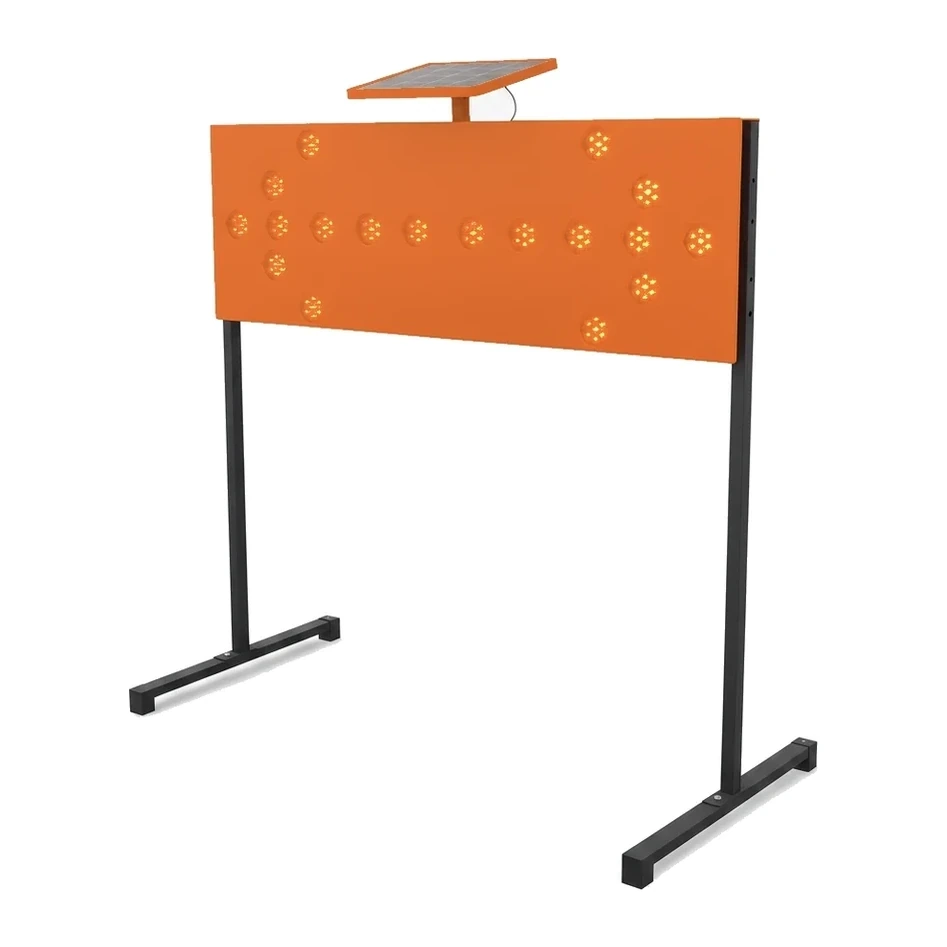
An arrow board is a portable electronic traffic control device that displays illuminated directional arrows, chevrons, or warning patterns to guide motorists through work zones, lane closures, and temporary traffic diversions. These devices use arrays of incandescent or LED lamps arranged in specific patterns to provide clear, visible guidance to approaching traffic. Arrow boards are classified by lamp count and pattern type, with larger arrays providing greater visibility for higher-speed roadways.
Cómo funciona
Arrow boards use electronically controlled lamp arrays to display sequential or static patterns including left and right arrows, chevrons, double arrows, and caution modes. The controller cycles power through specific lamps in programmed sequences, creating the appearance of directional motion or warning patterns. Most units operate on battery power with solar panel charging, allowing extended autonomous deployment in traffic control applications. The device mounts on a trailer, truck bed, or stand, positioning the display panel at a height and angle visible to approaching traffic. Operators select display patterns via a control panel, typically offering 8-12 standard patterns including arrow directions, alternating displays, and flashing caution modes compliant with traffic control standards.
Tipos y variantes
- Type B (13-Lamp)
- Minimum configuration for low-speed urban applications, displaying basic arrow and caution patterns for roads under 45 mph
- Type B (15-Lamp)
- Standard configuration for general road work and lane closures on roads posted up to 45 mph, offering fuller pattern visibility
- Type C (25-Lamp)
- High-visibility configuration for freeway and high-speed applications, providing legibility at distances exceeding one mile
- Trailer-Mounted
- Self-contained units on road-towable trailers with integrated power systems, battery banks, and solar panels for extended deployment
- Truck-Mounted
- Fixed or portable units designed for installation in pickup truck beds or vehicle-mounted frames for mobile operations
Especificaciones clave
| Especificación | Rango típico | Qué significa |
|---|---|---|
| Lamp Count | 13, 15, or 25 lamps | Determines display size, pattern complexity, and MUTCD type classification (Type B or Type C) |
| Display Patterns | 8–12 modes | Standard patterns include left/right arrows, double arrows, chevrons, alternating arrows, and caution/flashing modes |
| Visibility Range | 0.5–1+ miles | Distance at which patterns remain legible; Type C units achieve maximum range for high-speed roadways |
| Power Source | 12V DC battery with solar | Deep-cycle batteries recharged by solar panels enable multi-day autonomous operation without external power |
| Panel Dimensions | 48–96 inches wide | Overall display width increases with lamp count; larger panels provide greater conspicuity at distance |
Cómo la industria lo dimensiona
The industry sizes arrow boards primarily by lamp count, which determines both the physical size of the display and its classification under traffic control standards. Type B boards with 13 or 15 lamps suit low- to moderate-speed urban and suburban work zones on roads posted up to 45 mph. Type C boards with 25 lamps provide the visibility required for freeway and high-speed applications where approaching traffic travels at highway speeds, offering legibility at distances exceeding one mile. The lamp count directly correlates to pattern complexity, display area, and the range at which directional guidance remains clear to motorists.
Aplicaciones
- Highway and freeway lane closures requiring advance warning and directional guidance at high approach speeds
- Urban street work zones and utility projects with temporary lane shifts or closures on moderate-speed roadways
- Road construction projects requiring traffic merging, splitting, or transitioning between temporary and permanent lanes
- Special events and emergency detours where temporary traffic pattern changes require clear directional communication
- Mobile maintenance operations such as striping, pothole repair, or sweeping with moving work zones
- Intersection closures and detours requiring motorists to navigate alternative routes around construction areas
Seguridad y operación
- Position boards at appropriate advance distances per MUTCD guidelines based on road speed and sight distance to provide adequate reaction time
- Ensure stable mounting or trailer positioning on level ground with wheel chocks and outriggers deployed to prevent tipping in wind
- Verify display patterns match actual traffic control setup; incorrect arrows directing traffic into closed lanes create hazard conditions
- Maintain clear sight lines to the display panel by avoiding placement behind curves, crests, or obstructions that reduce visibility
- Monitor battery charge levels and solar panel function to prevent display failure during active traffic control operations
Normas y certificaciones
- MUTCD · Part 6
- Manual on Uniform Traffic Control Devices specifies arrow board types, placement, patterns, and applications for temporary traffic control
- NCHRP 350
- Crash testing standards for work zone devices; trailer-mounted units may require crashworthy designs or shielding in certain placements
- ITE
- Institute of Transportation Engineers provides supplemental guidance on work zone traffic control device deployment and visibility
- SAE J595
- Defines directional flashing and sequential lighting standards applicable to arrow board lamp sequencing and flash rates
Preguntas frecuentes
What is the difference between Type B and Type C arrow boards?
How long do arrow boards operate on battery power?
Which display pattern should be used for lane closures?
Can arrow boards operate in all weather conditions?
Equipos relacionados
Explorar por fabricante
Todos los modelos
14 modelos · Cada especificación citada a la fuente