

Early Entry Saw
An early entry saw cuts control joints into concrete while it is still green, typically within the first hours after finishing, using a skid plate that supports the surface at the blade to prevent chipping and raveling. Cutting before shrinkage stresses develop stops random cracking.
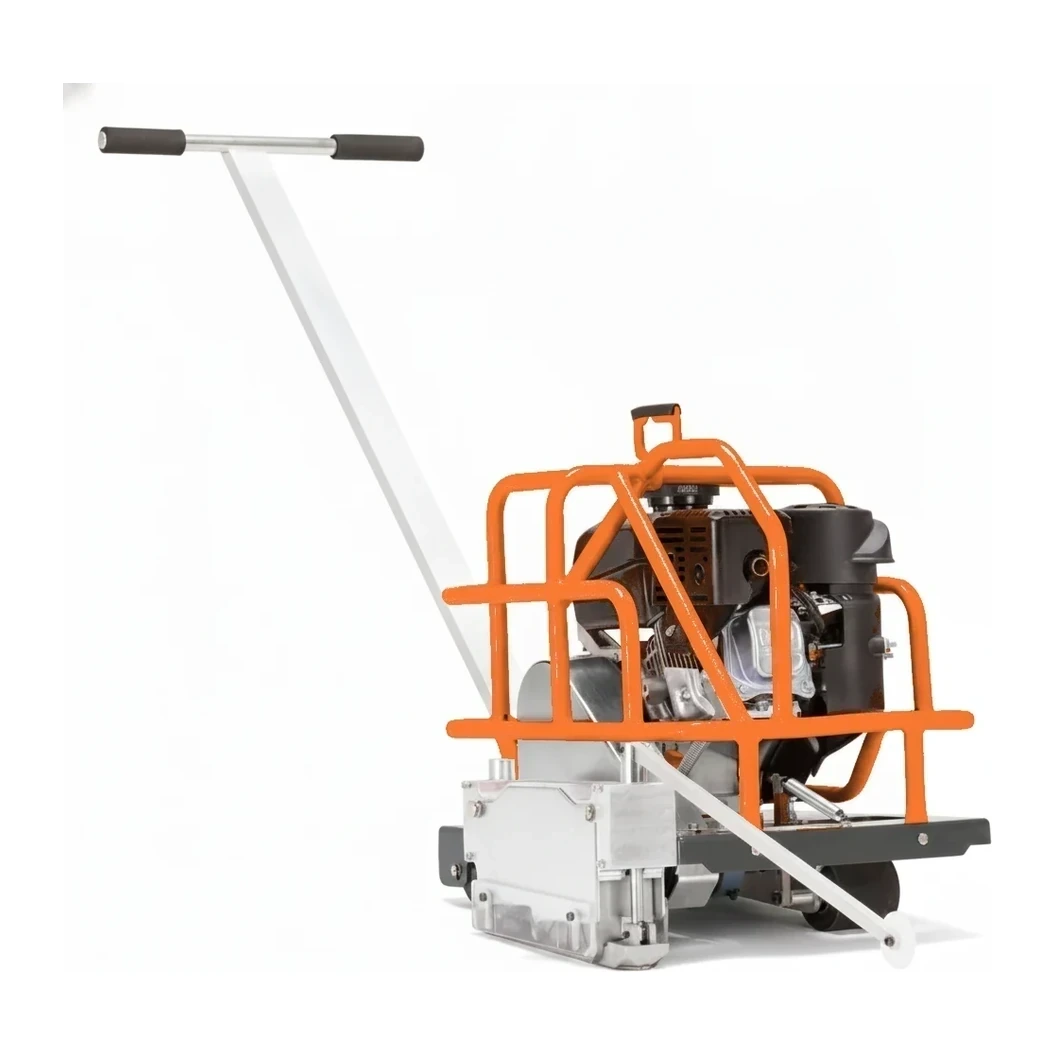
Fonctionnement
The saw rides on a flat skid plate rather than wheels at the cut, holding the green surface down on both sides of a dry-cutting diamond blade as it enters. An up-cut or down-cut blade action combined with the plate keeps the joint edge clean at an age when a conventional wet saw would tear and ravel the slab. Joints are cut shallow relative to conventional sawing, the early timing, not depth, controls cracking, and the saw follows the finishing crew across the placement in the same working window.
Types et variantes
- Compact early entry saw
- Residential and light commercial finishing; one-person machines that follow the crew across the placement.
- Larger early entry saw
- Deeper early-entry cuts on thick commercial slabs and paving joints.
- Down-cutting skid saw
- Blade rotation presses the surface into the skid plate: the design principle behind clean green-concrete joints.
Spécifications clés
| Spécification | Plage typique | Signification |
|---|---|---|
| Capacity | 0-8 in or deeper than 8 in | Industry separates compact saws for residential and light commercial slabs from deeper-cutting machines for thick commercial floors. |
| Skid plate | replaceable anti-ravel plate at the blade | Supports the green surface at the cut; plate condition directly controls joint edge quality. |
| Blade type | dry-cut diamond blade for green concrete | Green-concrete blades are specified for early cutting and differ from cured-concrete wet blades. |
Comment l'industrie le dimensionne
Early entry saws are sized by cutting depth capacity: machines up to 8 in serve residential and light commercial slabs, while deeper-cutting machines handle thick industrial floors and paving. Because the method depends on timing, saw capacity is chosen so jointing keeps pace with the finished area before the cutting window closes.
Applications
- Control joints in warehouse and industrial floors
- Same-day jointing on driveways and sidewalks
- Parking lot slab joints
- Highway and airport paving joints
- Bridge deck jointing
- Interior slabs in occupied or enclosed buildings
Sécurité et opération
- Early entry cutting is typically a dry process on green concrete: silica dust control by vacuum shroud or dust-suppression accessories applies even though the concrete is young.
- The blade runs exposed at slab level near the finishing crew; guard and skid plate must be intact and bystanders kept clear of the cutting line.
- Green slabs are walked while barely set; access is planned so the operator does not mar finished surface or trip on embedded items.
Normes et certifications
- OSHA · 29 CFR 1926.1153
- Respirable crystalline silica controls for concrete sawing, including dust collection on dry-cut joint saws.
- ACI · 302.1R
- Floor and slab construction guide: joint layout and the timing window for early-entry sawing.
Questions fréquentes
How soon after finishing can joints be cut?
Why cut early instead of waiting for a conventional saw?
What separates compact and larger early entry saws?
Do early entry saws cut as deep as conventional joint saws?
Comparer les modèles populaires
Chercher par spécification →Normalisé aux mêmes unités. Un tiret signifie que la valeur n'a pas été publiée.
| Modèle | Puissance moteur | Poids en service |
|---|---|---|
| Multiquip SS233 | 0 hp | - |
| Multiquip FCG16HA | 5 hp | 106 lb (48 kg) |
| Multiquip FCG-1 | 6 hp | 101 lb (46 kg) |
Équipements connexes
Parcourir par fabricant
Sources
Chaque spécification est vérifiée par rapport aux données publiées par le fabricant, avec la source liée pour référence.
Tous les modèles
8 modèles · Chaque spécification citée à la source