

Wall Saw
A wall saw is a track-mounted concrete cutting machine designed to cut precise openings in vertical walls, horizontal floors, and other surfaces where controlled, deep cuts are required. The system consists of a diamond blade mounted on a carriage that travels along a fixed track, enabling straight, accurate cuts through reinforced concrete, masonry, and other structural materials.
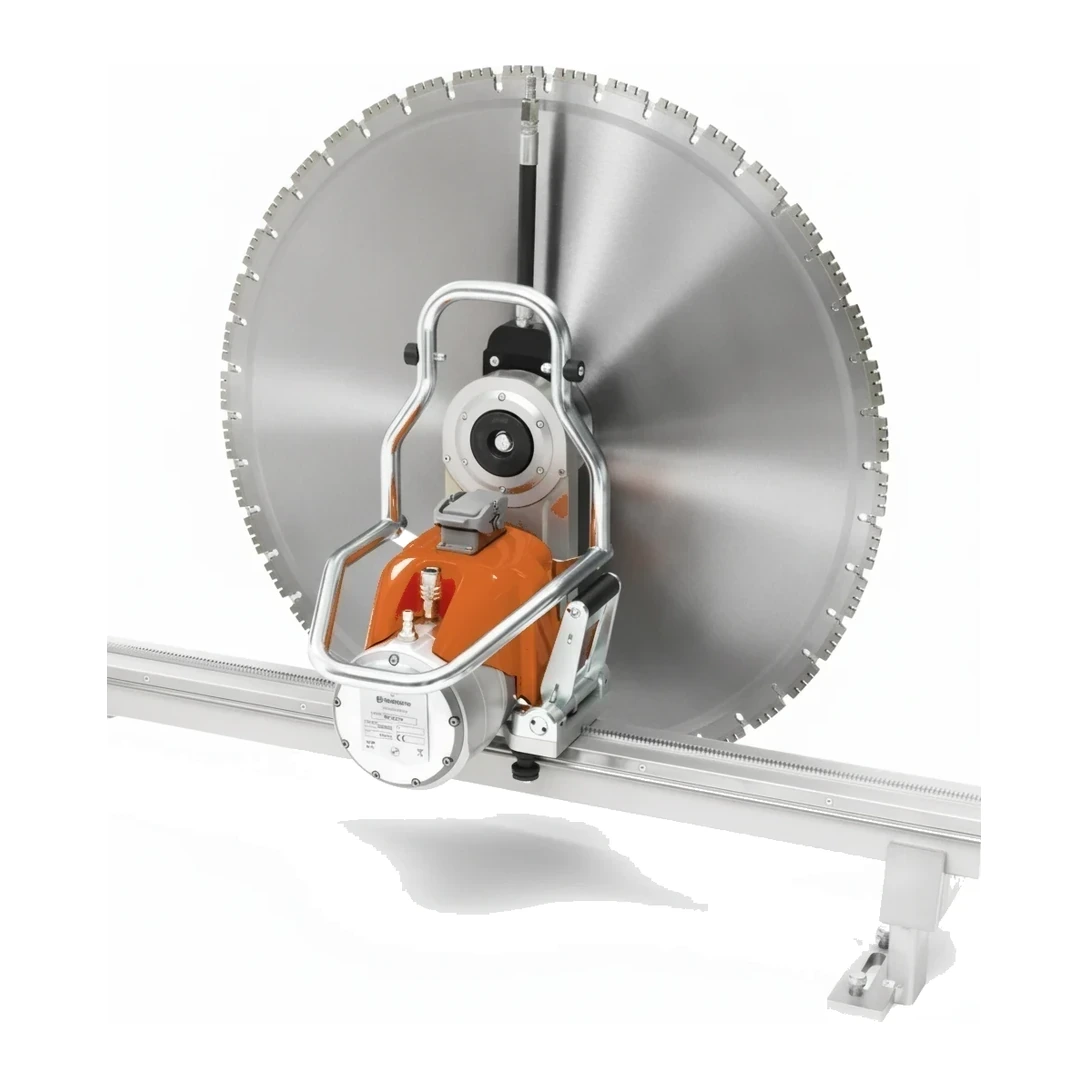
Fonctionnement
The wall saw operates by securing a rigid track to the surface using anchor bolts or vacuum mounting systems. A motorized carriage runs along this track, carrying a large-diameter diamond blade that rotates at controlled speeds. The operator guides the carriage along the track, advancing the blade into the material at a controlled feed rate. Hydraulic or electric motors power both the blade rotation and carriage movement, with water supplied continuously to the blade for cooling and dust suppression. The track system ensures perfectly straight cuts and maintains blade alignment throughout the cutting process, even through heavily reinforced concrete. Depth of cut is determined by blade diameter, with the track positioned to guide the blade along the desired cut line. The system can be oriented vertically for wall cuts or horizontally for floor cutting, and some configurations allow for bevel cuts at various angles.
Types et variantes
- Hydraulic Wall Saw
- Powered by hydraulic motors, offering high torque and consistent power delivery for demanding cuts in thick concrete and continuous operation on large projects.
- Electric Wall Saw
- Uses electric motors for power, providing quieter operation and suitable for indoor environments where exhaust fumes must be avoided.
- High-Cycle Wall Saw
- Designed for rapid blade rotation, optimized for faster cutting speeds in moderate-thickness applications.
- Track-Mounted Floor Saw
- Wall saw configured for horizontal cutting applications, mounted on tracks to cut through floor slabs and horizontal structural elements with precision.
- Rail-Mounted Bevel Saw
- Features adjustable angle capability, allowing the blade to cut at various bevels for specialized architectural or structural requirements.
Spécifications clés
| Spécification | Plage typique | Signification |
|---|---|---|
| Maximum Cutting Depth | Varies by blade diameter | Determined by blade diameter; defines the maximum thickness of material that can be cut in a single pass. |
| Blade Diameter | Varies by application | Larger blades enable deeper cuts; selected based on required cutting depth and material thickness. |
| Power Source | Hydraulic or Electric | Determines torque delivery, operational environment suitability, and power requirements for the job site. |
| Track Length | Varies by model, extendable | Defines the maximum length of a single continuous cut; tracks can be repositioned or extended for longer cuts. |
| Blade Speed | Varies by model and application | Rotation speed affecting cutting rate and finish quality; adjusted based on material hardness and blade type. |
Comment l'industrie le dimensionne
Wall saws are sized primarily by maximum cutting depth capacity, measured in inches. The industry distinguishes between systems for cuts up to 16 inches, used for door and window openings in walls up to about 16 inches thick, and heavy-duty systems for cuts beyond 16 inches, used for thick structural walls, dams, and bridge piers where no other method can achieve the required depth.
Applications
- Creating door and window openings in existing concrete and masonry walls during renovation and remodeling projects
- Cutting through thick structural walls, bridge piers, dams, and other heavy concrete elements in infrastructure work
- Precise floor slab cutting for stairwell openings, elevator shafts, and HVAC penetrations in multi-story buildings
- Demolition of reinforced concrete structures where controlled, precision cutting is required to preserve adjacent areas
- Utility and plumbing rough-ins requiring exact-dimension openings through load-bearing walls
- Bridge deck removal and modification in highway construction and repair projects
Sécurité et opération
- Proper track anchoring is critical; verify anchor integrity and substrate strength before operation to prevent track movement or detachment during cutting
- Maintain continuous water flow to the blade for cooling, dust suppression, and prevention of blade overheating or breakage
- Inspect diamond blades for cracks, missing segments, or excessive wear before each use; damaged blades can disintegrate catastrophically
- Establish exclusion zones around cutting operations due to potential blade failure, material ejection, and structural instability during cutting
- Verify location of embedded utilities, rebar, and post-tensioning cables before cutting to avoid hazardous contact or structural compromise
Normes et certifications
- OSHA · 29 CFR 1926.304
- Establishes requirements for woodworking and abrasive wheel machinery, with provisions applicable to diamond blade cutting equipment and guarding.
- OSHA · 29 CFR 1926.1153
- Regulates respirable crystalline silica exposure during concrete cutting operations, requiring dust control measures and exposure monitoring.
Questions fréquentes
How is a wall saw different from a handheld concrete saw?
What determines the maximum thickness a wall saw can cut?
Can wall saws be used on horizontal surfaces?
What is the difference between hydraulic and electric wall saws?
Équipements connexes
Parcourir par fabricant
Tous les modèles
4 modèles · Chaque spécification citée à la source