

Drum Floor Sander
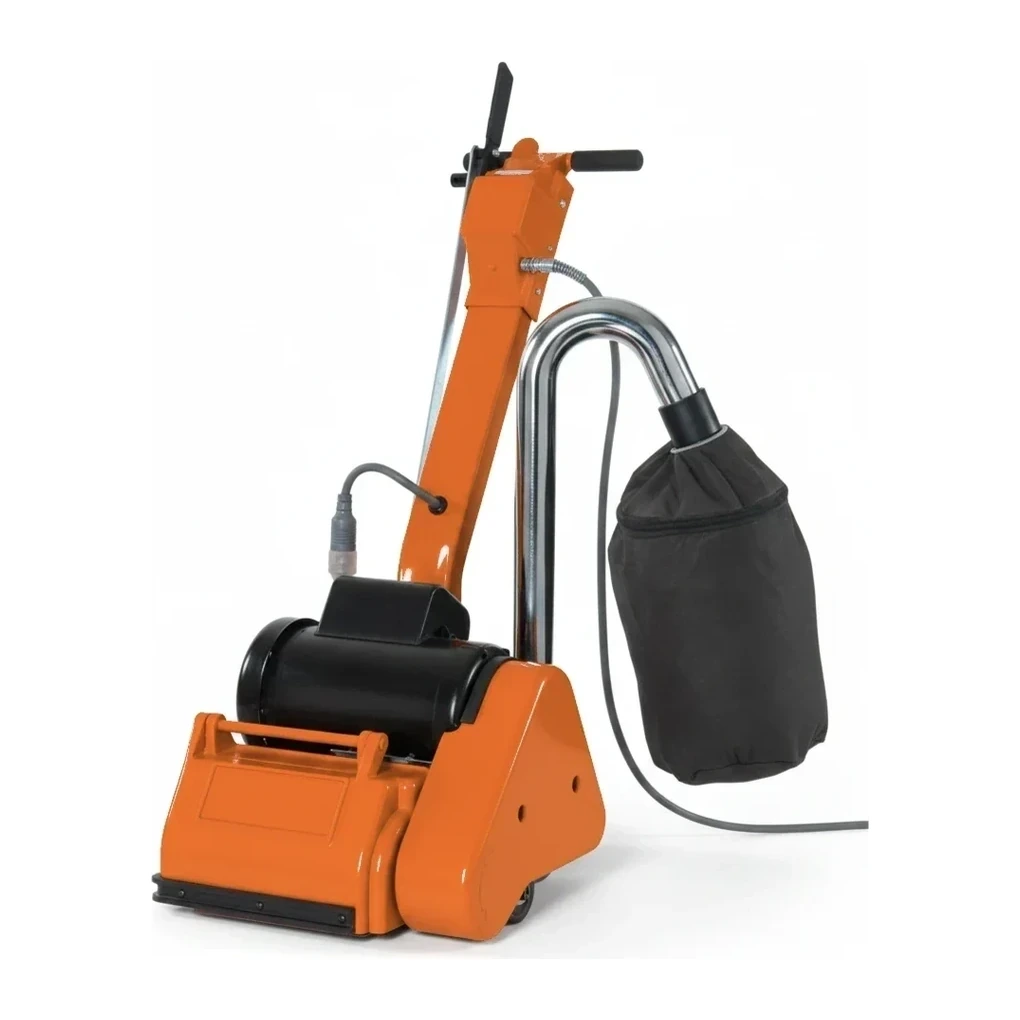
A drum floor sander is an aggressive, drum-style floor finishing machine designed to level, strip, and refinish wood floors using a rotating cylindrical drum wrapped with abrasive belts. The equipment class represents the traditional, high-removal approach to floor sanding, distinguished from orbital sanders by its directional cutting action and material removal rate. Drum floor sanders are the standard tool for initial leveling passes and heavy surface removal in hardwood floor refinishing projects.
Fonctionnement
The machine operates by rotating a horizontal drum (typically 8 inches wide) wrapped with an abrasive belt at high speed, while the operator walks the unit forward across the floor. As the drum rotates against the floor surface, the abrasive belt cuts into the wood, removing old finishes, surface imperfections, and shallow damage. Weight distribution and drum pressure are controlled by a lever mechanism that raises or lowers the drum into contact with the floor, allowing the operator to modulate cutting depth and aggression. Most units feature a dust collection bag or port, capturing the majority of sawdust generated during operation. The machine is designed for forward-only cutting passes in the direction of the wood grain, with the drum lifted during backward movement to reposition for the next pass. Sequential grits, from coarse to fine, are employed across multiple passes to achieve the desired surface smoothness before finishing.
Types et variantes
- Standard Drum Sander
- Conventional upright design with handlebar controls and integrated dust bag; the most common configuration for general floor refinishing work.
- Heavy-Duty Drum Sander
- Reinforced frame and motor designed for commercial-scale projects and continuous operation; typically higher horsepower and more robust dust collection.
- Edger-Compatible Systems
- Drum sanders paired with matching edger units for reaching perimeter areas and tight spaces where the main drum cannot access.
- Variable-Speed Drum Sander
- Models offering adjustable drum rotation speed to control aggressiveness and adapt to different wood species and conditions.
Spécifications clés
| Spécification | Plage typique | Signification |
|---|---|---|
| Drum Width | 8 in (20.3 cm) | Industry-standard drum dimension; determines coverage width per pass and distinguishes this class from wider belt sanders. |
| Motor Power | 1.5-2.5 HP | Horsepower range for most professional units; higher power supports sustained cutting in harder wood species. |
| Abrasive Belt Size | 8 in × 19-20 in | Standard belt dimensions compatible with the 8-inch drum; readily available consumable across suppliers. |
| Weight | 80–120 lb (36.3–54.4 kg) | Machine mass provides cutting pressure; heavier units offer more aggressive removal but require more effort to maneuver. |
| Dust Collection Capacity | Bag or vacuum port | Onboard dust bag or connection point for external vacuum systems to manage airborne particulate during operation. |
Comment l'industrie le dimensionne
The drum floor sander class is effectively uniform in size across the industry, with the 8-inch drum width serving as the de facto standard. Unlike other equipment classes, sizing is not a primary differentiation factor; the meaningful choice in floor sanding is between drum sanders (aggressive, directional removal) and orbital sanders (less aggressive, multi-directional finish), rather than between different widths or capacities within the drum category. Model selection focuses on motor power, build quality, and dust collection capability rather than dimensional variations.
Applications
- Initial leveling and stock removal in hardwood floor refinishing projects
- Stripping old finishes, sealers, and coatings from solid wood floors
- Removal of surface damage, cupping, and minor irregularities in wood flooring
- Preparation of reclaimed or salvaged wood floors for new finish application
- Heavy sanding passes in gymnasium, commercial, and institutional wood floor restoration
- Leveling of newly installed but unfinished hardwood flooring
Sécurité et opération
- Hearing protection required due to high noise levels during operation; drum sanders generate significant audible noise.
- Respiratory protection necessary even with dust collection, as fine wood dust becomes airborne and can be inhaled.
- Proper lifting technique and two-person handling recommended due to equipment weight, particularly when loading or transporting.
- Drum must be lifted off floor surface before starting and stopping to prevent gouging or creating depressions in the wood.
- Electrical grounding and GFCI protection important when operating in environments where sawdust and potential moisture are present.
Normes et certifications
- OSHA · 29 CFR 1926.57
- Ventilation and dust control requirements for wood sanding operations to limit worker exposure to airborne particulate.
- ANSI · B7.1
- Safety requirements for woodworking machinery, including guarding, electrical safety, and operator controls for power sanders.
- NFPA · NFPA 654
- Standard for prevention of fire and dust explosions from wood dust accumulation; relevant to dust collection and storage practices.
- EPA · Lead RRP Rule
- Lead-safe work practices required when sanding floors in pre-1978 structures where lead-based paint or finishes may be present.
Questions fréquentes
What distinguishes a drum sander from an orbital floor sander?
Why is the 8-inch drum width the industry standard?
What grit progression is typical for drum sanding hardwood floors?
Can drum sanders be used on engineered wood flooring?
Équipements connexes
Parcourir par fabricant
Sources
Chaque spécification est vérifiée par rapport aux données publiées par le fabricant, avec la source liée pour référence.
Tous les modèles
10 modèles · Chaque spécification citée à la source
