

Reciprocating Saw
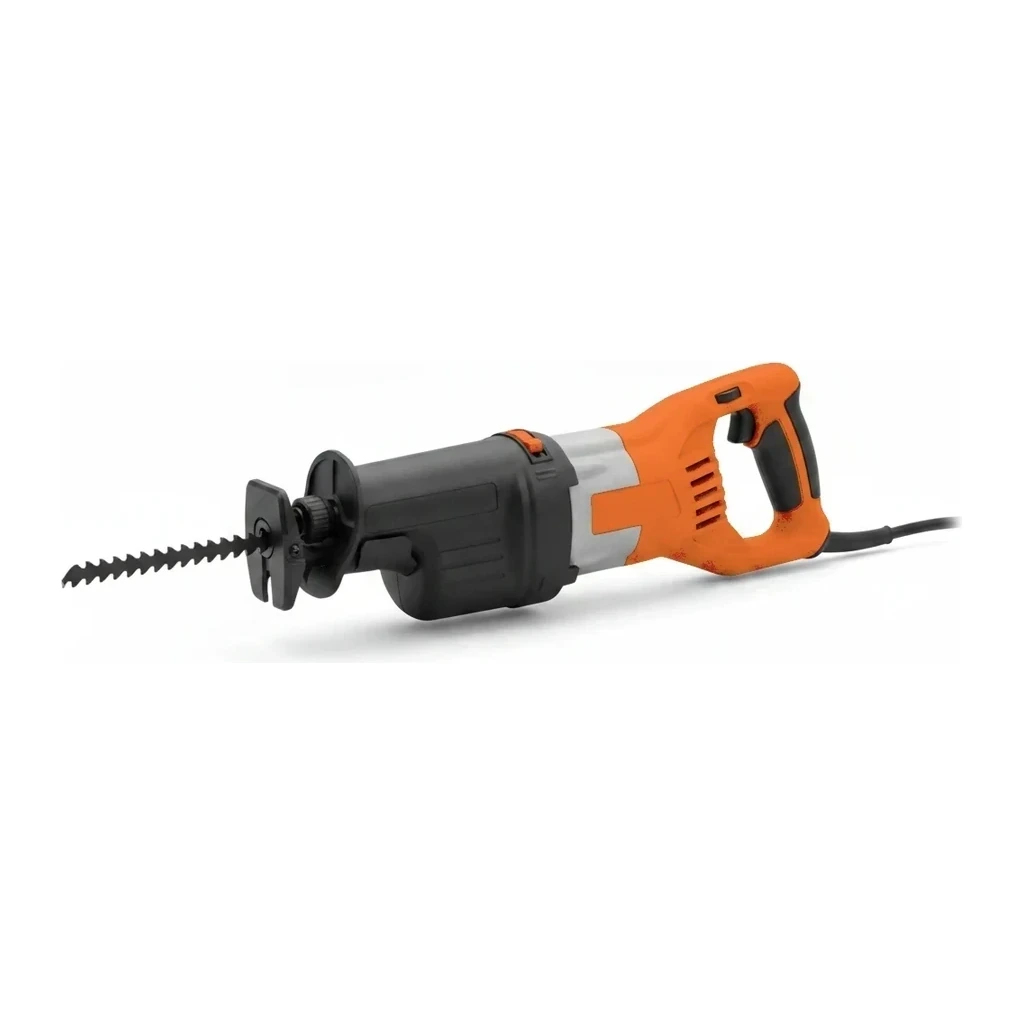
A reciprocating saw drives a straight blade in a rapid push-pull stroke to make rough cuts in nearly any building material. It is the defining demolition saw, cutting wood with nails, pipe, and metal in place.
Fonctionnement
A motor and crank mechanism strokes the blade back and forth while a pivoting shoe braces the tool against the work. The operator controls the cut entirely freehand, which trades precision for reach into walls, floors, and overhead structure. Blade swaps convert the saw between wood, embedded-nail, metal, and pruning duty.
Types et variantes
- Full-size reciprocating saws
- Corded and cordless demolition saws for continuous heavy cutting.
- Compact one-hand saws
- Short-body models for pipe, conduit, and overhead work in tight spots.
- Orbital-action saws
- Models that add an elliptical stroke for faster wood demolition.
Spécifications clés
| Spécification | Plage typique | Signification |
|---|---|---|
| Overall length | 11–19 in (27.9–48.3 cm) | Compact bodies fit between studs and joists; full-size bodies absorb heavy cutting. |
| Stroke and speed | Varies by model | Longer, faster strokes clear material quicker in demolition-grade cuts. |
| Power source | 12-18 V cordless or corded | Cordless dominates general use; corded suits sustained demolition. |
Comment l'industrie le dimensionne
Models split by body size and stroke class: compact saws for mechanical-trade cutting in confined spaces, and full-size saws for structural demolition. Some torque and drive-size figures recorded for this class belong to impact wrenches and should be ignored.
Applications
- Demolition cuts through framing, sheathing, and embedded nails
- Pipe, conduit, and duct cutting in place
- Window and door opening cut-outs in existing walls
- Pruning and rough site clearing with coarse blades
Sécurité et opération
- Keep the shoe pressed against the work; cutting on blade tip alone causes violent chatter and blade snap.
- Blind cuts into walls and floors risk hidden electrical and plumbing; verify what is behind the surface first.
- Blades run hot after metal cuts and vibration exposure is significant in long demolition sessions.
Normes et certifications
- OSHA · 29 CFR 1926.302(a)
- Electric power tool requirements, including damaged-tool removal from service.
- UL · UL 62841
- Safety standard for hand-held motor-operated electric tools.
Questions fréquentes
What blade cuts nail-embedded wood?
Why does the saw vibrate violently mid-cut?
Can it make clean, straight cuts?
Équipements connexes
Parcourir par fabricant
Sources
Chaque spécification est vérifiée par rapport aux données publiées par le fabricant, avec la source liée pour référence.
Tous les modèles
64 modèles · Page 2 sur 2 · Chaque spécification citée à la source