

Stand-On Mower
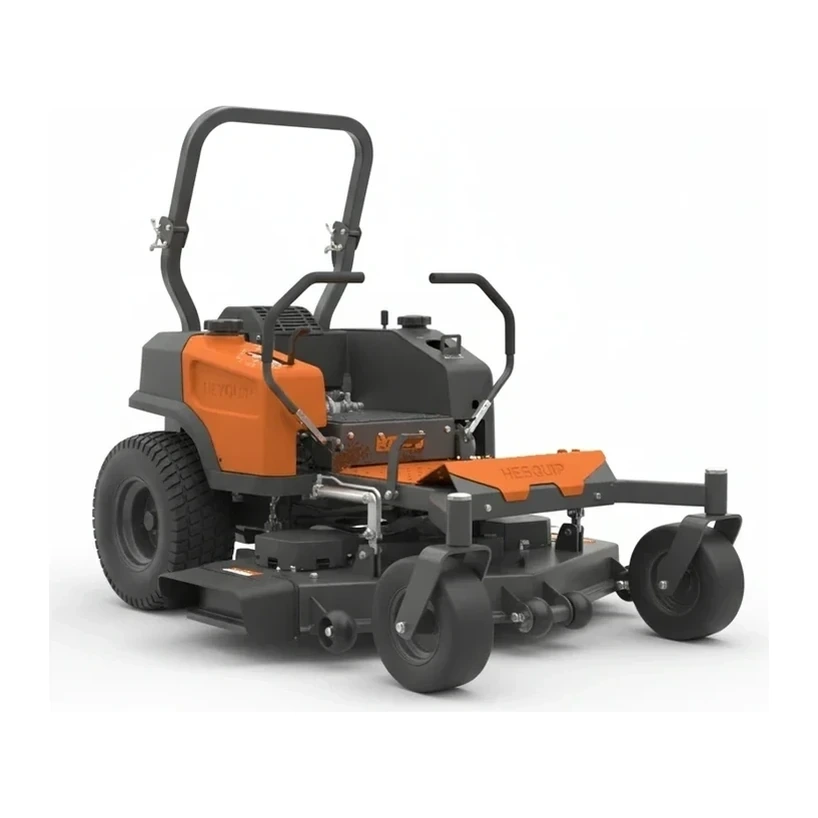
A stand-on mower is a zero-turn commercial mowing platform where the operator stands on a rear deck rather than sitting, controlling the machine via lap bars. These machines are designed for landscape maintenance routes requiring frequent mounting and dismounting, combining the maneuverability of walk-behinds with the speed of riding mowers. The standing platform lowers the center of gravity and reduces the overall footprint compared to seated zero-turn mowers.
Fonctionnement
The operator stands on a folding platform at the rear of the machine and controls direction and speed using dual lap bars connected to independent hydraulic wheel motors. Pushing both bars forward drives straight ahead; pulling back both bars reverses; and pushing one bar while pulling the other executes a zero-radius turn. The standing position allows instant weight transfer for slope stability and permits the operator to step off and back on in seconds without climbing over seats or fenders. The mower deck is mounted beneath the operator platform, typically using a spindle-driven blade system powered by a PTO from the engine. Most stand-on mowers feature a platform that folds vertically for transport and storage, reducing the machine's overall length. The standing posture reduces operator fatigue on routes with numerous stops compared to repeatedly mounting and dismounting a seated mower.
Types et variantes
- Compact Stand-On (36": 48")
- Small-footprint models designed for gated backyards, narrow gates, and tight residential properties where access is limited but speed is still needed.
- Mid-Size Stand-On (48": 60")
- The workhorse of landscape maintenance routes, balancing deck width with the ability to navigate typical residential and light commercial properties with frequent stops.
- Wide-Deck Stand-On (60"+)
- Large-property machines combining the productivity of wide cutting decks with the low center of gravity and slope stability of the standing platform design.
- Dual-Wheel Stand-On
- Models featuring paired rear drive wheels for enhanced traction on slopes and wet turf, distributing weight over a wider footprint.
- Fixed-Platform Stand-On
- Units with non-folding operator platforms, prioritizing durability and simplicity over compact transport dimensions.
Spécifications clés
| Spécification | Plage typique | Signification |
|---|---|---|
| Cutting Width | 36": 72" | Determines productivity and access capabilities; most commercial route machines range from 48" to 60". |
| Engine Power | 15-32 hp | Gasoline engines sized to deck width and hydraulic drive demands; larger decks require higher horsepower. |
| Ground Speed | 0-10 mph forward | Transport speed between properties and mowing zones; reverse speeds typically limited for safety. |
| Platform Height | 8": 12" from ground | Low platform height improves stability on slopes and reduces step-on/step-off effort during frequent stops. |
| Weight | 600–1,200 lbs (272–544 kg) | Operating weight affects hillside performance, turf compaction, and trailering; lighter than comparable seated zero-turns. |
Comment l'industrie le dimensionne
The industry sizes stand-on mowers primarily by cutting width measured in inches, ranging from compact 36-inch models for gated access to wide 72-inch decks for large properties. Machines are commonly grouped into three operational categories: compact units (under 48 inches) for tight residential access, mid-size route machines (48-60 inches) for typical landscape maintenance routes with constant mounting and dismounting, and wide stand-ons (over 60 inches) for larger properties where the standing platform's slope stability and lower center of gravity provide advantages over seated mowers. Engine horsepower scales with deck size but is secondary to cutting width in classification.
Applications
- Residential landscape maintenance routes with multiple small to mid-size properties per day
- Commercial property maintenance requiring frequent stops for trimming, edging, and obstacle navigation
- Hillside and sloped turf where lower center of gravity and weight transfer improve safety and traction
- Gated and restricted-access properties where compact footprint is needed but walk-behind productivity is insufficient
- Municipal parks and athletic fields combining open mowing areas with landscaped zones requiring maneuverability
- Cemetery and memorial grounds with headstones and markers requiring frequent direction changes and operator awareness
Sécurité et opération
- Operator presence controls immediately disengage blades and drive when the platform is unoccupied; systems must not be bypassed
- Standing posture requires constant core engagement and balance, particularly on slopes and uneven terrain where weight shift is necessary
- Folding platforms must be fully locked in the deployed position before operation; transport locks prevent accidental deployment
- Slope operation limits are typically lower than walk-behind mowers but may exceed seated zero-turns due to weight transfer capabilities and lower center of gravity
- Rollover protective structures (ROPS) are not standard on stand-on platforms; operators must dismount rather than ride out tip scenarios
Normes et certifications
- ANSI/OPEI B71.4 · B71.4-2017
- Commercial turf care equipment safety standard covering stand-on mower design, operator controls, and safety systems.
- OSHA · 1910.266 / 1926 Subpart W
- General equipment operation and powered industrial equipment standards applicable to commercial landscape operations.
- EPA · Tier 4 / CARB
- Emissions standards for small non-road spark-ignition engines under 25 horsepower used in commercial mowing equipment.
- SAE J2258 · Operator Controls
- Standardized control patterns and locations for operator presence, blade engagement, and motion control systems on commercial mowers.
Questions fréquentes
How does cutting width affect operational efficiency on landscape routes?
What are the slope operation differences between stand-on and seated zero-turn mowers?
Why are stand-on mowers preferred for high-stop-count routes?
What maintenance intervals apply to stand-on mower hydraulic systems?
Équipements connexes
Parcourir par fabricant
Tous les modèles
2 modèles · Chaque spécification citée à la source