

All-Terrain Crane
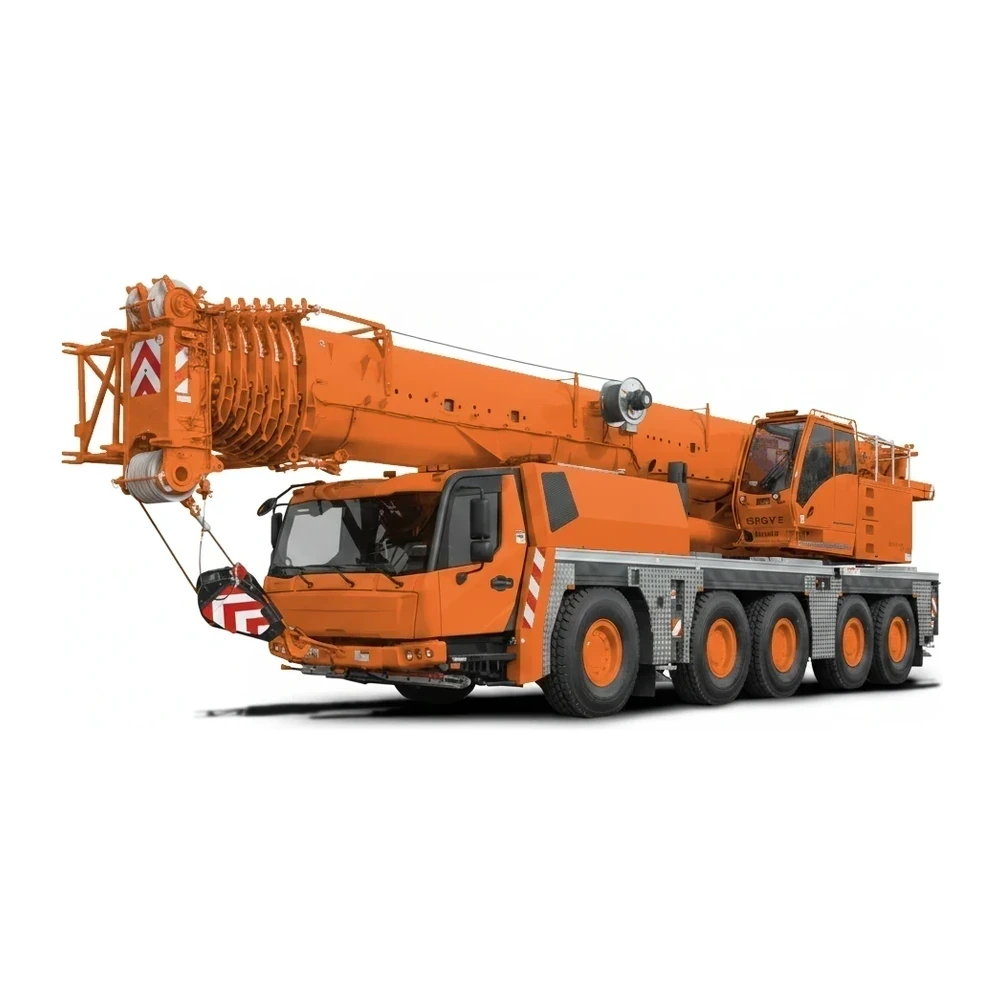
An all-terrain crane is a mobile crane built on a purpose-designed carrier that combines highway travel speed with off-road maneuverability. Multiple steering axles and all-wheel drive let it reach unprepared sites, while a long telescopic boom covers lifts that would otherwise call for a lattice crawler crane. Listed models in this class come from Liebherr.
How it works
An all-terrain crane pairs a multi-axle carrier with a rotating superstructure that holds the operator cab, winches, counterweight and a telescopic boom. The carrier drives to site on public roads, then hydraulic outriggers lift the machine off its tires and level it before any pick. Boom sections telescope out under hydraulic power, and jib extensions can be pinned on for extra height or reach. Capacity is governed by a load chart: the further the load is from the center of rotation, the less the crane can lift. On-board rated-capacity limiters monitor boom angle, extension and load, and warn the operator before the configuration is exceeded.
Types & variants
- Compact all-terrain cranes
- Short-wheelbase carriers built for congested urban sites, fast setup and single-operator travel.
- Mid-range all-terrain cranes
- General construction machines balancing capacity, boom length and roading weight for everyday structural lifts.
- Heavy-lift all-terrain cranes
- Multi-axle machines with large counterweight packages for plant, energy and infrastructure work.
- Jib-equipped configurations
- Fixed or luffing jibs added to the main boom for tall, long-radius or up-and-over lifts.
Key specifications
| Specification | Typical range | What it means |
|---|---|---|
| Maximum lifting capacity | Documented per model listing | The heaviest pick at minimum radius; it anchors the crane's size class and load chart. |
| Main boom length | Documented per model listing | Sets hook height and working radius before any jib is rigged. |
| Axle count and carrier weight | Documented per model listing | Drives road permits, travel routing and ground bearing pressure on site. |
| Counterweight package | Documented per model listing | Ballast carried to balance the load; affects both the load chart and transport planning. |
How the industry sizes it
The industry sizes all-terrain cranes by maximum rated capacity in tons at minimum radius, supported by axle count and main boom length. A machine is selected from its load chart working backwards from the heaviest planned lift and the radius at which it must be made, then checked against site access and ground bearing limits.
Applications
- Structural steel erection on commercial and industrial builds
- Bridge girder and infrastructure component placement
- Plant, refinery and utility maintenance lifts
- Wind, energy and telecom component installation
- Tower crane assembly and dismantling
- Rooftop mechanical and HVAC unit placement
Safety & operation
- OSHA 1926.1400 (Subpart CC) governs crane work in construction: rigging must be inspected by a qualified rigger and a signal person used whenever the operator's view of the load path is obstructed.
- Minimum clearance distances from energized power lines must be maintained per OSHA 1926.1407-1411, with a dedicated spotter when working near them.
- Outriggers must be fully deployed on pads or mats rated for the ground conditions before lifting; ground bearing capacity is verified in the lift plan.
- The operator works from the load chart for the exact configuration, boom length, counterweight, outrigger spread, and never relies on the limiter alone.
Standards & certifications
- OSHA · 29 CFR 1926.1427
- Operator certification requirement for cranes used in construction.
- OSHA · 29 CFR 1926.1400 (Subpart CC)
- Cranes and derricks in construction: assembly, signals, inspections, power-line clearances.
- ASME · B30.5
- Safety standard for mobile and locomotive cranes: construction, inspection, operation.
Frequently asked
How does an all-terrain crane differ from a rough terrain crane?
Can an all-terrain crane drive to the site on its own?
What certification does the operator need?
Related equipment
Browse by manufacturer
All models
12 models · Every spec cited to source