

Articulated Dump Truck
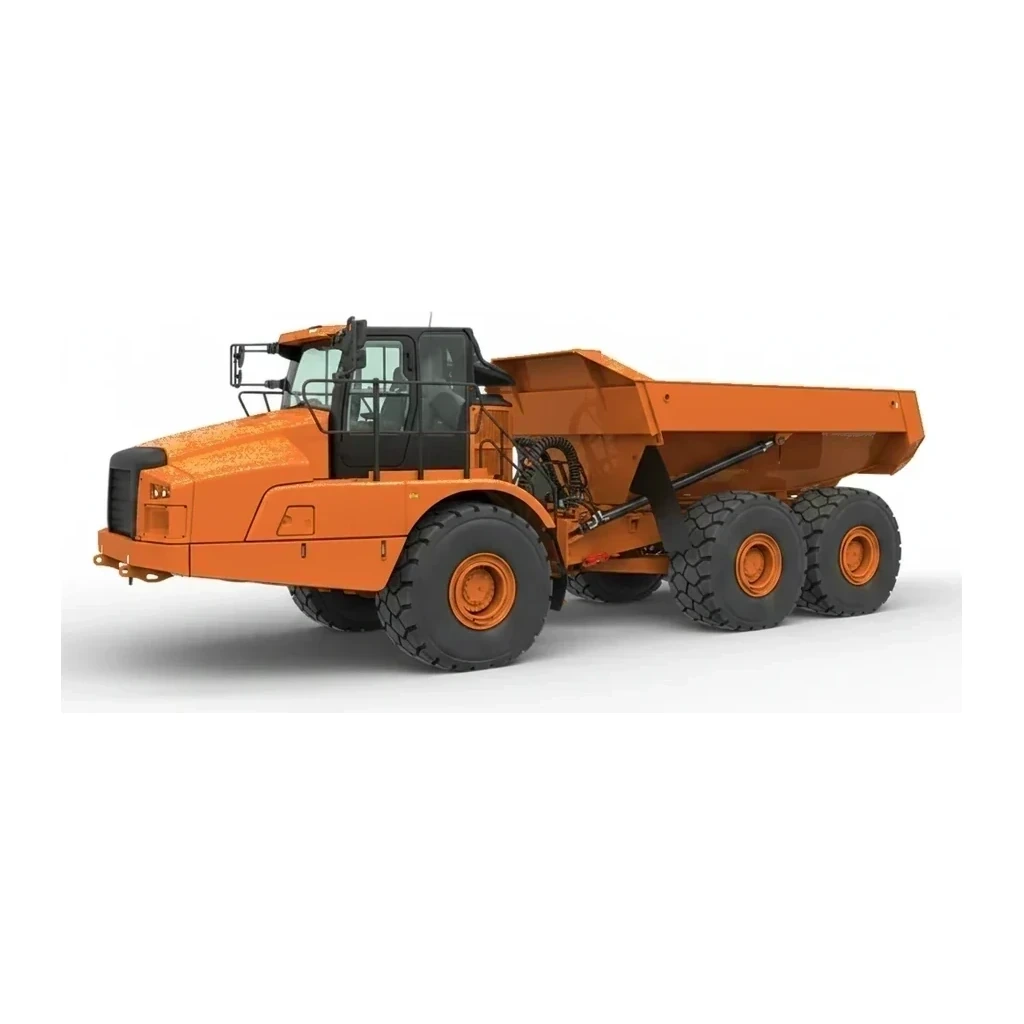
An articulated dump truck (ADT) is an off-road hauler whose cab and dump body are separate frames joined by an oscillating articulation hinge, with all-wheel drive across three axles. The geometry keeps six wheels loaded on rough, soft ground where rigid trucks lose traction, making the ADT the standard earthmoving hauler for unimproved sites.
How it works
The tractor unit carries the engine and cab; the trailer unit carries the dump body; between them, the articulation joint steers the truck by folding the frames with hydraulic cylinders while an oscillation ring lets the two frames roll independently. That combination keeps all wheels grounded through ruts, crossfalls and soft spots that would lift a rigid truck's wheels off the haul surface. A torque-converter powershift transmission drives all axles, with differential locks for the worst ground. At the dump, hoist cylinders raise the body; because the tractor steers by articulation, the truck can position accurately at fills, hoppers and paver feeds despite its length. Payload monitoring and traction control are standard on current models.
Types & variants
- Standard rear-dump ADTs
- The class default: a heaped body tipping rearward for fills, stockpiles and crusher feeds.
- Ejector-body variants
- A pushing blade discharges the load without raising the body, for dumping under structures, powerlines or on unstable ground.
- Specialty-body chassis
- ADT tractors carrying water tanks, hooklifts or other bodies where off-road mobility is needed.
Key specifications
| Specification | Typical range | What it means |
|---|---|---|
| Payload class | Model-specific in current catalog data | ADTs are conventionally sized by rated payload; current catalog records for this class do not include banded payload figures. |
| Drive configuration | 6x6 across the class | Three driven axles with articulation-oscillation coupling: the feature that defines the type's soft-ground capability. |
| Body capacity | Model-specific in current catalog data | Heaped volume must be matched to the loading tool so trucks fill in a few passes without spill. |
How the industry sizes it
ADTs are sized by rated payload in tons, with body volume and engine power scaling together; fleets pair truck size to the excavator or loader so each truck fills in three to six passes and the haul cycle stays balanced. The catalog currently lists models from JCB, Caterpillar, Hyundai and Doosan without banded size data; selection in practice starts from required production (tons per hour) and haul-road conditions.
Applications
- Mass-excavation hauling on sites without built haul roads
- Cut-to-fill earthmoving in wet or soft conditions
- Feeding crushers and stockpiles in quarry stripping
- Infrastructure projects, dams, highways, wind farms, with long unimproved hauls
- Winter and rain-season hauling where rigid trucks are traction-limited
Safety & operation
- Never travel with the body raised; body-up contact with powerlines and structures is a leading ADT incident.
- Respect dump-edge protocol: spot at berms, dump short on unstable fill edges and let a dozer push out.
- Lock the articulation hinge before service or transport: the hinge zone is a crush hazard exactly like a wheel loader's.
- Manage haul-road grades and speed; a loaded ADT's stopping distance grows sharply downhill even with retardation.
- Seat belts under ROPS at all times, including during dumping: tip-overs at the dump are the characteristic rollover.
Standards & certifications
- ISO · ISO 3471
- Roll-over protective structure requirements for the operator station.
- OSHA · 29 CFR 1926.601/.602
- Motor vehicle and material handling equipment rules for construction haulage.
- EPA · Tier 4 Final (40 CFR Part 1039)
- Nonroad diesel emissions certification for current engines.
Frequently asked
Articulated or rigid dump truck: when does each apply?
Why does the articulation joint matter?
How are ADTs matched to loading equipment?
What is an ejector body for?
Compare popular models
Find by spec →Normalised to the same units. A dash means the figure was not published.
| Model | Operating weight | Max dig depth | Max reach | Engine power |
|---|---|---|---|---|
| John Deere 260P ADT | 8,250 lb (3,742 kg) | - | - | - |
| Bell B18E ADT | - | - | - | 219 hp |
| Bell B25E ADT | - | - | - | 275 hp |
| Bell B30E ADT | - | - | - | 322 hp |
| Bell B40E ADT | - | - | - | 510 hp |
| Bell B45E ADT | - | - | - | 523 hp |
Related equipment
Browse by manufacturer
Sources
Every specification is verified against the manufacturer's published data, with the source linked for reference.
All models
24 models · Every spec cited to source