

Tractor Three-Point Attachment
A tractor three-point attachment is an implement designed to connect to the standardized three-point hitch system on the rear of agricultural and utility tractors for earthmoving, grading, and vegetation management tasks. These attachments leverage the tractor's hydraulic system and power take-off (PTO) to perform functions ranging from soil leveling to brush cutting. The three-point hitch configuration provides precise control over implement depth and angle during operation.
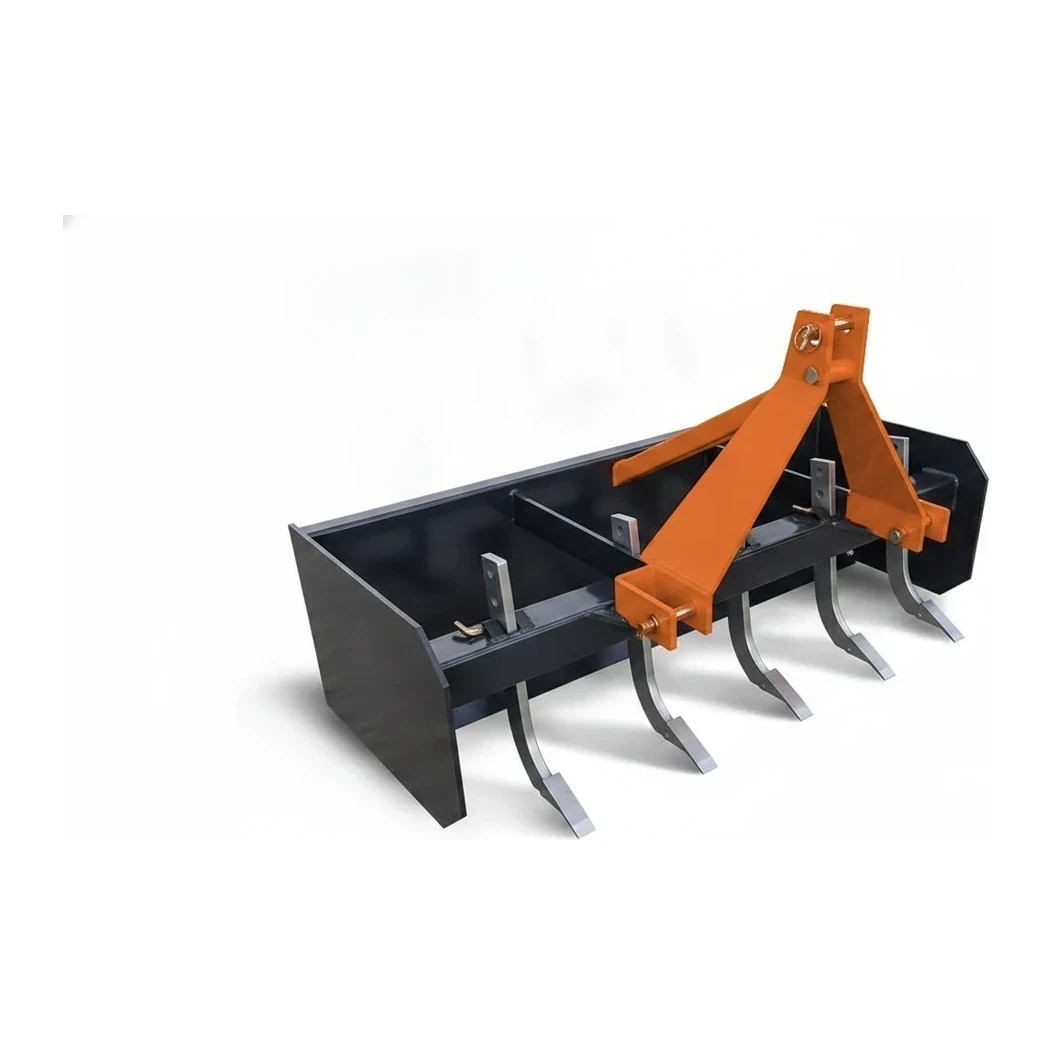
How it works
The attachment connects to the tractor via two lower lift arms and one upper stabilizing link, forming a triangular mounting structure that transfers hydraulic lifting force from the tractor to the implement. Hydraulic cylinders raise and lower the attachment, while the upper link controls pitch angle. Many attachments utilize the tractor's PTO shaft to drive rotating components such as blades or augers, transmitting rotational power from the tractor's engine to the implement. Operators position the attachment by backing the tractor to align hitch points, then secure the lower pins and upper link before connecting hydraulic and PTO systems as applicable. Hydraulic controls adjust working depth and angle during operation, allowing real-time modification of cutting or grading performance based on terrain and material conditions.
Types & variants
- Box Blade
- Grading attachment with front and rear scarifying teeth and an adjustable blade for leveling, backfilling, and finish grading of soil and aggregate materials
- Rotary Cutter (Bush Hog)
- PTO-driven mowing implement with heavy-duty rotating blades for cutting tall grass, brush, and light vegetation in agricultural and land clearing applications
- Land Plane
- Wide scraper blade used for precision leveling and soil redistribution in agricultural fields, arenas, and finish grading operations
- Rear Blade
- Angled grading blade for ditching, backfilling, and snow removal with adjustable offset and tilt positioning
- Subsoiler
- Deep tillage implement with heavy shanks designed to break up compacted soil layers and improve drainage without inverting topsoil
- Post Hole Digger
- PTO-driven auger attachment for drilling vertical holes in soil for fence posts, signage, and foundation supports
Key specifications
| Specification | Typical range | What it means |
|---|---|---|
| Operating Weight | 5,291–46,297 lb (2,400–21,000 kg) | Total mass of the attachment, affecting tractor ballast requirements and lifting capacity demands on the three-point hitch system |
| Tractor Horsepower Requirement | 60 HP and above | Minimum tractor power needed to operate the attachment effectively, determined by implement weight, PTO demand, and working resistance |
| Hitch Category | Category I, II, or III | Standardized three-point hitch size classification defining pin diameter and spacing for compatibility with tractor lift systems |
| PTO Speed | 540 or 1000 RPM | Required rotational speed of the power take-off shaft for driven implements, standardized across the agricultural industry |
How the industry sizes it
The industry sizes tractor three-point attachments primarily by the horsepower requirement of the host tractor rather than by distinct size bands of the attachment itself. Models are matched to tractors rated at 60 HP and above, with specific compatibility determined by hitch category (I, II, or III), hydraulic lift capacity, and PTO availability. Because each attachment type performs a specialized function regardless of its physical size, the critical sizing factor is ensuring the tractor has adequate power, hydraulic capacity, and ballast to operate the implement safely and effectively across varying soil and vegetation conditions.
Applications
- Agricultural field leveling and finish grading for drainage and irrigation management
- Vegetation management including pasture mowing and brush clearing on rural properties
- Driveway and road maintenance including grading, ditching, and snow removal
- Land preparation for construction sites requiring initial soil leveling and debris removal
- Arena and sports field maintenance for surface leveling and grooming
- Post installation and fencing operations in agricultural and boundary demarcation projects
Safety & operation
- Operators must verify tractor ballast and wheel weights are adequate for attachment weight to prevent rear instability and loss of steering control
- PTO shields and guards must remain in place during operation to prevent entanglement with rotating drivelines and implement components
- Attachments should be lowered to ground level during transport and when parked to prevent tip-over hazards and hydraulic system failure
- Bystanders must remain clear of the operating area due to risk of thrown debris from rotary cutters and tillage implements
- Hydraulic connections require inspection for secure coupling and leak-free operation before applying system pressure to prevent fluid injection injuries
Standards & certifications
- ASABE · S217.15
- Defines standardized dimensions and specifications for three-point hitch categories I, II, III, and IV to ensure implement compatibility
- OSHA · 1928.57
- Establishes requirements for power take-off guarding on agricultural equipment to prevent entanglement and contact injuries
- SAE · J909
- Specifies PTO shaft dimensions, rotational speeds, and torque ratings for agricultural power transmission systems
- ANSI · B71.4
- Provides safety standards for commercial turf care equipment including rotary cutters and mowing attachments
Frequently asked
What determines compatibility between a tractor and a three-point attachment?
What is the difference between Category I, II, and III hitches?
How does PTO speed affect attachment operation?
Why do heavier attachments require additional tractor ballast?
Compare popular models
Find by spec →Normalised to the same units. A dash means the figure was not published.
| Model | Operating weight | Max dig depth | Max reach | Engine power |
|---|---|---|---|---|
| Vermeer CT718 Compost Turner | 52,999 lb (24,040 kg) | - | - | 540 hp |
| Vermeer CT612 Compost Turner | 8,779 lb (3,982 kg) | - | - | - |
Related equipment
Browse by manufacturer
Sources
Every specification is verified against the manufacturer's published data, with the source linked for reference.
All models
10 models · Every spec cited to source