

Rotary Hammer
A rotary hammer is a percussive drill that combines rotation with a piston-driven hammering action to bore concrete, block, and stone. It is the standard tool for anchor holes and through-penetrations in masonry.
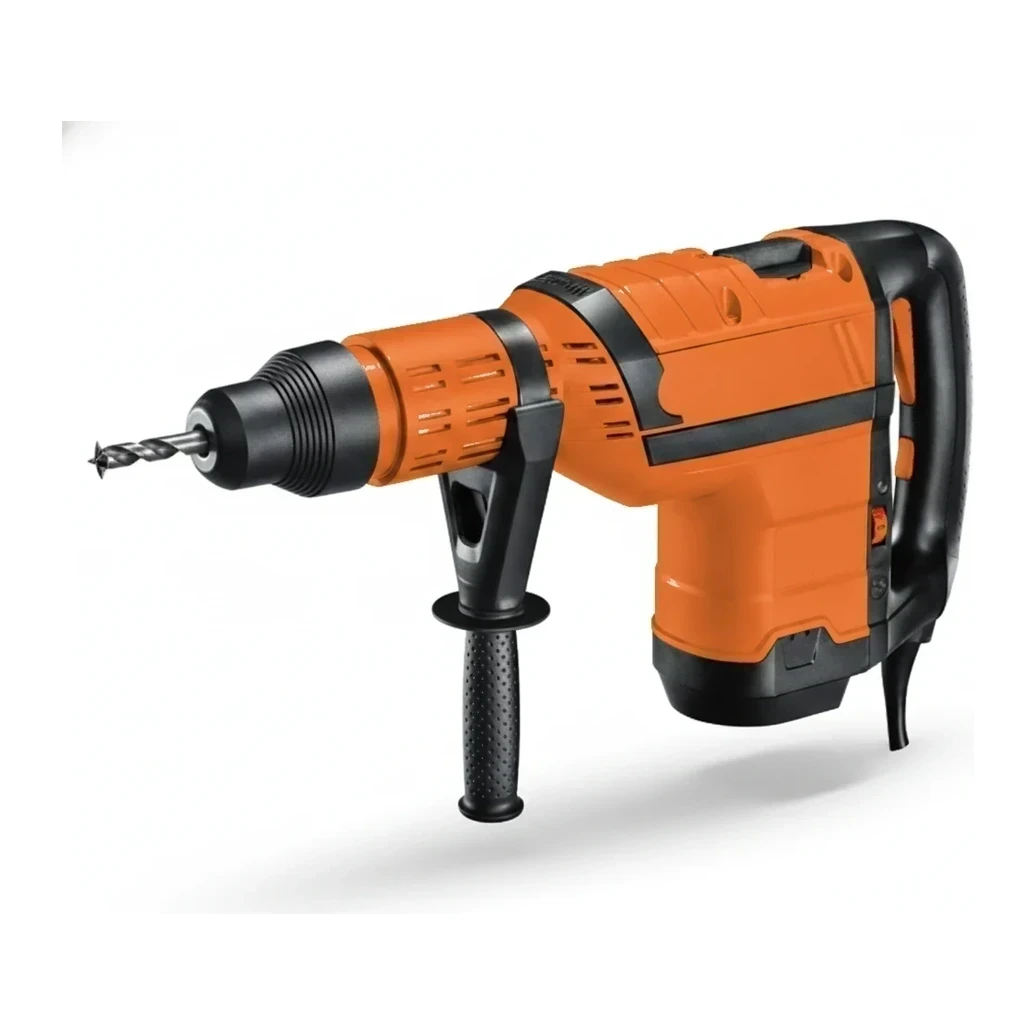
How it works
An electro-pneumatic piston compresses an air cushion that slams a striker against the bit many times per second while the SDS shank lets the bit slide axially under each blow. The carbide tip fractures the concrete and the flutes rotate the dust out of the hole. Most models offer drill-only, hammer-drill, and chisel-only modes, so the same tool also handles light chipping.
Types & variants
- SDS-Plus rotary hammers
- Compact models for anchor holes up to about 1 in diameter.
- SDS-Max rotary hammers
- Larger machines driving bits in the 1-2 in range and heavier chisels.
- Cordless rotary hammers
- Battery versions of both shank systems for work away from power.
- Combination hammers
- Units with a dedicated chipping mode for scaling, chasing, and small demolition.
Key specifications
| Specification | Typical range | What it means |
|---|---|---|
| Operating weight | 4.0–38.4 lb (1.8–17.4 kg) | Weight tracks impact energy; heavy machines drill large holes fast but fatigue the operator. |
| Solid-bit capacity | 1.125-1.875 in carbide | The largest solid carbide bit the tool drives efficiently in concrete. |
| Core-bit capacity | up to 6 in | Thin-wall core bits extend the machine to large penetrations for pipe and duct. |
| Power supply | 120 V, 15 A | Corded models draw a full standard circuit under load. |
How the industry sizes it
The class is banded by bit diameter. Machines in the 0-1 in band cover anchors, dowels, and conduit fastening with one-hand control; 1-2 in machines take over for large anchors, through-holes, and core work, at two or three times the weight.
Applications
- Drilling anchor and dowel holes in slabs, walls, and footings
- Through-penetrations for conduit, pipe, and duct in concrete and block
- Setting adhesive and mechanical anchors for railings and equipment
- Light chipping, tile removal, and chasing in chisel mode
Safety & operation
- Concrete drilling generates respirable silica; dust-extraction shrouds or wet methods are required under OSHA Table 1.
- Percussive tools transmit hand-arm vibration; low-vibration models and work rotation limit HAVS exposure.
- A jammed bit spins the tool body hard; the side handle must be fitted and the clutch function verified.
Standards & certifications
- OSHA · 29 CFR 1926.1153
- Table 1 specifies dust controls for hammer drilling in concrete.
- OSHA · 29 CFR 1926.302(a)
- Electric tool safety requirements for corded models.
Frequently asked
Rotary hammer or hammer drill?
What is the difference between SDS-Plus and SDS-Max?
Can a rotary hammer drill wood or steel?
Related equipment
Browse by manufacturer
Sources
Every specification is verified against the manufacturer's published data, with the source linked for reference.
All models
282 models · Page 6 of 6 · Every spec cited to source