Drywall Screwgun
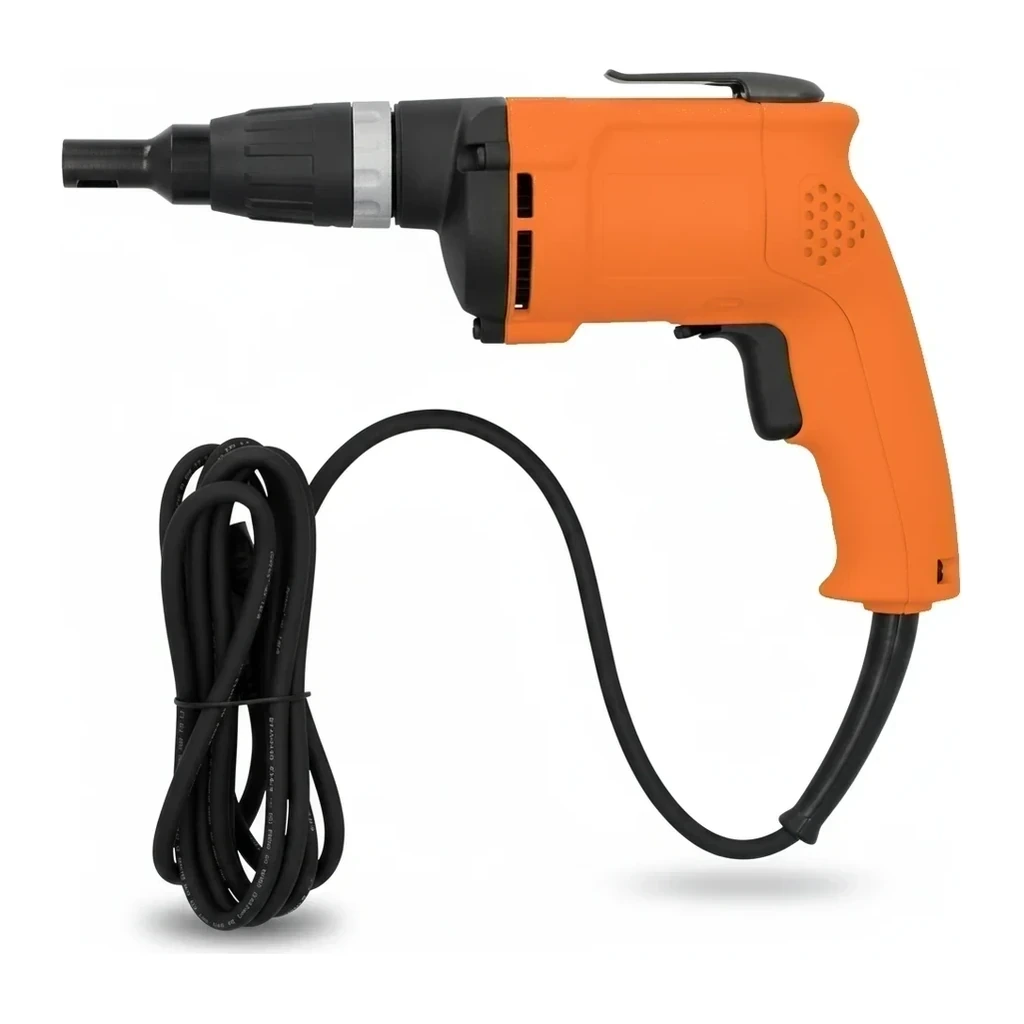
A drywall screwgun is a specialized fastening tool designed to drive screws into gypsum board (drywall) at a controlled, consistent depth without tearing the paper facing. Unlike standard drills, these tools feature adjustable depth-setting nosepieces and clutch mechanisms that automatically disengage when the screw reaches the preset depth. They are essential for high-volume drywall installation where speed and finish quality are critical.
How it works
The tool uses an adjustable nosepiece (depth locator) that contacts the drywall surface and sets the maximum screw penetration depth. When the screw head reaches the preset depth, typically flush with or slightly recessed below the surface, a clutch mechanism automatically stops the driving action, preventing over-driving that would tear the paper or under-driving that would leave proud fasteners. The motor typically operates at higher RPMs than standard drills to enable rapid fastening. Single-feed models require manual loading of individual screws into the bit holder, while collated (auto-feed) versions use screw strips or magazines that advance screws automatically to the bit. The operator positions the tool against the work surface and pulls the trigger; the tool drives the screw and stops at the correct depth, allowing rapid repositioning for the next fastener.
Types & variants
- Single-Feed Screwgun
- Standard configuration requiring manual screw placement for each fastener; lighter weight and simpler mechanism suited for general drywall installation and repair work.
- Collated/Auto-Feed Screwgun
- Features magazine attachment that automatically feeds screws from a collated strip to the bit; maximizes speed for large-scale drywall hanging operations.
- Cordless Drywall Screwgun
- Battery-powered models offering portability without air hoses or power cords; increasingly common on residential job sites and remodel work.
- Corded Electric Screwgun
- AC-powered tools providing consistent torque and unlimited runtime; standard for commercial drywall installation with ready access to power.
- Deck/Subfloor Screwgun
- Heavy-duty variant adapted for driving longer screws into wood substrates; typically features more aggressive clutch settings and reinforced drive mechanisms.
Key specifications
| Specification | Typical range | What it means |
|---|---|---|
| Motor Speed | 2,500-4,000 RPM | Higher speeds enable rapid screw driving; most models operate at fixed high RPM optimized for drywall screws. |
| Screw Capacity | #6 to #8, 1-3 in. | Standard drywall screws; depth adjustment typically accommodates single-layer and double-layer gypsum board applications. |
| Motor Type | Corded 5-7 A or 18-20V cordless | Corded models draw moderate amperage; cordless versions use standard tool battery platforms for interchangeability. |
| Weight | 2.5–5 lbs (1.1–2.3 kg) | Lighter than standard drills to reduce operator fatigue during repetitive overhead and vertical fastening. |
| Clutch Type | Adjustable depth-sensing | Mechanical or electronic clutch disengages drive when preset depth is reached, preventing paper damage. |
How the industry sizes it
The drywall screwgun class is not sized into distinct bands because all models perform the same core function: setting screws to a consistent, adjustable depth in gypsum board. The industry treats collated versus single-feed capability as a magazine/attachment option rather than a separate size or class. Selection is typically based on power source (corded vs. cordless), weight, and whether auto-feed capability is needed for production volume, but these are feature variations rather than size classifications.
Applications
- Hanging gypsum wallboard in residential and commercial construction
- Installing ceiling drywall panels, including single-layer and multi-layer fire-rated assemblies
- Fastening cement board and other sheathing materials in wet areas
- Installing wood or composite decking when equipped with appropriate depth settings
- Securing subflooring and underlayment panels with modified clutch settings
- Repair and remodel work requiring precision fastener depth control
Safety & operation
- Disconnect power or remove battery before adjusting depth settings or clearing jammed screws to prevent accidental activation
- Use appropriate eye protection to guard against debris and metal particles from screw heads
- Maintain firm grip and stable footing when working overhead or on scaffolding to control tool weight and torque reaction
- Inspect depth adjustment mechanism regularly to ensure consistent screw setting and prevent surface damage
- Be aware of hidden electrical wiring and plumbing behind installation surfaces before driving fasteners
Standards & certifications
- UL · UL 45
- Safety standard for portable electric tools covering construction, electrical insulation, and operator protection for corded screwguns.
- OSHA · 29 CFR 1926 Subpart I
- Covers general hand and power tool safety requirements on construction sites, including guarding and proper use.
- ANSI · ANSI/ISEA 121
- Standard for hand protection; relevant for selecting gloves that maintain dexterity during repetitive screw driving operations.
- CSA · CSA C22.2 No. 62841
- Canadian safety standard for electric motor-operated hand-held tools; harmonized with international IEC requirements.
Frequently asked
What distinguishes a drywall screwgun from a standard drill/driver?
When does collated auto-feed capability justify the added tool cost?
Can drywall screwguns be used for applications other than gypsum board?
How is proper screw depth determined for different drywall applications?
Related equipment
Browse by manufacturer
Sources
Every specification is verified against the manufacturer's published data, with the source linked for reference.
All models
52 models · Page 2 of 2 · Every spec cited to source