
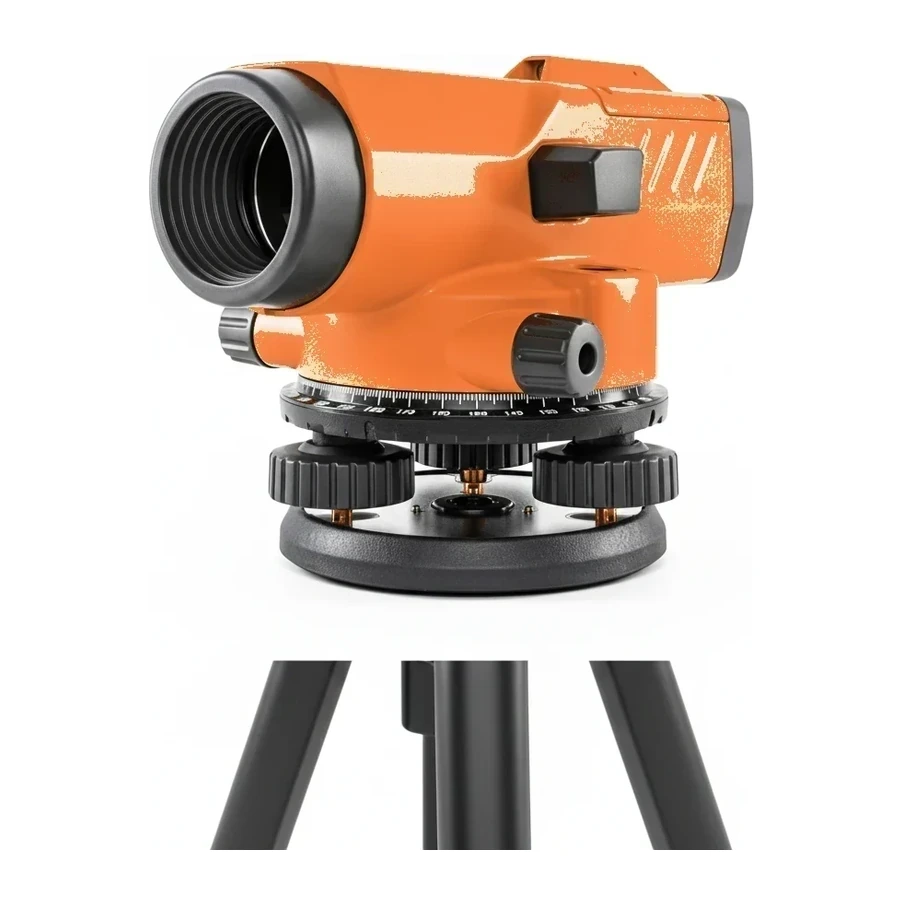
Optical Automatic Level
An optical automatic level is a surveying instrument that establishes a horizontal line of sight for measuring relative elevations and heights across a work area. The device uses an internal compensator mechanism to automatically maintain a level sight line once roughly leveled, eliminating the need for manual fine adjustments. Widely used in construction and site work, it enables accurate elevation readings when paired with a graduated leveling rod.
How it works
The instrument mounts on a tripod and contains a telescope with crosshairs and an internal pendulum-based compensator. Once the operator levels the base using circular bubble vials and adjustable leveling screws, the compensator automatically maintains a true horizontal line of sight even with minor instrument movement or tripod settling. The operator sights through the telescope to read graduations on a leveling rod held at various points across the site. The telescope magnifies the view of the rod, allowing precise reading of elevation measurements. Horizontal angles can be read from a graduated circle at the base on some models. The difference between rod readings at different locations determines relative elevations, allowing contractors to establish grade, set forms, and verify level surfaces across the work area.
Types & variants
- Standard Automatic Level
- General-purpose instrument with typical 20x-32x magnification for most construction layout and grading work
- Tilting Level
- Manual fine-leveling screw allows precise adjustment of the sight line; less common than fully automatic compensator models
- Digital Display Level
- Optical level with electronic readout showing measurements from bar-coded leveling rods for faster data recording
- Transit-Level Combination
- Instrument offering both level and transit functions, allowing vertical angle measurement in addition to leveling
Key specifications
| Specification | Typical range | What it means |
|---|---|---|
| Magnification | 20x-32x | Telescope power determining readable rod distance and precision; higher magnification allows longer sight distances |
| Accuracy | ±1/16" at 100 ft | Typical leveling precision for construction-grade instruments over standard working distances |
| Minimum Focus Distance | 3–5 ft (0.9–1.5 m) | Closest distance at which the telescope can clearly read a leveling rod |
| Compensator Range | ±15 arc minutes | Amount of tilt the automatic compensator can correct once base is roughly leveled |
| Working Range | 200–300 ft (61.0–91.4 m) | Practical maximum sight distance for clear rod readings under typical site conditions |
How the industry sizes it
The optical automatic level class is not sized into bands because all instruments perform the same fundamental task: reading elevations from a graduated rod. While magnification varies slightly among models, these differences do not meaningfully change the work performed or require distinct equipment selection criteria. The industry treats these as a single functional class, with specific model selection based on availability and accuracy requirements rather than size designation.
Applications
- Establishing grade elevations for excavation and site grading operations
- Setting concrete forms and screeds to specified elevations
- Checking flatness and level of slabs, floors, and paving surfaces
- Transferring benchmark elevations across construction sites
- Verifying drainage slopes and confirming proper fall in utility trenches
- Foundation and footing elevation layout and verification
Safety & operation
- Secure tripod legs firmly on stable ground to prevent instrument tipping or movement during use
- Maintain awareness of surroundings when positioning equipment in active work zones with vehicle or equipment traffic
- Transport instrument in protective case to prevent optical misalignment from impact or vibration
- Avoid direct viewing of the sun through the telescope, which can cause eye injury
- Verify compensator function daily using test procedures to ensure accuracy before commencing measurements
Standards & certifications
- ASTM E2435 · Standard Practice for Periodic Inspection of Levels
- Establishes procedures for verifying accuracy and compensator function of surveying levels
- ISO 17123-2 · Optics and Optical Instruments: Field Procedures for Testing Geodetic and Surveying Instruments
- International standard for field testing and calibration verification of leveling instruments
- OSHA 1926 Subpart P · Excavation Standards
- Requires accurate measurement and documentation of excavation depths and slopes where levels are commonly employed
Frequently asked
What distinguishes an automatic level from a manual dumpy level?
How does an optical level differ from a laser level?
What maintenance affects optical level accuracy?
Why do some models include horizontal circles?
Related equipment
Browse by manufacturer
Sources
Every specification is verified against the manufacturer's published data, with the source linked for reference.
All models
7 models · Every spec cited to source