

Fish Tape
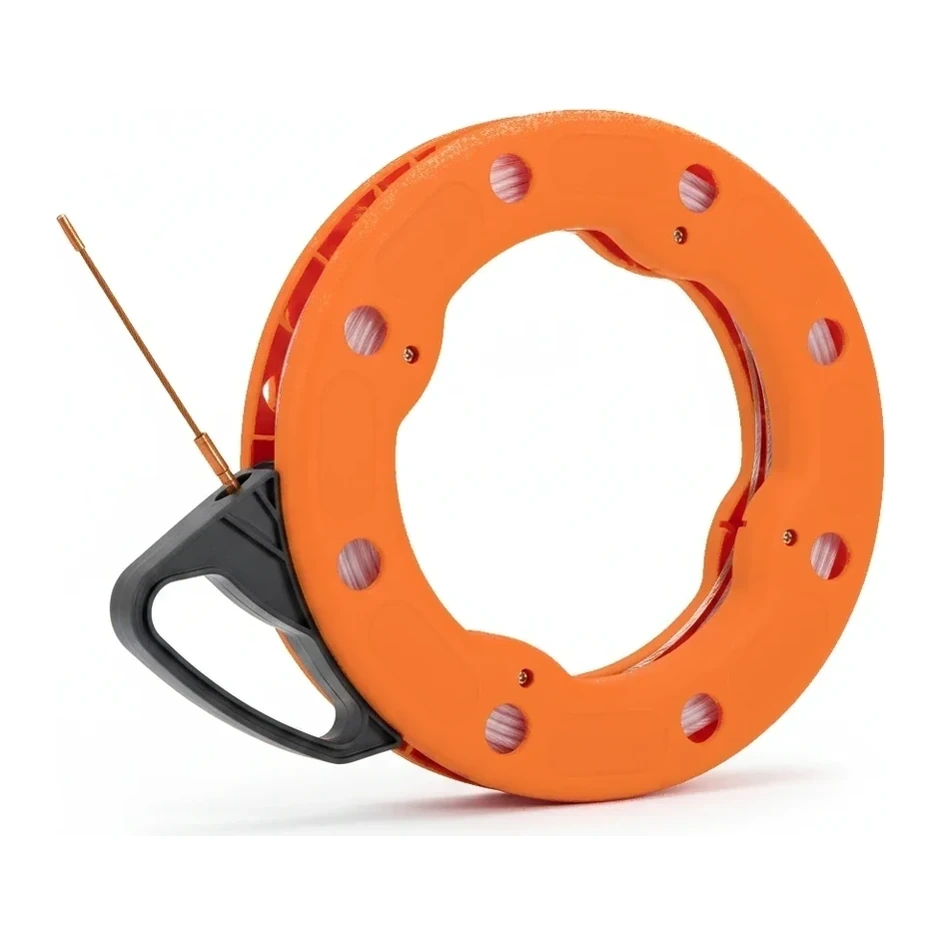
A fish tape is a stiff but flexible ribbon wound in a reel, used to route pull lines and cable through conduit, walls and other enclosed paths. Fed through the run and attached to the conductors, it pulls wire back along the same path. The catalog lists 20 models from Klein Tools and KNIPEX.
How it works
The tape pays out from its reel and is pushed through the raceway or cavity, its stiffness letting it track through bends without buckling. At the far end, wire or a pull rope is secured to the tape tip, and winding the reel draws everything back through the run. Material sets the behavior: steel tapes push hardest and last longest, while fiberglass and nylon tapes stay non-conductive for work around energized equipment and resist taking a set.
Types & variants
- Steel fish tapes
- The stiffest and most durable option, preferred for long conduit runs: but conductive.
- Fiberglass fish tapes
- Non-conductive tapes for work near potentially energized parts, with good pushability.
- Nylon and polymer tapes
- Flexible non-conductive tapes that snake through crowded cavities and tight bends.
Key specifications
| Specification | Typical range | What it means |
|---|---|---|
| Tape material | Varies by model | Steel for stiffness and durability; fiberglass or nylon where non-conductivity matters. |
| Case or reel style | Varies by model | Reel design controls payout speed, rewind effort and how well the tape stores without kinks. |
| Tip type | Varies by model | Eyelets, hooks and swivel leaders determine how securely wire attaches and how the tip steers past obstructions. |
How the industry sizes it
Fish tapes are sized by length and cross-section. Longer, wider tapes push farther through conduit before buckling, while narrow flexible tapes negotiate crowded stud bays and short bends. Electricians commonly carry a long steel tape for raceway work and a non-conductive tape for troubleshooting around equipment that could be energized.
Applications
- Routing pull lines through conduit before wire pulls
- Fishing cable through finished walls and ceilings
- Retrofit wiring in occupied buildings
- Placing pull rope in underground duct
- Low-voltage and datacom cable routing
Safety & operation
- A steel tape entering an energized panel is a conductor: non-conductive tapes are specified around anything that could be live, and circuits are verified de-energized first.
- A long tape under push force stores spring energy; tips can whip out of a run suddenly, making eye protection standard.
- Ends are inspected and dressed: a burred steel tip slices hands and snags insulation inside walls.
Standards & certifications
- NFPA · NFPA 70E
- Electrical safe work practices, including the use of non-conductive tools near energized parts.
- OSHA · 29 CFR 1910.333
- Selection and use of work practices around energized and de-energized circuits.
Frequently asked
When does a non-conductive fish tape matter?
How does a fish tape differ from a pulling rope?
Why do tapes kink, and does it matter?
Related equipment
Browse by manufacturer
All models
21 models · Every spec cited to source