
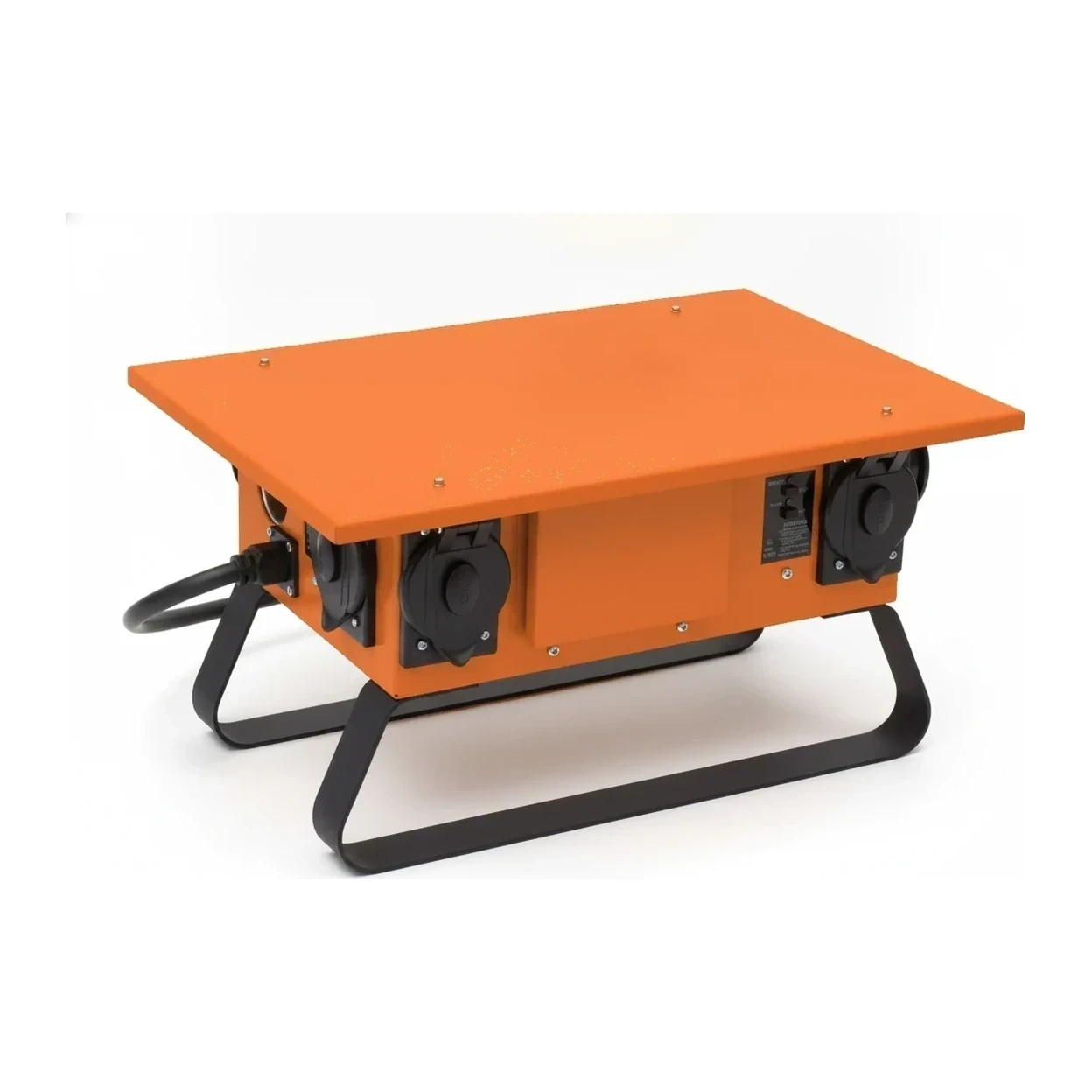
Distribution Panel
A portable distribution panel is the branch-circuit hub of a temporary power system: an enclosure that accepts a feeder from a generator or service, protects outgoing circuits with breakers, and hands power off through receptacles or sub-feed connections. Panels convert one large feed into the many protected circuits a site actually uses.
How it works
Feeder power enters through cam-type inlets, hardwired lugs, or a cord, landing on a main breaker or lugs. From there, branch breakers protect individual circuits terminating in receptacles: commonly a mix of straight-blade duplexes for tools and twist-lock or pin-and-sleeve outlets for equipment and sub-feeds. Construction-grade panels build in the protections temporary power demands: GFCI on receptacle circuits, weather-resistant enclosures with covers, and skids, stands, or hanging brackets that keep the panel out of water and traffic.
Types & variants
- Portable panelboards
- Free-standing or skid-mounted panels distributing a generator or service feed into multiple protected branch circuits.
- Temporary power boxes
- Compact cord-connected boxes bringing a few protected receptacle circuits to a work area.
- Sub-feed and stringer panels
- Panels designed to daisy-chain, passing the feeder through while dropping protected circuits along a route.
- Hazardous-location distribution
- Certified distribution assemblies for classified areas in industrial and plant work.
Key specifications
| Specification | Typical range | What it means |
|---|---|---|
| System voltage | 120/240 V single-phase and 208Y/120 V or 480 V three-phase nominal, configuration dependent | The panel's voltage configuration must match the source and the loads; mixed-voltage panels also host step-down connections. |
| Branch protection | Thermal-magnetic breakers with GFCI on receptacle circuits | Breakers protect conductors; GFCI protects people: required on construction receptacle circuits. |
| Feeder inlet | Cam-type inlets, pin-and-sleeve inlets, or lugs, model dependent | Determines how the panel connects to the feeder system and how quickly services assemble. |
| Enclosure rating | Weather-resistant enclosures on outdoor-rated panels, model dependent | Temporary panels live outdoors in traffic; the enclosure rating must match the exposure. |
How the industry sizes it
Panels are sized from the branch-circuit map: enough breaker positions and receptacle types for the tools and equipment served, a main rating that covers the connected demand, and a voltage configuration matching the source. Large sites layer panels, feeder-level panels near the generator sub-feeding smaller boxes at work areas, keeping cord runs short and protection close to the load.
Applications
- Distributing generator power into protected tool circuits on construction sites
- Temporary building services during renovation and fit-out
- Event and production power distribution to vendors and stages
- Plant shutdown and turnaround temporary power
- Powering trailers, hoists, and fixed equipment through sub-feeds
Safety & operation
- Receptacle circuits serving portable tools on construction sites require GFCI protection per OSHA and NEC Article 590.
- Keep enclosure covers closed and cord entries fitted; open panels expose energized parts to weather and contact.
- Mount panels above standing water and out of vehicle paths, on their skids, stands, or hangers.
- Verify grounding and bonding continuity back to the source before energizing; a floating panel ground defeats every downstream protection.
- Only qualified persons should open panels or alter breaker configurations.
Standards & certifications
- UL · UL 1640
- Safety standard for portable power-distribution equipment.
- NFPA · NFPA 70 (NEC), Article 590
- Temporary installation rules including GFCI requirements for receptacle circuits.
- OSHA · 29 CFR 1926.404(b)(1)
- Ground-fault protection requirements for receptacle outlets on construction sites.
Frequently asked
What distinguishes a portable distribution panel from a building panelboard?
Does every circuit on a temporary panel need GFCI?
How many panels does a site need?
Related equipment
Browse by manufacturer
Sources
Every specification is verified against the manufacturer's published data, with the source linked for reference.
All models
19 models · Every spec cited to source