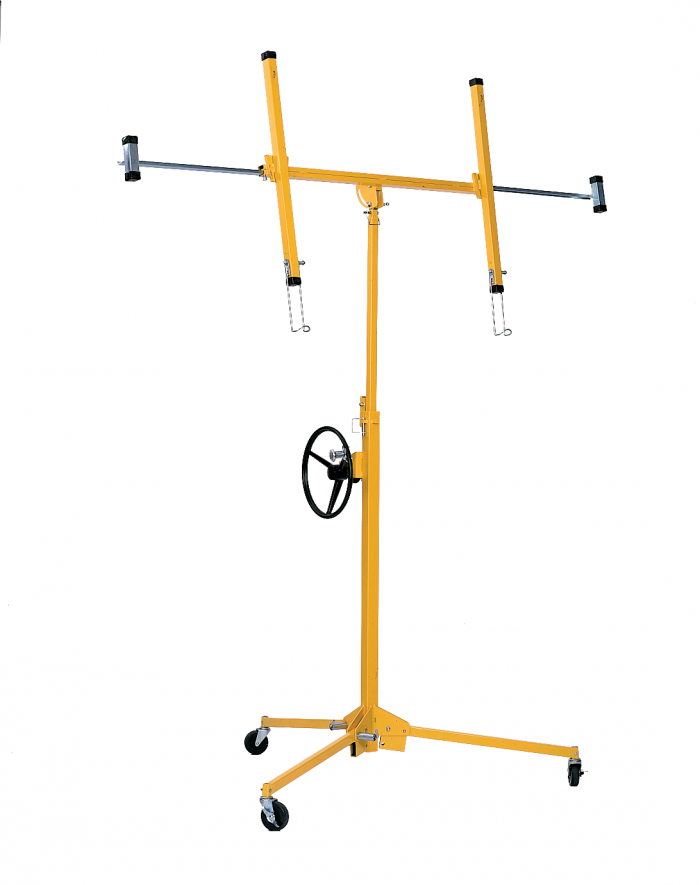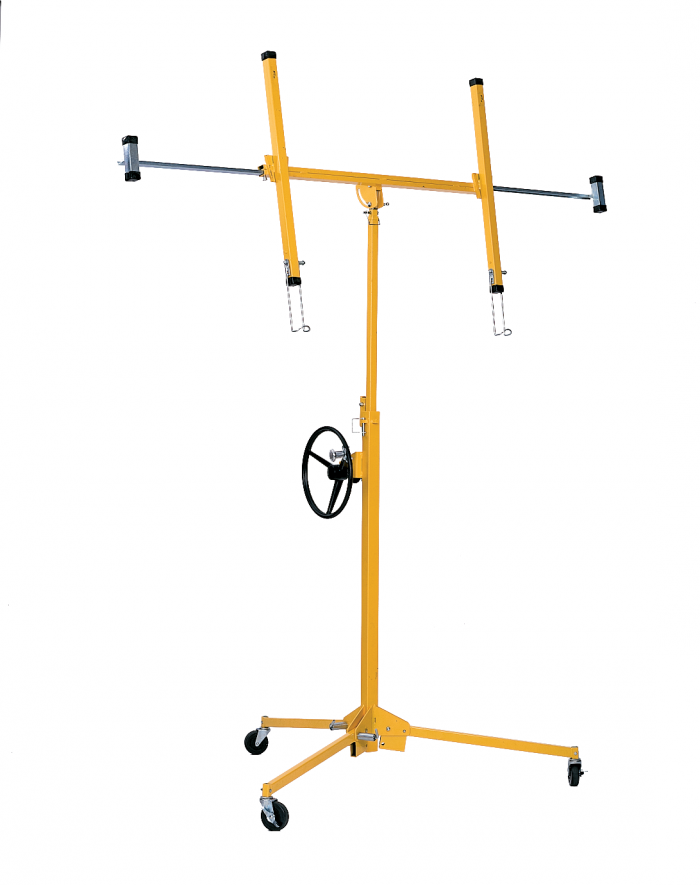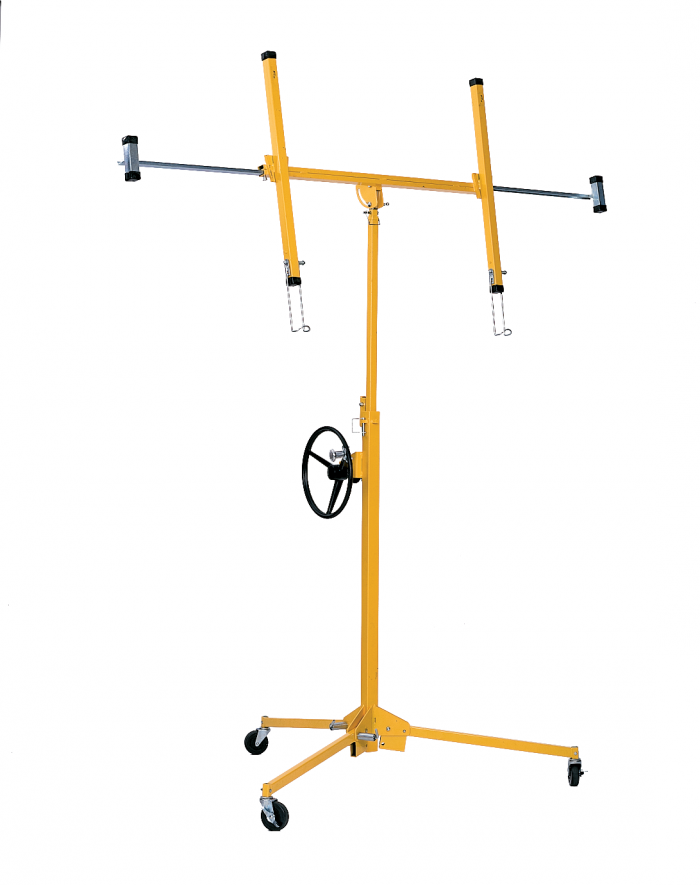

Drywall Panel Lift
A drywall panel lift is a mechanical lifting device designed to position and temporarily hold drywall panels against ceilings or walls during installation. The equipment enables single-operator installation of heavy or oversized sheets by elevating the material to the desired height and holding it in place while fasteners are applied. Drywall panel lifts are standard equipment in residential and commercial construction for efficient wallboard installation.
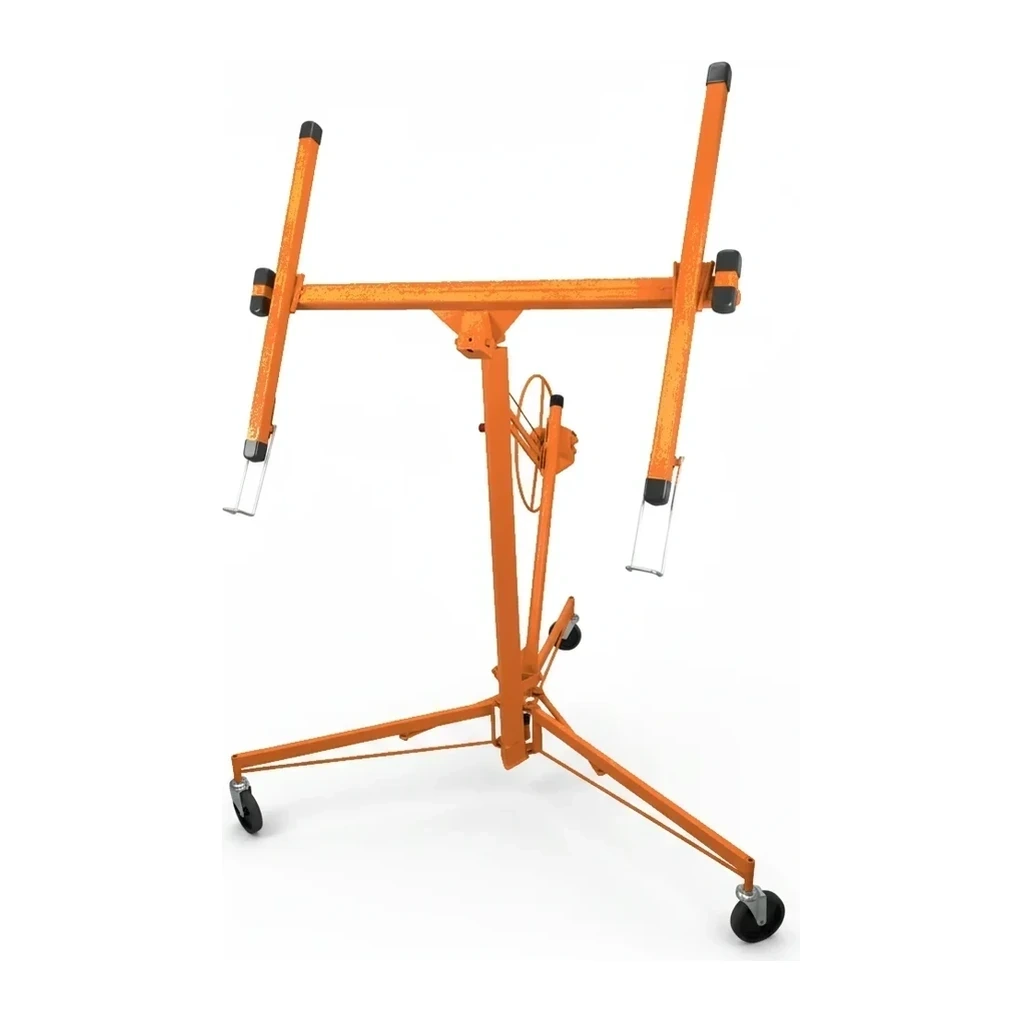
Cómo funciona
The lift consists of a wheeled base frame supporting a vertical mast with a manually operated winch or crank mechanism. The drywall sheet rests on a cradle or platform equipped with adjustable support arms that grip the panel edges. The operator positions the panel on the cradle, then uses the crank to raise the mast and tilt the cradle, elevating and angling the sheet against the ceiling or wall surface. Once positioned, the lift's cradle locks in place to hold the panel securely while the operator fastens it with screws or nails. Tilting mechanisms allow adjustment to accommodate sloped ceilings and wall installations. The wheeled base provides mobility for repositioning between installation locations, and stabilizing legs extend to prevent movement during lifting operations.
Tipos y variantes
- Manual Crank Lift
- Operates via hand-crank winch mechanism; most common type for standard residential and light commercial applications.
- Fixed-Height Lift
- Designed for standard 8-9 ft ceiling heights with limited vertical adjustment range; lighter and more portable.
- Extended-Reach Lift
- Features taller mast and greater lift capacity for commercial applications with ceilings above 10 ft.
- Tilt-Capable Lift
- Includes cradle rotation mechanisms for installing panels on sloped or cathedral ceilings and vertical wall surfaces.
- Heavy-Duty Lift
- Reinforced frame and cradle for handling thicker specialty panels or multiple sheets simultaneously.
Especificaciones clave
| Especificación | Rango típico | Qué significa |
|---|---|---|
| Lift Height | 7.5–11 ft (2.3–3.4 m) | Maximum vertical reach determines ceiling heights the lift can service; sized to match typical residential and commercial construction. |
| Panel Capacity | Up to 12 ft panel length | Maximum drywall sheet dimension the cradle can support; standard 4×8 to 4×12 ft sheets are typical. |
| Weight Capacity | 150–200 lbs (68.0–90.7 kg) | Maximum load the lift mechanism can safely elevate; accommodates standard and fire-rated drywall panels. |
| Cradle Width | 48–54 in (122–137 cm) | Width of panel support platform; must match or exceed standard drywall sheet widths. |
| Tilt Range | 0-90° | Cradle rotation angle for positioning panels on horizontal ceilings through vertical walls and sloped surfaces. |
Cómo la industria lo dimensiona
The industry sizes drywall panel lifts by maximum lift height in feet, which corresponds to the ceiling heights the equipment can service. The standard category covers lifts up to 12 ft, suitable for residential ceilings typically 8-9 ft high with adequate overhead clearance. Models above 12 ft are classified separately for commercial and high-ceiling applications. Lift height determines the equipment's suitability for specific construction environments, with standard residential units focused on 7.5-11 ft working ranges and extended models addressing taller commercial spaces and vaulted ceilings.
Aplicaciones
- Residential ceiling drywall installation in single-family and multi-family construction
- Commercial interior build-out with standard and elevated ceiling heights
- Remodeling and renovation projects requiring wallboard replacement or addition
- Cathedral and vaulted ceiling installation where panels must be positioned at angles
- Solo contractor operations where single-person installation is required
- Fire-rated drywall installation in commercial and institutional buildings
Seguridad y operación
- Extend stabilizing legs fully and verify level footing before lifting panels to prevent tipping during operation
- Confirm weight capacity is not exceeded; fire-rated and specialty panels may exceed standard drywall weights
- Maintain clear zone around lift during elevation and tilting to prevent pinch points and struck-by hazards
- Inspect winch mechanisms, cables, and cradle supports for wear or damage before each use
- Position wheels or engage brakes to prevent unintended movement while panel is elevated and being fastened
Normas y certificaciones
- ANSI · ANSI A92 series
- Standards for vehicle-mounted elevating and rotating aerial devices; principles apply to manual lifting equipment design and stability.
- OSHA · 29 CFR 1926.451
- Scaffolding and work platform standards; applies to equipment used for positioning workers and materials at height.
- ASME · B30 series
- Safety standards for lifting devices and hoists; provides guidance on load capacity marking and inspection requirements.
- CSA · CSA B354.6
- Canadian standards for manually propelled elevating work platforms; relevant for design and operational safety considerations.
Preguntas frecuentes
What ceiling height range do standard drywall panel lifts accommodate?
How are drywall lifts sized and classified in the industry?
Can drywall panel lifts handle both ceiling and wall installations?
What panel sizes and weights can typical drywall lifts support?
Equipos relacionados
Explorar por fabricante
Fuentes
Cada especificación se verifica con los datos publicados por el fabricante, con la fuente enlazada como referencia.
Todos los modelos
6 modelos · Cada especificación citada a la fuente