Vacuum-Assisted Pump
A vacuum-assisted pump is a self-priming centrifugal dewatering pump equipped with a vacuum system that evacuates air from the suction line and pump casing, enabling operation without manual priming or flooded suction. These pumps are engineered for applications requiring automatic priming, unattended operation, and significant suction lift, including sewer bypass, wet well draining, and cofferdam dewatering.
Cómo funciona
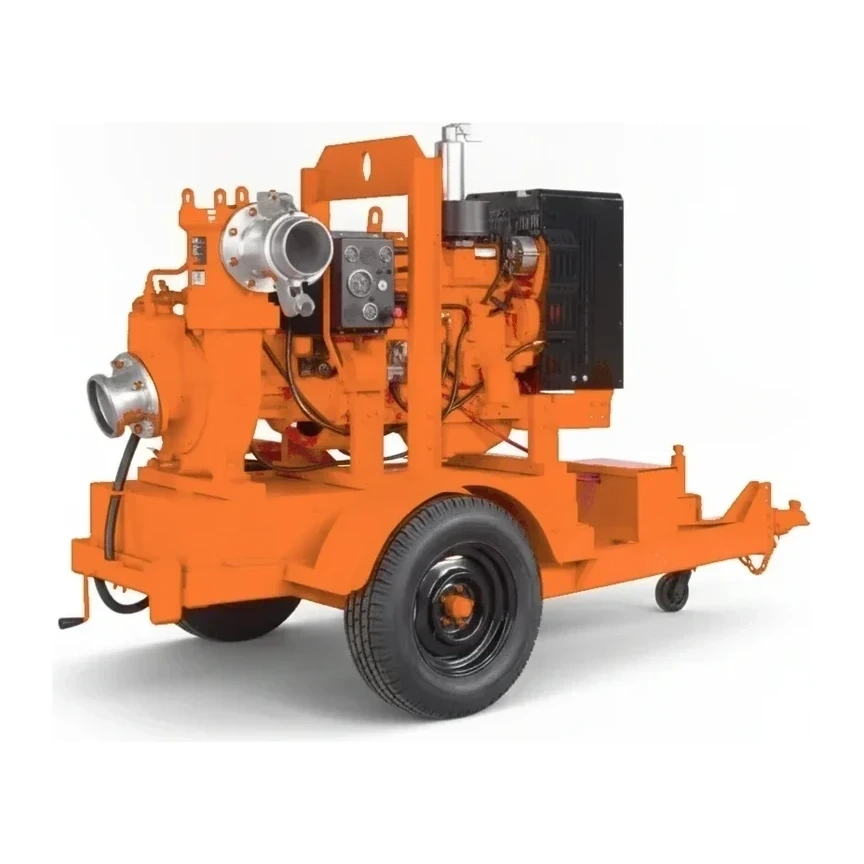
The vacuum-assisted pump uses an integrated vacuum pump or compressor system to create negative pressure within the pump chamber and suction piping. When air enters the system or the pump runs dry, the vacuum system automatically evacuates air and vapor, allowing water to be drawn into the impeller. Once priming is achieved and flow begins, the centrifugal pump operates conventionally, moving water through the volute and discharge. The vacuum system continuously monitors and maintains prime, automatically re-priming if the pump loses suction due to air entrainment, fluctuating water levels, or temporary dry conditions. This closed-loop priming capability allows unattended operation over extended periods and automatic restart after power interruptions or when the sump refills.
Tipos y variantes
- Trailer-Mounted Vacuum-Assisted Pump
- Self-contained unit on a road-towable trailer with integrated engine, pump, vacuum system, and fuel tank for mobile bypass and emergency dewatering applications.
- Stationary Vacuum-Assisted Pump
- Skid-mounted or base-mounted configuration for semi-permanent installations such as long-term bypass operations or fixed dewatering stations.
- Sound-Attenuated Vacuum-Assisted Pump
- Enclosed in noise-reducing housing for use in noise-sensitive environments such as residential areas, hospitals, or urban bypass projects.
- Electric Vacuum-Assisted Pump
- Powered by electric motor rather than diesel engine, suitable for indoor locations, environmentally restricted sites, or where utility power is available.
- Dual-Prime Vacuum-Assisted Pump
- Features redundant vacuum or priming systems for critical applications where continuous operation is essential and downtime is unacceptable.
Especificaciones clave
| Especificación | Rango típico | Qué significa |
|---|---|---|
| Discharge Size | 2–12 in (5.1–30.5 cm) | Nominal diameter of the pump discharge connection, determining flow capacity and application scale; the industry sizes vacuum-assisted pumps by this dimension. |
| Flow Rate | 45-4000 gpm | Volume of water moved per minute at rated head; varies based on pump size and impeller configuration. |
| Maximum Suction Lift | 15–28 ft (4.6–8.5 m) | Vertical distance the vacuum system can lift water from source to pump centerline; critical for deep excavations and high-lift bypass applications. |
| Total Dynamic Head (TDH) | 20–200 ft (6.1–61.0 m) | Combined vertical lift, friction losses, and discharge pressure the pump can overcome at specified flow rate. |
| Solids Handling | Up to 3 in | Maximum diameter of spherical solids that can pass through the impeller without clogging; essential for raw sewage and debris-laden water. |
Cómo la industria lo dimensiona
The industry sizes vacuum-assisted pumps primarily by discharge diameter, measured in inches. Units under 4 inches handle automatic priming and unattended running on small bypass or trench work. The 4-6 inch range serves as the standard sewer-bypass pump, priming itself and running unattended overnight. The 6-8 inch class addresses large bypass and cofferdam dewatering with heavy suction lift. Pumps 8 inches and larger handle municipal-scale bypass, moving entire sewer mains around construction zones. Flow rate (gpm) and total dynamic head (feet) are the operational parameters used to match the pump to specific job requirements.
Aplicaciones
- Sewer main bypass during pipeline rehabilitation, repair, or replacement
- Wet well and lift station bypass for maintenance or emergency pump failures
- Cofferdam and excavation dewatering with high suction lift requirements
- Stormwater management and flood control pumping
- Industrial process water transfer and wastewater handling
- Municipal emergency response for sanitary sewer overflows (SSO) prevention
Seguridad y operación
- Ensure adequate ventilation when operating diesel-powered units indoors or in confined spaces to prevent carbon monoxide accumulation
- Verify suction and discharge hoses are properly secured and rated for expected pressures to prevent separation or rupture during operation
- Inspect vacuum system components regularly for leaks that reduce priming efficiency and increase engine load
- Maintain awareness of discharge destination and flow path to prevent flooding, erosion, or environmental permit violations
- Use appropriate hearing protection when working near operating units, particularly non-attenuated models
Normas y certificaciones
- Hydraulic Institute (HI) · HI 9.6.6
- Standards for centrifugal and vertical pumps, including performance testing and application guidelines applicable to vacuum-assisted dewatering pumps.
- EPA · Tier 4
- Emission standards for non-road diesel engines; many modern vacuum-assisted pumps use Tier 4 Final compliant engines to meet air quality regulations.
- OSHA · 29 CFR 1926 Subpart P
- Excavation and trenching standards governing dewatering operations, including pump placement and trench stability requirements.
Preguntas frecuentes
What distinguishes a vacuum-assisted pump from a standard centrifugal pump?
How does suction lift capability affect pump selection?
Why are vacuum-assisted pumps preferred for sewer bypass applications?
What maintenance does the vacuum system require?
Equipos relacionados
Explorar por fabricante
Fuentes
Cada especificación se verifica con los datos publicados por el fabricante, con la fuente enlazada como referencia.
Todos los modelos
32 modelos · Cada especificación citada a la fuente