
Concrete Bucket and Hopper
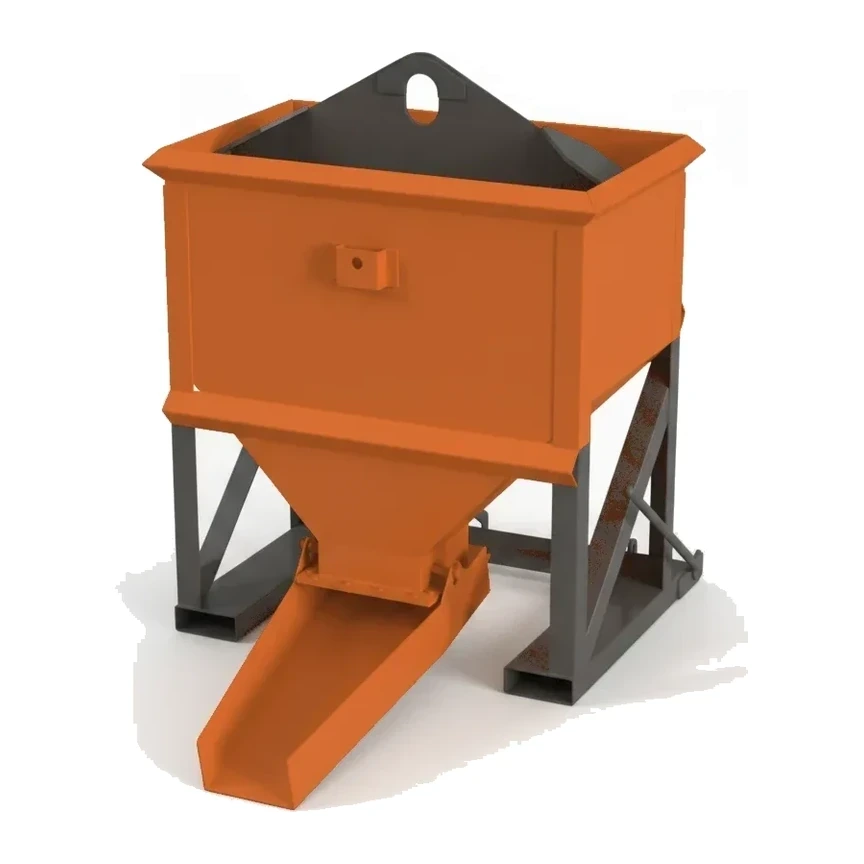
A concrete bucket and hopper receives ready mix from a truck or pump and releases it at the pour location on demand, usually flown by crane or carried by an excavator or forklift. It provides controlled placement where chutes and pump lines cannot reach. Listed sizes in this class fall in 1.00-2.00 and 3.00-4.00 cu yd capacity bands.
Fonctionnement
The bucket charges under a truck chute or pump discharge, is rigged to the crane hook, and travels to the forms. A gate at the bottom — lever, wheel or air-operated — meters the discharge, letting the crew fill columns, walls and congested forms at a controlled rate rather than in one dump. Cycle time is set by charge, flight and discharge, so bucket capacity is matched to crane capacity and the batch delivery rate. Listed load capacities in the class run 1,814-2,722 kg.
Types et variantes
- General-purpose crane bucket
- Round or square-bodied bucket with a center discharge gate, the standard format for wall, column and footing pours.
- Laydown (low-profile) bucket
- Charges on its side under a truck chute, then uprights when lifted; useful where headroom under the chute is limited.
- Fork-carried hopper
- Hopper framed for forklift or telehandler forks, moving concrete at grade where no crane is available.
- Gated discharge hopper
- Static hopper that buffers mix between delivery and placement, feeding buggies or barrows at a controlled rate.
Spécifications clés
| Spécification | Plage typique | Signification |
|---|---|---|
| Capacity | 1.00-2.00 or 3.00-4.00 cu yd listed bands | Sets volume per lift; total rigged weight of a full bucket must stay inside the crane's chart at working radius. |
| Load capacity | 1,814-2,722 kg on listed units | The rated payload of the bucket structure; full wet concrete plus bucket weight defines the rigging load. |
| Gate type | manual lever or air-operated gate | Controls discharge rate and precision; air gates suit high placements where a worker guides the bucket from a platform. |
Comment l'industrie le dimensionne
Buckets are sized by struck capacity in cubic yards, chosen against two limits: the crane's rated capacity at the working radius, and the pour rate the crew and finisher can absorb. The 1.00-2.00 cu yd band suits columns, piers and spot pours where control matters; 3.00-4.00 cu yd cuts the number of lifts on slab and wall pours but demands proportionally more crane capacity.
Applications
- Foundation and footing pours with crane-only access
- Column, pier and wall placement needing controlled release
- High-rise deck and core pours
- Bridge and structural pours over water or grade
- Remote placements beyond chute or line reach
- Buffering mix between truck delivery and placement
Sécurité et opération
- Workers must never position themselves under a suspended bucket; placement paths are planned so loads do not pass over the crew.
- Riding a concrete bucket is prohibited.
- A filled bucket plus its own weight defines the rigged load; it must be verified against the crane load chart at the actual working radius before the first lift.
- Rigging, gate mechanisms and bails are inspected before each shift; a gate failure releases the full load without warning.
Normes et certifications
- OSHA · 29 CFR 1926.701(e)
- Prohibits riding concrete buckets and requires employees to stay clear of suspended buckets.
- OSHA · 29 CFR 1926.702(f)
- Concrete bucket equipment requirements, including protection from shock and vibration on hydraulic and pneumatic gates.
- ASME · B30.20
- Below-the-hook lifting devices — design, marking, inspection and operation practices applicable to crane-handled buckets.
Questions fréquentes
When is a bucket used instead of a pump?
What sizes do concrete buckets come in?
How does bucket size affect crane selection?
What does the gate do?
Équipements connexes
Parcourir par fabricant
Sources
Chaque spécification est vérifiée par rapport aux données publiées par le fabricant, avec la source liée pour référence.
Tous les modèles
22 modèles · Chaque spécification citée à la source