

Step-Down Transformer
A portable step-down transformer converts a site's higher distribution voltage, commonly 480 V three-phase nominal, down to the 208Y/120 V or 240/120 V levels that tools, lighting, and receptacles require. It is the bridge that lets a single high-voltage temporary service power ordinary low-voltage loads across a site.
Fonctionnement
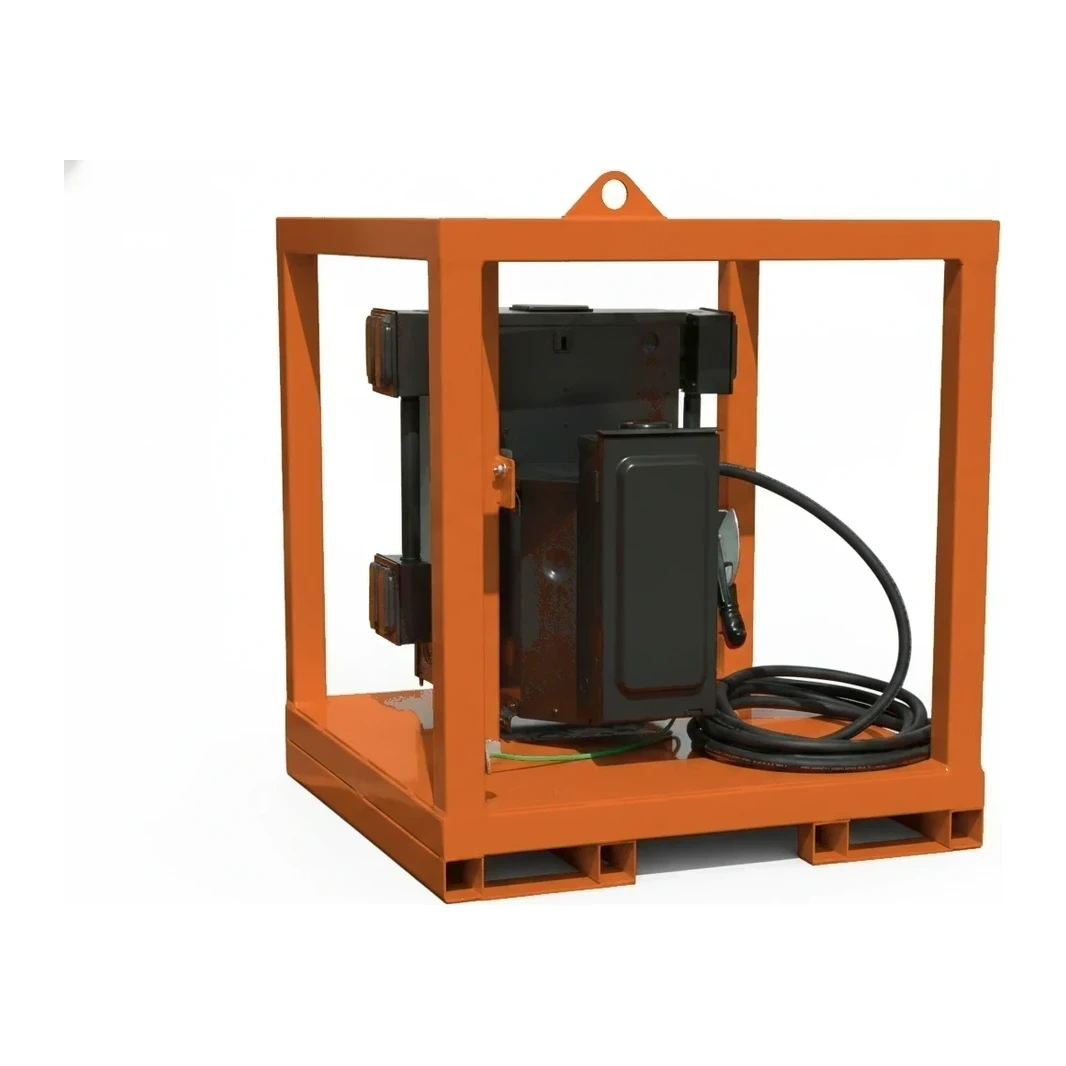
Windings magnetically couple the primary (high-voltage) side to the secondary (low-voltage) side, transforming voltage by the winding ratio with no moving parts. Portable units package a dry-type transformer in a protective frame or enclosure with input and output connections, cam-type, pin-and-sleeve, or lugs, and often integrate secondary breakers and receptacles. The secondary of a transformer is a separately derived system: its neutral-to-ground bond and grounding-electrode connections must be established per the NEC for downstream protection to function.
Types et variantes
- Portable frame-mounted transformers
- Dry-type units in roll-cage frames, moved by hand truck or forklift and connected by cord or cam-type feeders.
- Transformer distribution combos
- Units integrating secondary breakers and receptacle banks, combining step-down and distribution in one box.
- Skid- and trailer-mounted units
- Larger-kVA transformers for site-level conversion, placed once and feeding panel systems.
Spécifications clés
| Spécification | Plage typique | Signification |
|---|---|---|
| Voltage conversion | 480 V primary to 208Y/120 V or 240/120 V secondary nominal, configuration dependent | The winding configuration must match both the available service and the loads to be fed. |
| Capacity | Rated in kVA, model dependent | The transformer's kVA rating caps the connected load; undersizing shows up as heat and voltage sag under load. |
| Construction | Dry-type (air-cooled) windings in portable enclosures | Dry-type construction suits portable service: no oil to contain and simpler siting. |
| Secondary protection | Integral breakers and GFCI-protected receptacles on combo units | Protection on the secondary side is what makes the derived circuits safe to use directly. |
Comment l'industrie le dimensionne
Transformers are sized in kVA against the connected secondary load with headroom for motor starting, and selected by winding configuration to match source and load voltages. Site layouts place the transformer close to the low-voltage loads: running the higher voltage across the distance and converting near the point of use minimizes conductor size and voltage drop on the heavy low-voltage side.
Applications
- Deriving 120 V tool and receptacle power from a 480 V temporary service
- Feeding low-voltage panels and spider boxes on high-voltage site distributions
- Plant shutdowns where only high-voltage sources are available at the work area
- Event and production power conversion from facility services
- Powering specialty equipment whose voltage differs from the site standard
Sécurité et opération
- Secondary neutral bonding and grounding must be established per NEC rules for separately derived systems before the transformer is put in service.
- Only qualified persons should make primary-side connections; the 480 V side carries higher arc-flash energy than the tool circuits it feeds.
- Position units for ventilation per the manual, dry-type transformers reject their losses as heat, and keep enclosures clear of stored material.
- Verify secondary voltage and rotation before connecting loads; a mis-tapped transformer delivers wrong voltage to everything downstream.
Normes et certifications
- NFPA · NFPA 70 (NEC), Articles 450 and 250.30
- Transformer installation rules and grounding/bonding requirements for separately derived systems.
- UL · UL 1561
- Safety standard for dry-type general-purpose and power transformers.
- OSHA · 29 CFR 1926.404-405
- Temporary wiring and equipment installation requirements on construction sites.
Questions fréquentes
Why distribute at 480 V and step down, instead of distributing at 120/208 V?
What does 'separately derived system' mean for a portable transformer?
How is a portable transformer sized?
Équipements connexes
Parcourir par fabricant
Sources
Chaque spécification est vérifiée par rapport aux données publiées par le fabricant, avec la source liée pour référence.
Tous les modèles
4 modèles · Chaque spécification citée à la source