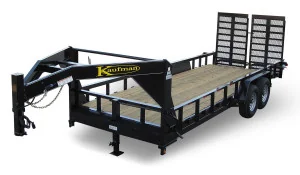

Gooseneck Trailer
A gooseneck trailer is a heavy-duty towing trailer that connects to a ball hitch mounted in the bed of a pickup truck, positioned over or just forward of the rear axle. The gooseneck design allows for greater weight distribution and stability compared to bumper-pull trailers, making it the standard choice for transporting construction equipment, livestock, and heavy materials. These trailers range from light-duty flatbeds to heavy-haul lowboys requiring commercial licensing.
Fonctionnement
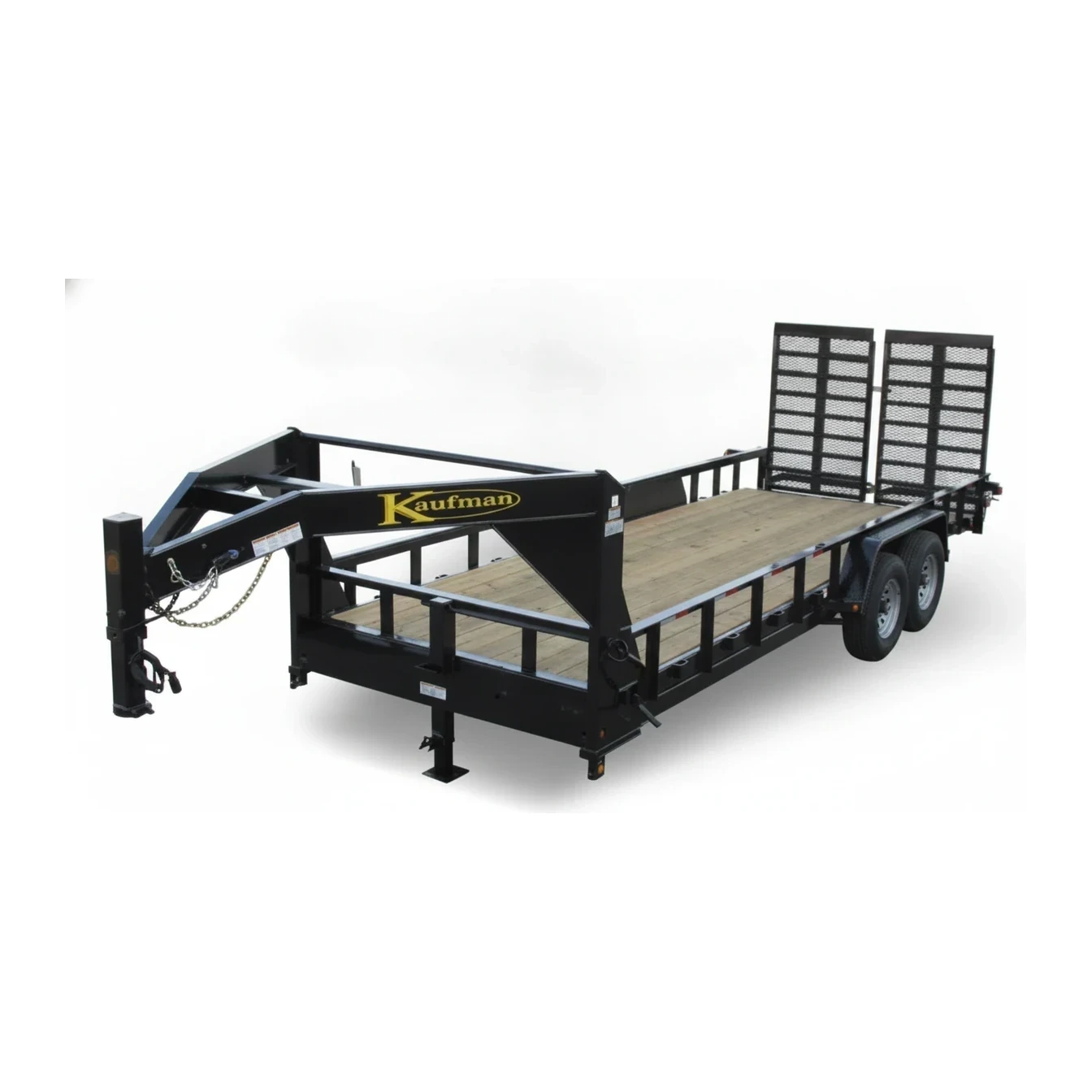
The gooseneck coupling consists of a downward-extending neck from the front of the trailer that terminates in a coupler, which locks onto a ball hitch installed in the truck bed. This over-axle mounting position transfers tongue weight directly above the rear axle, improving weight distribution and reducing sway. The pivot point's elevated position relative to bumper-pull hitches creates a tighter turning radius and better maneuverability, particularly with longer trailers. Many gooseneck trailers feature hydraulic dovetails that tilt downward to create a loading ramp, allowing wheeled equipment to drive on and off without separate ramps. The trailer's deck height, wheelbase, and axle configuration vary based on capacity, with heavier models incorporating tandem or triple axles and lower deck heights (lowboy style) to accommodate taller equipment while staying within height regulations.
Types et variantes
- Flatbed Gooseneck
- Open deck design with stake pockets and tie-down points, used for general hauling of equipment, materials, and palletized loads
- Hydraulic Dovetail Gooseneck
- Features a rear section that hydraulically lowers to ground level, creating a drive-on/drive-off ramp for loading wheeled equipment
- Lowboy Gooseneck
- Low-profile deck positioned between the axles for hauling tall equipment while maintaining legal height limits, common in heavy equipment transport
- Dump Gooseneck
- Hydraulic dump bed that tilts to unload aggregate, soil, and bulk materials, combining gooseneck stability with dumping functionality
- Equipment Tilt Deck
- Entire deck tilts backward to ground level for loading equipment without ramps, typically used for skid steers and compact machinery
Spécifications clés
| Spécification | Plage typique | Signification |
|---|---|---|
| Gross Vehicle Weight Rating (GVWR) | 14,000-26,000 lb (common range); up to 40,000+ lb for heavy-haul | Maximum loaded weight the trailer is designed to carry, determining capacity class and licensing requirements |
| Deck Length | 18–32 ft (5.5–9.8 m) | Usable cargo area from gooseneck to rear, affecting what equipment and loads can be accommodated |
| Deck Width | 96–102 in (244–259 cm) | Standard width fitting highway regulations; wider decks may require permits depending on jurisdiction |
| Axle Configuration | Tandem (2) or triple (3) axle | Number of axles determines load distribution, tire wear, and state registration requirements |
| Deck Height | 36-48 in (flatbed); 18-24 in (lowboy) | Ground-to-deck clearance affecting loading ease and total height when hauling tall equipment |
Comment l'industrie le dimensionne
The rental industry sizes gooseneck trailers primarily by Gross Vehicle Weight Rating (GVWR) in pounds, which determines capacity class and legal requirements. Light goosenecks up to 14,000 lb provide the stability advantage of a bed-mounted hitch for smaller equipment without excessive weight. Mid-capacity models from 14,000 to 26,000 lb represent the everyday equipment hauling segment, compatible with one-ton dually pickups and typically remaining under CDL requirements (26,001 lb threshold). Heavy-haul goosenecks above 26,000 lb require commercial driver licensing and dedicated tow vehicles, often configured as lowboys for oversized equipment transport. Deck length and axle count are secondary sizing factors that correlate with weight capacity.
Applications
- Hauling compact to mid-size construction equipment such as skid steers, mini excavators, and compact track loaders
- Transporting heavy machinery including bulldozers, backhoes, and agricultural tractors on lowboy configurations
- Moving palletized building materials, steel, lumber, and pipe to job sites with flatbed goosenecks
- Livestock transport in agricultural operations, taking advantage of superior stability and weight capacity
- Landscape contractor use for hauling mowers, attachments, and aggregates with dump or flatbed configurations
- Utility and infrastructure projects requiring transport of transformers, generators, and heavy components
Sécurité et opération
- Verify the tow vehicle's payload capacity includes trailer tongue weight, which typically represents 15-25% of loaded trailer weight
- Ensure the ball hitch is properly rated for the trailer's GVWR and is securely installed in the truck bed with appropriate reinforcement
- Load cargo with proper weight distribution, keeping the center of gravity low and forward to maintain 15-20% tongue weight for stability
- Check that all safety chains are crossed under the gooseneck and connected to the truck frame, with sufficient slack for turning
- Confirm trailer brakes are functioning and properly adjusted, as most goosenecks over 3,000 lb GVWR require braking systems by law
- Verify that operators hauling trailers with combined GVWR over 26,000 lb hold appropriate commercial driver licenses per FMCSA regulations
Normes et certifications
- FMCSA · 49 CFR Part 383
- Federal Motor Carrier Safety Administration regulations governing CDL requirements for combinations exceeding 26,000 lb GVWR
- SAE · J684
- Society of Automotive Engineers standard for trailer ball and coupler dimensions, strength, and compatibility specifications
- DOT · 49 CFR Part 393
- Department of Transportation parts and accessories regulations covering brakes, lighting, and safety chain requirements for trailers
- NATM
- North American Trailer Manufacturers Association guidelines for trailer construction, loading, and weight distribution practices
Questions fréquentes
What is the difference between a gooseneck and a fifth-wheel trailer?
At what capacity does a gooseneck trailer require a CDL?
How is tongue weight calculated and why does it matter?
Can a standard pickup truck tow any gooseneck trailer?
Équipements connexes
Parcourir par fabricant
Sources
Chaque spécification est vérifiée par rapport aux données publiées par le fabricant, avec la source liée pour référence.
Tous les modèles
2 modèles · Chaque spécification citée à la source