

Hammerhead Tower Crane
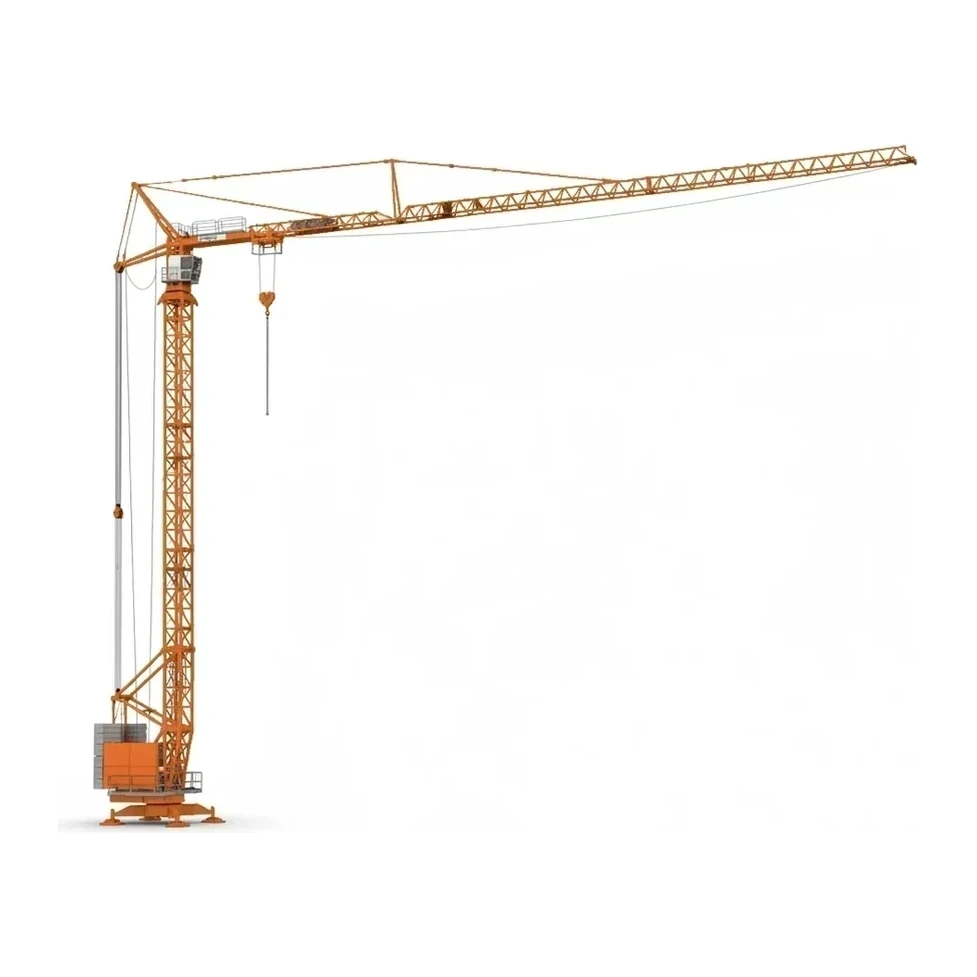
A hammerhead tower crane is a top-slewing tower crane characterized by a horizontal jib extending from both sides of the mast, with a trolley that travels along the jib to position loads. The crane's rotating superstructure and counterweights sit atop a vertical mast, giving the machine its distinctive hammerhead silhouette. These cranes are essential in high-rise construction for lifting and placing heavy materials at significant heights and radii.
How it works
The hammerhead tower crane operates by rotating its entire superstructure—including the horizontal jib, machinery deck, and counterweights—around the top of the fixed mast. A trolley moves along the jib's length, allowing precise load positioning across the working radius. The hoisting mechanism lifts loads vertically while the trolley's radial movement and the crane's slewing motion provide horizontal positioning. Power is supplied through cables running up the mast to the slewing unit, which houses the hoist motor, trolley motor, and slewing motor. Operators work from a cab mounted on the slewing superstructure, providing visibility across the entire job site. The counterweights balance the jib and load, with structural geometry transferring forces down through the mast to the foundation or climbing frame.
Types & variants
- Top Slewing Hammerhead
- Traditional configuration with the entire superstructure rotating atop a fixed mast; offers maximum height and capacity for demanding projects.
- Luffing Jib Variant
- Features a jib that can change angle vertically, reducing the crane's swing radius for congested urban sites with restricted airspace.
- Self-Erecting Hammerhead
- Smaller capacity units with integrated erection mechanisms, allowing setup without an assist crane for low- to mid-rise work.
- Climbing Hammerhead
- Equipped with hydraulic climbing frames that allow the crane to rise within or alongside the structure as construction progresses.
- Rail-Mounted Hammerhead
- Mounted on track systems for longitudinal travel along infrastructure projects or industrial sites requiring extended reach zones.
Key specifications
| Specification | Typical range | What it means |
|---|---|---|
| Maximum Capacity | Sized by ton rating (0–8 ton, 8–16 ton, 16+ ton) | The maximum load the crane can lift at minimum radius; capacity decreases as the trolley moves outward along the jib. |
| Jib Length | Varies by model and configuration | The horizontal reach from mast centerline to jib tip; determines the crane's maximum working radius and coverage area. |
| Maximum Hook Height | Depends on mast configuration | The vertical distance from ground level to maximum hook position; extended through mast sections added during climbing operations. |
| Out-of-Service Radius | Varies by jib length | The swing radius when the jib is weathervaned out of service; critical for site planning and airspace clearance. |
How the industry sizes it
The rental industry sizes hammerhead tower cranes primarily by maximum lifting capacity, expressed in tons. Units under 8 tons serve residential and small commercial towers for forming, rebar, and material hoisting. The 8–16 ton range represents everyday tower cranes for mid-rise concrete and steel construction. Heavy tower cranes rated above 16 tons handle large precast panels and industrial construction demands. Sizing also considers jib length, hook height capability, and site-specific constraints such as foundation loads and airspace limitations.
Applications
- High-rise residential and commercial building construction for concrete placement and steel erection
- Bridge construction and infrastructure projects requiring extended reach and heavy lift capacity
- Industrial plant assembly and maintenance involving large modules and equipment
- Precast concrete panel installation on multi-story structures
- Urban infill projects in constrained sites requiring vertical material distribution
- Power plant and refinery construction with heavy component lifts at elevated work zones
Safety & operation
- Anti-collision systems and zone control devices prevent contact with adjacent cranes and structures in multi-crane environments
- Load moment indicators and rated capacity limiters provide real-time monitoring to prevent overload conditions
- Wind speed monitoring and automatic shutdown systems protect the crane during high-wind events; out-of-service weathervaning required
- Qualified riggers and signal persons coordinate lifts using standardized hand signals or radio communication per ASME B30.5
- Regular inspections of structural components, wire rope, and safety devices by competent persons per manufacturer and regulatory schedules
Standards & certifications
- ASME B30.3 · Construction Tower Cranes
- Establishes requirements for construction, installation, operation, inspection, testing, and maintenance of tower cranes.
- OSHA · 29 CFR 1926 Subpart CC
- Federal regulations governing crane operation in construction, including certification, assembly, and operational safety requirements.
- ANSI/ASSE A10.48 · Cranes and Derricks in Construction
- Safety standard addressing crane setup, operation, maintenance, and personnel qualifications for construction applications.
- FEM · European Materials Handling Federation
- International design and safety standards widely adopted by manufacturers, covering structural and mechanical design criteria.
Frequently asked
How are hammerhead tower cranes transported and erected on site?
What distinguishes hammerhead cranes from flat-top tower cranes?
How is the working capacity determined at different radii?
What foundation requirements do hammerhead tower cranes have?
Browse by manufacturer
All models
6 models · Every spec cited to source