

Bench Grinder
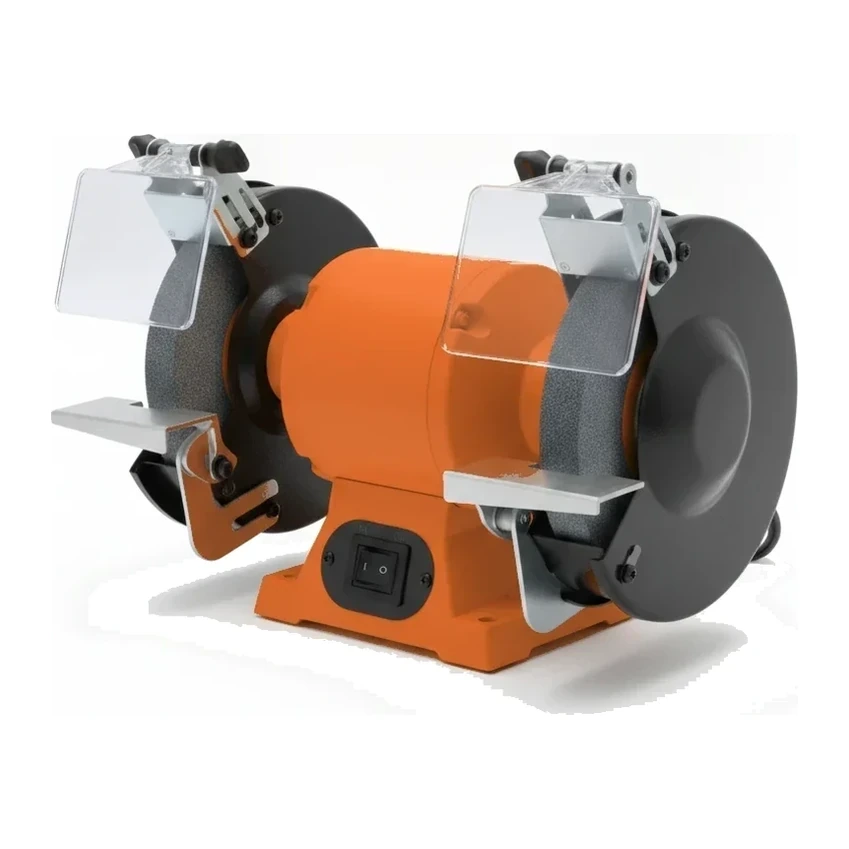
A bench grinder is a stationary tool with a motor spinning one or two abrasive wheels, mounted to a bench or pedestal. It sharpens edged tools and deburrs, shapes, and cleans small metal parts brought to the wheel.
How it works
A double-shafted induction motor carries a wheel on each end, typically a coarse wheel for stock removal and a finer one for finishing, or a wire wheel for cleaning. The operator supports the workpiece on an adjustable tool rest and presses it lightly against the rotating wheel face. Spark guards and eye shields sit above each wheel.
Types & variants
- 6-8 in bench grinders
- Bench-top units for sharpening bits, chisels, and blades.
- 8-14 in grinders
- Larger wheels for heavier deburring, weld cleanup, and shaping.
- Grinder/wire-wheel combos
- One abrasive wheel paired with a wire brush for rust and scale removal.
Key specifications
| Specification | Typical range | What it means |
|---|---|---|
| Wheel diameter | 6–14 in (15.2–35.6 cm) | Larger wheels grind faster, run cooler, and last longer between dressings. |
| Wheel grit pairing | Coarse plus fine | Two wheels let one machine rough-shape and finish without changing wheels. |
| Tool rest and guards | Adjustable | The rest must sit within 1/8 in of the wheel to prevent work being drawn in. |
How the industry sizes it
The class bands at 6-8 in and 8-14 in wheel diameter. The smaller band covers routine sharpening and light deburring on a workbench; the larger band suits maintenance shops doing frequent weld cleanup and heavier stock removal.
Applications
- Sharpening drill bits, chisels, and mower or site-tool blades
- Deburring cut edges after sawing or shearing
- Cleaning rust and scale off small parts with a wire wheel
- Shaping brackets, tips, and small metal parts
Safety & operation
- Keep the tool rest adjusted to within about 1/8 in of the wheel and the tongue guard within 1/4 in, per abrasive-wheel rules.
- Ring-test new wheels and let a freshly mounted wheel run a full minute before standing in line with it.
- Grind on the wheel face only; side pressure can crack a bonded wheel.
Standards & certifications
- OSHA · 29 CFR 1926.303
- Abrasive wheel guarding, work rest, and inspection requirements.
- ANSI · B7.1
- Abrasive wheel safety: mounting, speed, and guard geometry.
Frequently asked
What wheel size is right for general sharpening?
Why must the tool rest be so close to the wheel?
What does dressing a wheel do?
Related equipment
Browse by manufacturer
Sources
Every specification is verified against the manufacturer's published data, with the source linked for reference.
All models
24 models · Every spec cited to source