

Die Grinder
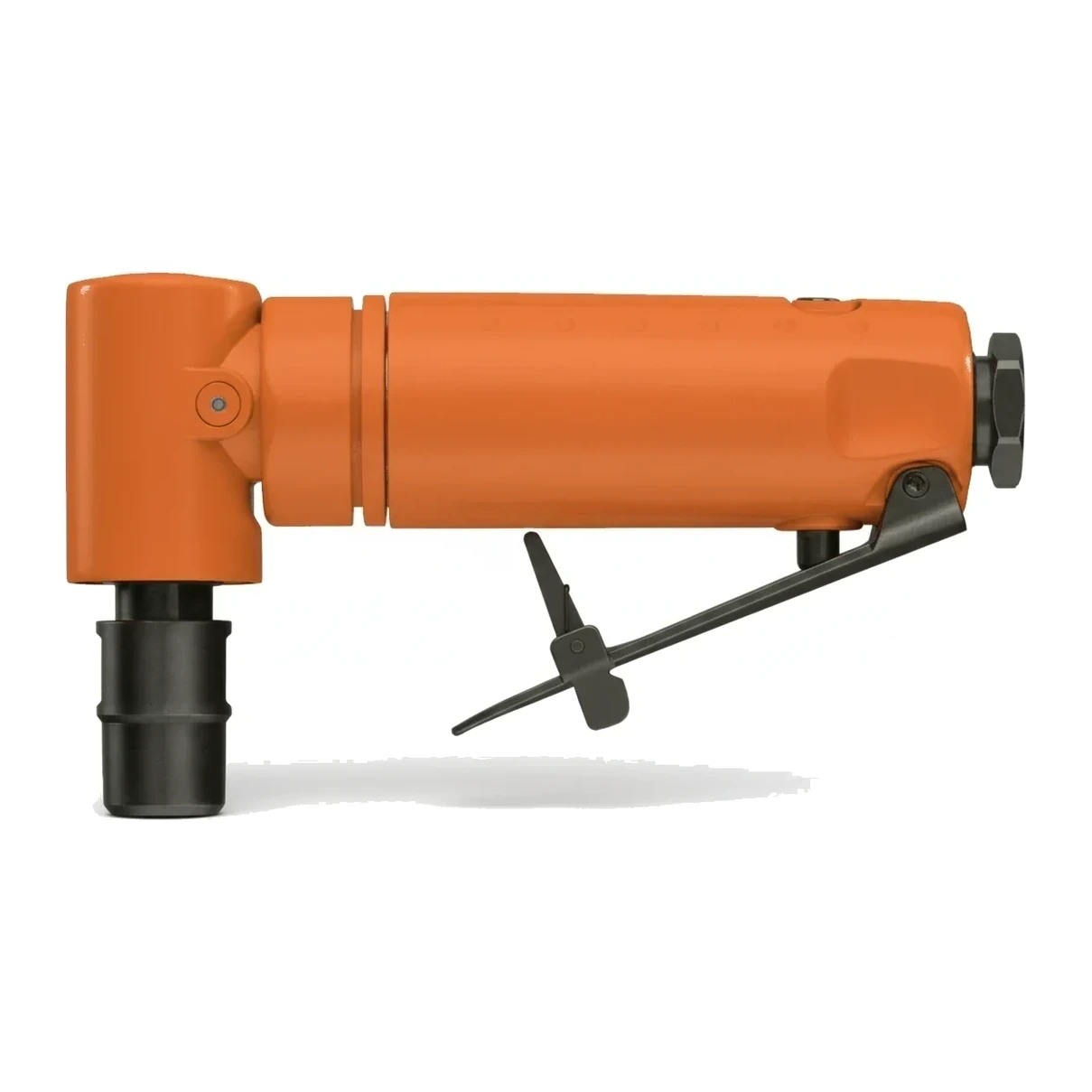
A die grinder is a compact rotary tool that spins small mounted points, carbide burrs, and abrasive accessories held in a collet. It handles precision grinding, deburring, and polishing in spots too tight for an angle grinder.
How it works
An electric or air motor drives a collet-held accessory directly, without a gearbox, at speeds far higher than an angle grinder. The operator guides the tool freehand, letting the small-diameter burr or point cut on contact. Straight-body and right-angle versions place the spindle in line with or perpendicular to the grip.
Types & variants
- Straight die grinders
- Inline spindle for porting, weld blending, and internal surfaces.
- Right-angle die grinders
- Angled heads that reach into confined and flat-access spots.
- Pneumatic die grinders
- Air-driven models favored in fabrication and automotive shops.
- Cordless die grinders
- Battery versions for field deburring away from air lines.
Key specifications
| Specification | Typical range | What it means |
|---|---|---|
| Collet size | 1/4 in common | Sets which burr and point shanks the tool accepts. |
| No-load speed | Varies by model | Small accessories need high RPM to reach effective surface speed; accessory ratings must match. |
| Power source | Air, corded, or cordless | Air models run compact and cool; electric models free the tool from a compressor. |
How the industry sizes it
Models differ by body style, collet size, and power source rather than a size band. Straight bodies suit internal and linear work; right-angle heads reach recessed surfaces. Numeric spec ranges recorded for this class are polluted with saw data and are not reliable.
Applications
- Deburring machined and flame-cut edges
- Blending and smoothing welds in corners and recesses
- Porting, enlarging, and chamfering holes in metal
- Rust and gasket removal with abrasive and wire accessories
Safety & operation
- Accessory rated speed must meet or exceed the grinder's RPM; small wheels over-speed easily and shatter.
- Seat shanks fully in the collet; an extended shank can whip and bend at speed.
- High-speed burrs throw fine sharp chips, so eye and face protection are mandatory.
Standards & certifications
- OSHA · 29 CFR 1926.303
- Abrasive wheel and mounted-point requirements apply to die grinder accessories.
- OSHA · 29 CFR 1926.302(b)
- Pneumatic tool rules cover air-driven models, including hose securing.
Frequently asked
Die grinder or angle grinder?
Air or electric?
What accessories does it take?
Related equipment
Browse by manufacturer
Sources
Every specification is verified against the manufacturer's published data, with the source linked for reference.
All models
37 models · Every spec cited to source