

Crash Cushion
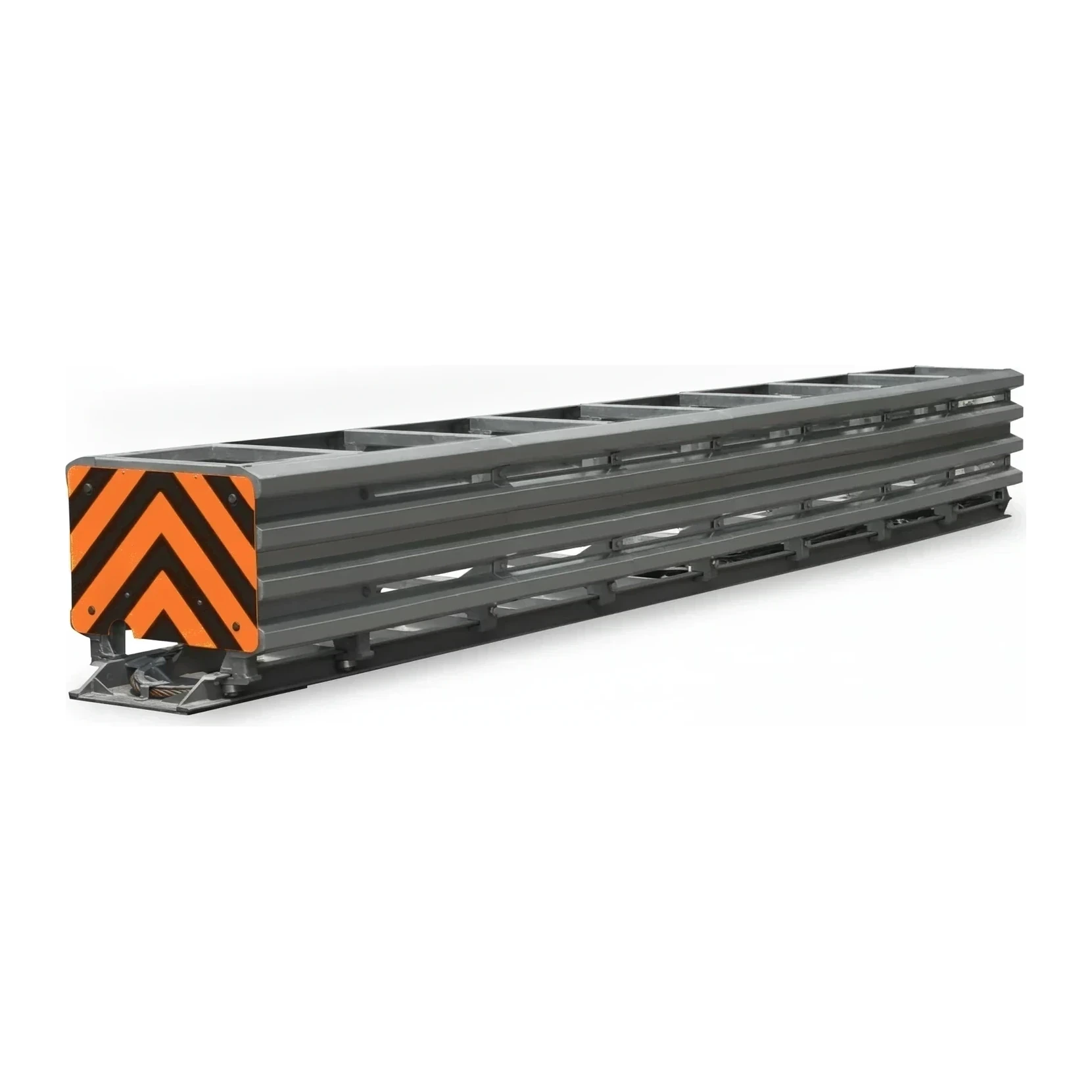
A crash cushion is an energy-absorbing barrier system designed to decelerate an errant vehicle and protect occupants from collision with fixed roadway hazards such as bridge piers, barrier ends, and gore points. Also known as impact attenuators or fixed attenuators, these devices gradually absorb kinetic energy through controlled deformation or displacement of internal materials. They are critical safety devices in work zones and permanent highway installations where hazards cannot be relocated or removed.
How it works
Crash cushions absorb impact energy through one or more mechanisms: crushable cartridges that deform permanently, sand or water-filled modules that displace upon impact, or honeycomb structures that compress in a controlled manner. When a vehicle strikes the cushion, the device decelerates the vehicle over a longer distance and time than would occur in a direct collision with the fixed object, reducing peak forces on vehicle occupants. Most systems are designed for single or limited impacts and require inspection or replacement after each collision. The cushion's length, width, and energy-absorption capacity are engineered to match the posted speed limit and approach conditions of the protected site. Some models are reusable after low-speed impacts, while high-speed collisions typically require component replacement.
Types & variants
- Sand Barrel Array
- Multiple sand-filled barrels arranged in a cluster or line; simple, low-cost solution for lower-speed applications with weight-based energy absorption
- Crushable Cartridge Attenuator
- Uses deformable honeycomb or plastic cartridges within a frame that crush progressively during impact to dissipate energy
- Water-Filled Module System
- Linked modules filled with water that displace and absorb energy through fluid dynamics; often reusable after minor impacts
- Steel Frame Attenuator
- Rigid steel framework with energy-absorbing elements designed for redirective impacts at barrier terminals and high-speed applications
- Temporary Work Zone Attenuator
- Portable or trailer-mounted systems designed for quick deployment and relocation in construction zones
Key specifications
| Specification | Typical range | What it means |
|---|---|---|
| MASH Test Level | TL-2 or TL-3 | Performance rating under Manual for Assessing Safety Hardware crash testing; TL-2 for lower speeds, TL-3 for freeway speeds |
| Length | 12–50 ft (3.7–15.2 m) | Deceleration distance required varies with test level and approach speed; longer systems accommodate higher energy |
| Width | 4–12 ft (1.2–3.7 m) | Lateral dimension at widest point; must accommodate the hazard width plus redirection envelope |
| Impact Resistance | Single-use or limited reuse | Most systems require inspection and component replacement after collision; some water-filled units allow multiple low-speed impacts |
How the industry sizes it
The industry sizes crash cushions primarily by MASH test level, which determines the crash test performance standard the device has passed. TL-2 systems protect fixed hazards on lower-speed roads (typically 45 mph design speed) and are common in urban and work zone applications. TL-3 systems are engineered for freeway-speed impacts (70 mph design speed) and protect barrier ends, bridge piers, and gore points on high-speed facilities. Selection also considers the specific hazard geometry, approach conditions, and whether the installation is temporary or permanent.
Applications
- Protection of bridge piers and overhead sign supports on highways
- Shielding barrier terminals and gore points at freeway interchanges
- Temporary protection of construction equipment and material stockpiles in work zones
- Permanent installation at toll plaza islands and median barrier ends
- Shielding utility poles, signal cabinets, and other fixed roadside obstacles
- Protection of temporary concrete barrier transitions and tapers
Safety & operation
- Proper anchoring and ballasting are critical; inadequate securing can cause the cushion to displace prematurely and reduce effectiveness
- Post-impact inspection protocols must be followed to assess structural integrity and determine replacement needs
- Visibility enhancement with reflective sheeting and markings ensures approaching drivers can detect the protected hazard
- Installation must follow manufacturer specifications and approved plans to ensure crash-tested performance is achieved in the field
- Regular inspections check for displaced components, vandalism, deterioration of materials, and proper alignment with the protected hazard
Standards & certifications
- AASHTO MASH · Manual for Assessing Safety Hardware
- Defines crash test criteria and performance evaluation for TL-2 through TL-6 test levels used to certify impact attenuators
- FHWA · Eligibility List
- Federal Highway Administration maintains list of approved crash cushions eligible for use on federal-aid highway projects
- MUTCD · Manual on Uniform Traffic Control Devices
- Provides guidance on placement, visibility, and markings for crash cushions in work zones and permanent installations
- NCHRP · Report 350 (legacy)
- Previous crash test standard now superseded by MASH; many existing installations were certified under NCHRP 350 criteria
Frequently asked
What is the difference between TL-2 and TL-3 crash cushions?
Can a crash cushion be reused after an impact?
How is a crash cushion different from a guardrail?
What maintenance do crash cushions require?
Related equipment
Browse by manufacturer
All models
10 models · Every spec cited to source