

Air-Cooled Chiller
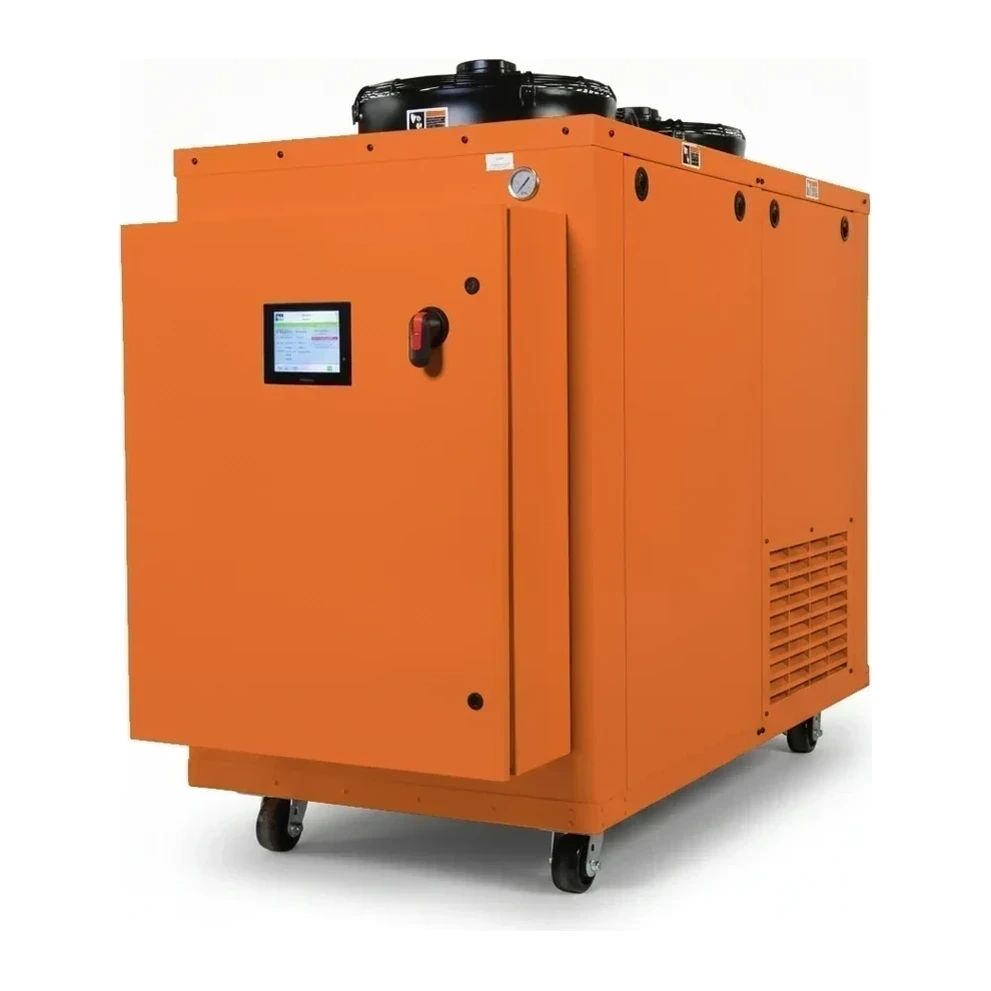
An air-cooled chiller is a self-contained refrigeration machine that produces chilled water by rejecting heat to ambient air rather than to a cooling tower or water loop. These units are widely deployed in the industry for temporary cooling, emergency backup during equipment failures, seasonal peak load support, and process cooling applications where water-cooled infrastructure is unavailable or impractical.
Cómo funciona
The chiller circulates a refrigerant through a vapor-compression cycle: a compressor raises refrigerant pressure and temperature, the hot gas flows through an air-cooled condenser where fans blow ambient air across finned coils to reject heat, the refrigerant then passes through an expansion valve to drop pressure, and finally the cold refrigerant absorbs heat from process water in an evaporator. The chilled water loop circulates through connected equipment or air handlers, returning warmer water to the chiller to be cooled again. Air-cooled chillers require only electrical power and process water connections, eliminating the need for cooling towers, condenser water pumps, and water treatment systems. Portable units typically ship as complete packages with integrated controls, pumps, and refrigerant charge, ready to connect to temporary distribution piping or existing building infrastructure.
Tipos y variantes
- Scroll Compressor Chillers
- Use scroll compressors for quiet, reliable operation; common in small to mid-size units up to about 60 tons.
- Screw Compressor Chillers
- Employ rotary screw compressors for higher capacities and continuous-duty industrial applications, typical above 60 tons.
- Skid-Mounted Portables
- Factory-assembled on a steel skid or frame with lifting points and forklift pockets for easy jobsite placement.
- Trailer-Mounted Chillers
- Built onto road-towable trailers for rapid deployment and relocation; often used for emergency response or events.
- Low-Ambient Chillers
- Equipped with head-pressure control and special controls to maintain operation in cold outdoor conditions.
- High-Efficiency Chillers
- Feature variable-speed drives, advanced controls, and optimized heat exchangers to reduce energy consumption.
Especificaciones clave
| Especificación | Rango típico | Qué significa |
|---|---|---|
| Cooling Capacity | 10-500+ tons | The refrigeration output, sized to match building or process heat load; the primary sizing parameter. |
| Airflow | 1,110-4,000 cfm | Volume of ambient air moved across the condenser coils to reject heat; determines clearance and noise considerations. |
| Chilled Water Temperature | 40-50°F leaving | The supply water temperature delivered to the process or air handlers; field-adjustable within design limits. |
| Power Supply | 208-480V, 3-phase | Electrical requirements vary with chiller size; larger units typically require higher voltages and dedicated feeds. |
| Refrigerant Type | R-410A, R-134a, R-513A | The working fluid in the refrigeration cycle; must comply with environmental regulations and efficiency standards. |
Cómo la industria lo dimensiona
The industry sizes air-cooled chillers by cooling capacity in tons of refrigeration (one ton equals 12,000 Btu/hr). Units up to 25 tons provide self-contained chilled water for a tent, a small process loop, or one air handler. The 25-60 ton range handles a floor of a building or a mid-size process load: the everyday chiller in the fleet. Chillers from 60-150 tons cover a whole building or a production line while the plant chiller is down. Large units from 150-350 tons handle large temporary cooling: hospital, data hall, or turnaround; these ship on a lowboy. Plant-scale cooling above 350 tons typically involves several units paralleled into one loop.
Aplicaciones
- Emergency replacement cooling when permanent building chillers fail or undergo maintenance
- Temporary HVAC for construction sites, temporary structures, tents, and special events
- Supplemental cooling during peak summer loads or building expansions before permanent equipment is installed
- Industrial process cooling for manufacturing, plastics processing, and chemical production
- Data center and server room environmental control for IT equipment protection
- Medical and pharmaceutical facility temperature control during renovations or equipment upgrades
Seguridad y operación
- Maintain manufacturer-specified clearances around air intake and discharge to prevent recirculation of warm exhaust air and ensure adequate condenser performance
- Verify electrical connections match chiller nameplate voltage and phase; ensure proper grounding and overcurrent protection per NEC requirements
- Monitor refrigerant charge and inspect for leaks regularly; refrigerants are regulated substances requiring certified technicians for service
- Protect water piping from freezing during shutdown in cold climates; drain or use glycol solutions as appropriate
- Ensure adequate structural support for skid-mounted or trailer units, especially on rooftops or elevated platforms where weight loads must be verified
Normas y certificaciones
- AHRI · Standard 550/590
- Performance rating standards for water-chilling and heat-pump water-heating packages using the vapor-compression cycle
- ASHRAE · Standard 15
- Safety standards for refrigeration systems, covering design, construction, installation, and operation of mechanical refrigeration
- EPA · Section 608/609
- Federal regulations governing refrigerant handling, recovery, recycling, and technician certification to protect stratospheric ozone
Preguntas frecuentes
How does an air-cooled chiller differ from a water-cooled chiller?
What factors affect the capacity of an air-cooled chiller?
Can air-cooled chillers operate in cold weather?
What is the typical lead time for chiller deployment?
Equipos relacionados
Explorar por fabricante
Fuentes
Cada especificación se verifica con los datos publicados por el fabricante, con la fuente enlazada como referencia.
Todos los modelos
127 modelos · Página 3 de 3 · Cada especificación citada a la fuente