

Concrete Barrier
A concrete barrier is a precast concrete traffic control device designed to physically separate lanes of traffic, redirect vehicles, or protect work zones and construction sites. Also known as jersey barriers or K-rail, these modular units provide positive protection through their mass and sloped profile. The tapered shape deflects vehicles upward upon impact, redirecting them back into their lane while minimizing damage.
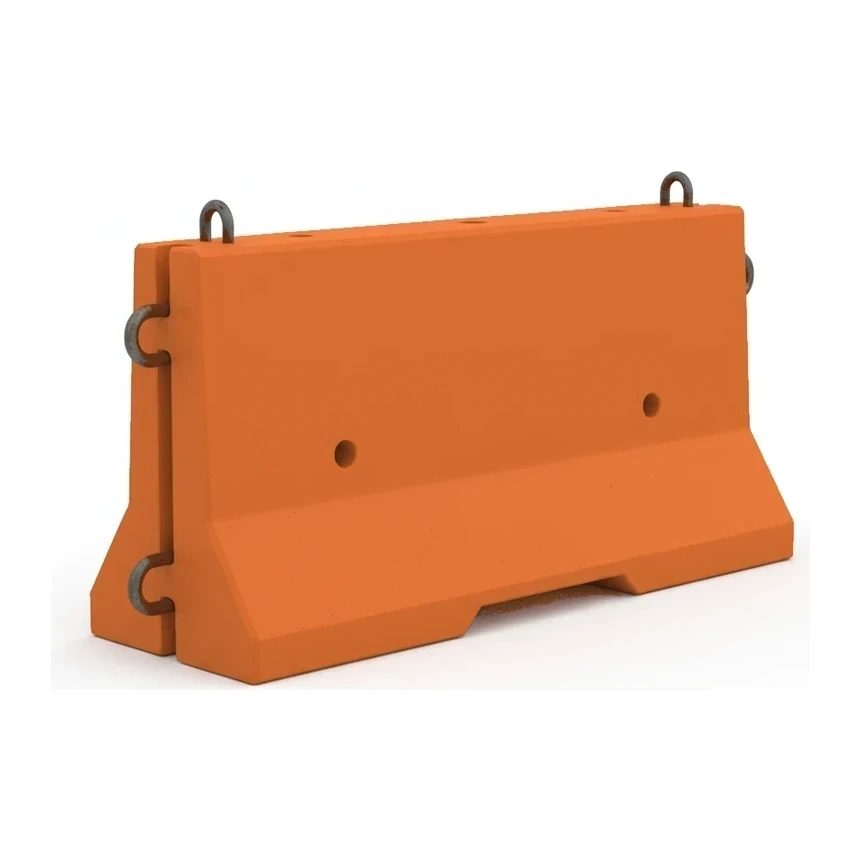
Cómo funciona
Concrete barriers function through passive protection, relying on their weight (typically 4,000+ pounds for a 10-foot section) and distinctive profile to contain and redirect vehicular impacts. The classic jersey barrier shape features a sloped lower section (typically 10 inches high at a shallow angle) that lifts the vehicle's tire, followed by a near-vertical upper section that redirects the vehicle parallel to the barrier. The barrier's mass absorbs impact energy while preventing penetration into protected areas. Deployment typically involves lifting and positioning individual sections using forklifts, cranes, or specialized barrier-moving equipment. Sections connect end-to-end to form continuous runs, with pin-and-loop or other connection systems available for permanent or semi-permanent installations. The modular design allows configurations to match site-specific traffic control needs, from single-lane closures to multi-mile highway median separations.
Tipos y variantes
- Standard Jersey Barrier
- The most common profile with symmetric sloped faces, designed to redirect vehicles from either side; widely used for temporary and permanent traffic separation
- F-Shape Barrier
- Modified profile with a steeper lower slope and vertical upper section; developed for higher-impact scenarios and often used on high-speed roadways
- Constant Slope Barrier
- Single-slope profile from base to top; simpler to manufacture and often used where space constraints limit barrier width
- Temporary (Portable) Barrier
- Designed for frequent relocation with lifting pockets or slots; typically not interconnected and used for short-duration traffic control
- Permanent (Fixed) Barrier
- Heavier sections designed for long-term installation, often interconnected with pins or post-tensioning for highway median applications
Especificaciones clave
| Especificación | Rango típico | Qué significa |
|---|---|---|
| Length | 10 to 12 ft per section | Standard module length balancing transportability, installation efficiency, and joint frequency |
| Height | 32 in (81.3 cm) | Standard height provides adequate vehicle containment while maintaining visibility for most passenger vehicles |
| Base Width | 24 in (61.0 cm) | Foundation width providing stability against impact forces and tipping moments |
| Weight | 4,000 lb per 10 ft section | Mass required to resist displacement during vehicle impacts and maintain barrier integrity |
Cómo la industria lo dimensiona
The industry sizes concrete barriers primarily by length in feet, with standard sections ranging from 10 to 12 feet representing the most common configurations for general traffic control. Longer sections exceeding 12 feet are manufactured for highway median installations and long-duration projects where minimizing joints improves continuity and reduces installation time. Height (typically 32 inches) and profile type (jersey, F-shape, constant slope) are specified based on crash test ratings and application requirements, but length remains the primary dimensional variable for ordering and deployment planning.
Aplicaciones
- Work zone protection separating traffic from construction activities on roadways and highways
- Lane separation during road rehabilitation, resurfacing, and long-term maintenance projects
- Highway median barriers providing positive separation between opposing traffic flows
- Temporary road closures and detours redirecting traffic around incidents or planned events
- Perimeter security at facilities, events, and sensitive sites requiring vehicle access control
- Parking lot delineation and protection of structures, utilities, or pedestrian areas from vehicle incursion
Seguridad y operación
- Barriers must be placed on stable, level surfaces to prevent tipping or displacement under impact loads
- Adequate clearance from the active work zone protects workers while maintaining sufficient roadway width for traffic flow
- End treatments such as tapers or crash cushions are required where barrier runs terminate in line with traffic to prevent head-on impacts
- Proper connection between sections prevents separation during impacts and maintains continuous protection in permanent installations
- Lifting operations require equipment rated for barrier weight and secure rigging to prevent dropped loads during placement or removal
Normas y certificaciones
- MASH · Manual for Assessing Safety Hardware
- Establishes crash test criteria and Test Levels (TL-1 through TL-6) for evaluating barrier performance under vehicular impacts
- MUTCD · Manual on Uniform Traffic Control Devices
- Provides guidance on proper placement, visibility treatments, and traffic control device integration for temporary and permanent barriers
- AASHTO · Roadside Design Guide
- Contains design standards for barrier geometry, placement, end treatments, and transitions between barrier types
- OSHA · 29 CFR 1926 Subpart G
- Addresses work zone safety requirements including traffic control and worker protection in construction areas
Preguntas frecuentes
What is the difference between a jersey barrier and K-rail?
How are concrete barriers moved and positioned on site?
Can concrete barriers be connected together?
What determines the appropriate barrier height for an application?
Equipos relacionados
Explorar por fabricante
Todos los modelos
1 modelos · Cada especificación citada a la fuente