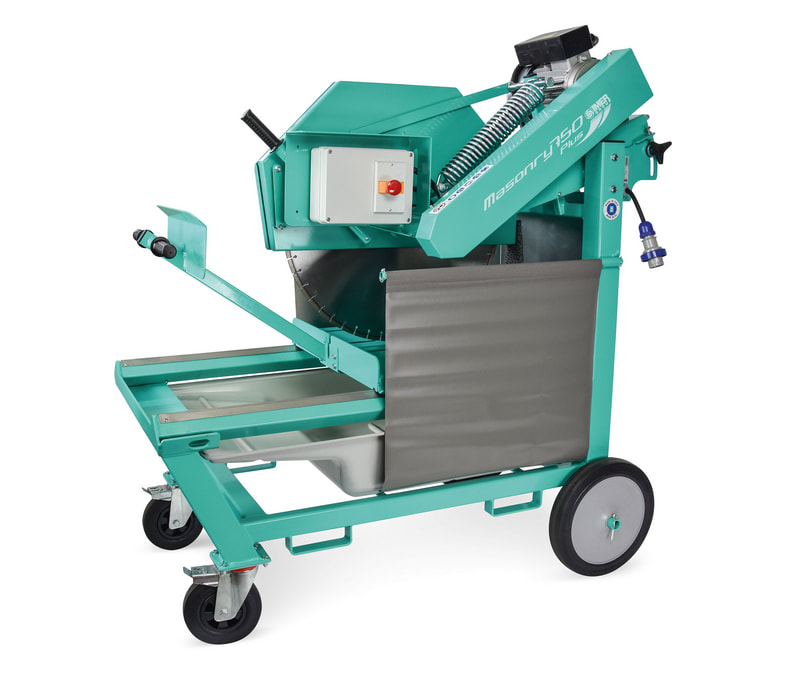

Masonry Saw
A masonry saw is a stationary or portable table saw equipped with a diamond blade and water delivery system, designed to cut brick, concrete block, pavers, and concrete masonry units (CMU). These saws feature a sliding table or fixed blade carriage that guides the workpiece through the cut, producing clean, precise cuts in masonry materials. Masonry saws are essential equipment in commercial and residential masonry construction, hardscape installation, and concrete block work.
How it works
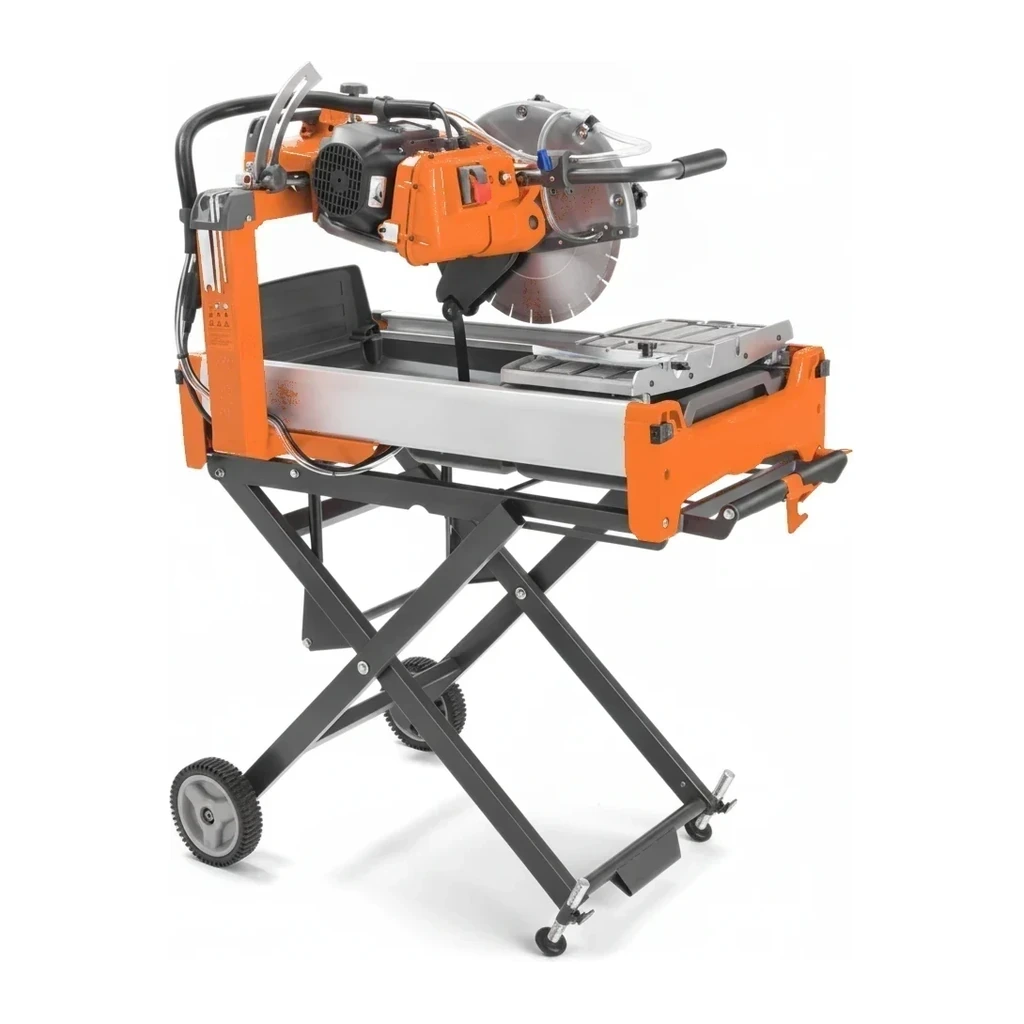
The masonry saw uses a circular diamond blade spinning at high RPM to abrade through masonry materials rather than cutting with teeth. As the operator feeds the workpiece across the sliding table or moves the blade carriage, a continuous water stream flows onto the blade and cut line to suppress dust, cool the blade, and flush away slurry. The water delivery system is integral to operation, preventing blade overheating and eliminating respirable crystalline silica dust. Most masonry saws position the blade vertically or at a slight angle, with the workpiece resting on a steel or aluminum table that slides on rails. The blade guard encloses the upper portion of the blade while allowing the workpiece to pass through. Engine-powered models use gasoline engines ranging from 5.0 to 13.0 hp, while electric versions draw from standard or high-voltage power sources depending on blade size and intended duty cycle.
Types & variants
- Portable Table Saw
- Compact masonry saw with 10-14 in blade capacity, designed for transport to job sites; typically features folding stand and wheels for mobility.
- Stationary Block Saw
- Heavy-duty masonry saw with 15-20 in blade capacity for full CMU cutting; features robust steel frame and larger water reservoir for continuous operation.
- Paver Saw
- Specialized masonry saw optimized for cutting pavers and thin brick; typically features extended table length and quick-adjust guides for repetitive cuts.
- Dual-Blade Saw
- Masonry saw equipped with two parallel blades for simultaneous cuts, enabling controlled joint cutting and precise width removal.
- Tile and Masonry Combo Saw
- Versatile saw designed for both tile and light masonry work; typically features adjustable blade height and interchangeable blade options.
Key specifications
| Specification | Typical range | What it means |
|---|---|---|
| Blade Diameter | 1-14 in or 15-20 in | Maximum blade size the saw accommodates; determines maximum cutting depth and workpiece size capacity. |
| Engine Power | 5.0-13.0 hp | Gasoline engine horsepower available to drive the blade through dense masonry materials under load. |
| Maximum Cutting Depth | 3.5–8 in (8.9–20.3 cm) | Deepest cut the saw can make in a single pass, typically 40-50% of blade diameter depending on arbor position. |
| Table Size | 24-48 in length | Dimensions of the sliding work table that supports and guides the masonry unit through the blade. |
| Water Reservoir Capacity | 10-30 gallons | Volume of onboard water storage for continuous dust suppression and blade cooling during operation. |
How the industry sizes it
The masonry saw industry sizes equipment by blade diameter measured in inches. Saws in the 1-14 in range serve as portable table saws for cutting brick, pavers, and thin block on smaller projects where maneuverability matters. Saws in the 15-20 in range function as full block saws capable of cutting full-width CMU (concrete masonry units) and large pavers in a single pass without requiring the operator to flip the workpiece. The blade diameter directly correlates to maximum cutting depth, with larger blades accommodating taller block and thicker materials while requiring more powerful engines and heavier construction.
Applications
- Cutting concrete masonry units (CMU) and cinder block to length for wall construction
- Trimming brick and thin brick veneer for residential and commercial masonry projects
- Cutting pavers and retaining wall blocks for hardscape and landscape installation
- Producing precise cuts in stone veneer and natural stone masonry materials
- Cutting control joints and expansion joints in precast concrete products
- Fabricating custom masonry shapes and angles for architectural details
Safety & operation
- Maintain continuous water flow to the blade to suppress respirable crystalline silica dust and prevent dry cutting
- Verify blade guard is properly positioned and secured before starting the saw
- Ensure the workpiece is firmly positioned against the guide fence and table before initiating the cut
- Wear eye protection, hearing protection, and waterproof gloves when operating wet masonry saws
- Position the saw on stable, level ground and verify the water reservoir is filled before each operating session
Standards & certifications
- OSHA · 29 CFR 1926.1153
- Specifies permissible exposure limits for respirable crystalline silica and requires wet-cutting methods or equivalent dust controls for masonry saws.
- ANSI · B7.1/B7.5
- Establishes safety requirements for the use, care, and protection of abrasive wheels including diamond blades used on masonry saws.
- EPA · Tier 4
- Emissions standards applicable to gasoline and diesel engines powering masonry saws, particularly for newer commercial-grade models.
- CSA · Z62
- Canadian standards for masonry saw construction, guarding, and operational safety in construction environments.
Frequently asked
What is the difference between a 14 in and 20 in masonry saw?
Why do masonry saws require water during operation?
Can a masonry saw cut natural stone and engineered pavers?
What engine power is needed for cutting CMU all day?
Related equipment
Browse by manufacturer
Sources
Every specification is verified against the manufacturer's published data, with the source linked for reference.
All models
20 models · Every spec cited to source