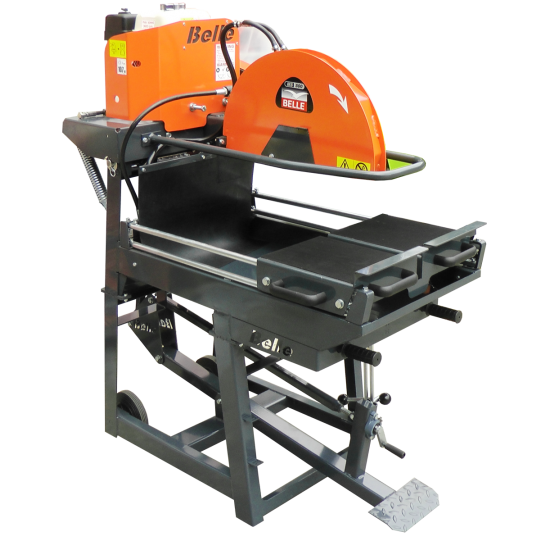

Tile Saw
A tile saw is a stationary or portable cutting tool designed to make precise cuts in ceramic tile, porcelain, natural stone, and masonry materials using a diamond-coated blade. The equipment employs water cooling to reduce blade friction, minimize dust, and produce clean cuts without chipping or cracking the material. Tile saws are essential equipment in flooring installation, bathroom remodeling, and masonry work.
How it works
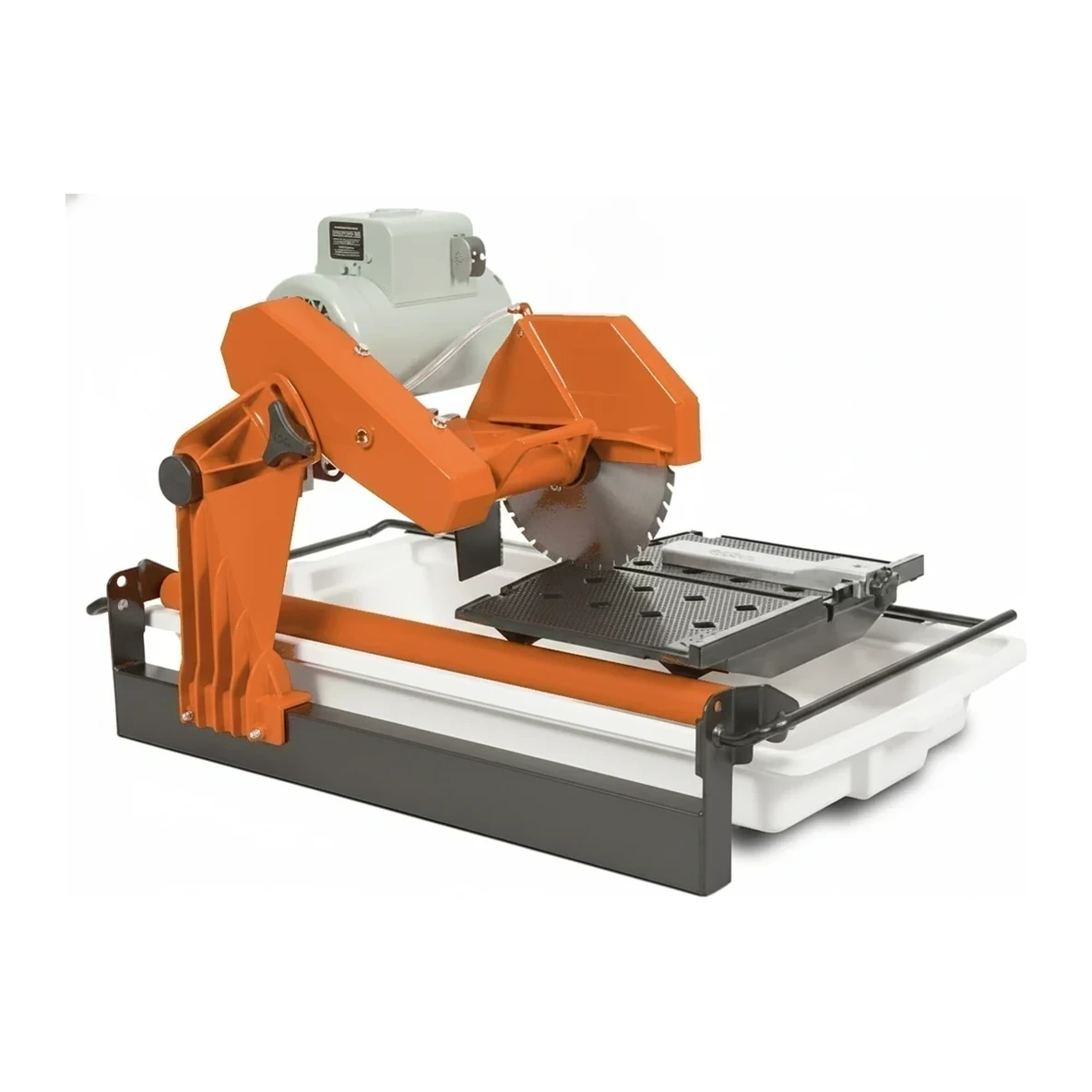
The tile saw operates by rotating a circular diamond blade through the material while water is continuously pumped over the cutting area. The water serves multiple functions: cooling the blade to prevent overheating, lubricating the cut to reduce friction, and suppressing dust particles. Material is fed into the blade either by sliding the workpiece on a table past a fixed blade (bench-style) or by moving a blade carriage along rails over a stationary workpiece (bridge or rail-style). Most tile saws feature adjustable fences and miter gauges to ensure accurate straight cuts and angled cuts. The blade typically rotates at speeds between 3,000-5,000 RPM, with the diamond-embedded rim grinding through hard materials rather than cutting with teeth. A water reservoir and pump system recirculates water through the cutting area, with some models incorporating filtration to extend water life.
Types & variants
- Bench Wet Saw
- Compact tabletop units with fixed blades where material slides on a table; typically 7-10 inch blade capacity for standard tile work.
- Rail Saw
- Mid-sized saws where the blade carriage moves along rails above a stationary table; suitable for larger format tiles and pavers.
- Bridge Saw
- Heavy-duty professional saws with overhead blade assemblies that bridge across large tables; designed for cutting stone slabs and large-format porcelain panels.
- Portable Tile Saw
- Lightweight, compact models designed for jobsite mobility; typically feature smaller blade diameters and reduced cutting capacity.
- Masonry Saw
- Heavy-duty saws optimized for cutting pavers, brick, and block; often feature larger blade diameters and reinforced frames for masonry applications.
Key specifications
| Specification | Typical range | What it means |
|---|---|---|
| Blade Diameter | 7-14 in (common models at 10 in, 14 in observed at 355 mm) | Determines maximum cutting depth and material capacity; larger diameters accommodate thicker materials and longer cuts. |
| Cutting Capacity | Measured in inches, typically 24-36 in for rail/bridge saws | The maximum length of straight cut the saw can accommodate, critical for large-format tile and stone slabs. |
| No-Load Speed | 3,800 RPM | The blade rotation speed without material contact; affects cutting efficiency and finish quality across different materials. |
| Net Weight | 16-120 lb depending on type (portable to bridge) | Indicates portability versus stability; heavier units provide vibration reduction for precision cuts. |
| Arbor/Hole Diameter | 25.4 mm (1 in) or 20 mm | The blade mounting hole size; must match compatible blade specifications for safe operation. |
How the industry sizes it
The tile saw industry sizes equipment primarily by blade diameter, measured in inches, which directly correlates to cutting capacity and application. Saws under 8 inches are classified as bench wet saws suitable for wall tile and standard floor tile installation. Models 8 inches and larger transition to rail or bridge saw configurations with the capacity for large-format porcelain, natural stone slabs, and thick masonry materials. Maximum rip capacity (diagonal or lengthwise cutting distance) serves as a secondary sizing metric, particularly for professional-grade equipment where large-format material handling is essential.
Applications
- Ceramic and porcelain floor tile installation in residential and commercial spaces
- Natural stone cutting for countertops, backsplashes, and wall cladding
- Large-format tile and slab fabrication for modern architectural installations
- Concrete paver and hardscape cutting for patios, walkways, and landscape projects
- Brick and masonry block cutting for construction and restoration work
- Glass tile and mosaic cutting for specialty decorative applications
Safety & operation
- Maintain proper water flow at all times during operation to prevent blade overheating, material cracking, and dust generation
- Ensure stable material support and secure workpiece positioning to prevent shifting during cutting operations
- Wear eye protection and hearing protection; water spray can carry fine particulate matter despite dust suppression
- Verify ground fault circuit interrupter (GFCI) protection on all electrical connections due to water presence around electrical components
- Inspect diamond blades before each use for cracks, missing segments, or excessive wear that could cause blade failure
Standards & certifications
- ANSI · B7.1/B7.5
- Safety requirements for the use, care, and protection of abrasive wheels and cutting-off wheels used in tile saws.
- OSHA · 29 CFR 1926.304
- Regulations covering woodworking tools that extend to powered saws including guarding and operational safety requirements.
- CSA · C22.2 No. 71.2
- Canadian standards for motor-operated hand-held tools and stationary equipment including tile cutting saws.
- ANSI · A300.1
- Specifications for diamond blades used in tile and stone cutting applications, addressing blade construction and safety.
Frequently asked
What is the difference between a tile saw and a masonry saw?
How is blade size related to cutting depth?
Why do some tile saws have the blade above the table versus below?
What determines whether to use a rail saw versus a bridge saw?
Compare popular models
Find by spec →Normalised to the same units. A dash means the figure was not published.
| Model | Engine power | Operating weight |
|---|---|---|
| Makita 2414DB | - | - |
| Makita 2414NB | - | - |
| Makita 2414B | - | - |
Related equipment
Browse by manufacturer
Sources
Every specification is verified against the manufacturer's published data, with the source linked for reference.
All models
31 models · Every spec cited to source