

Long-Reach Excavator
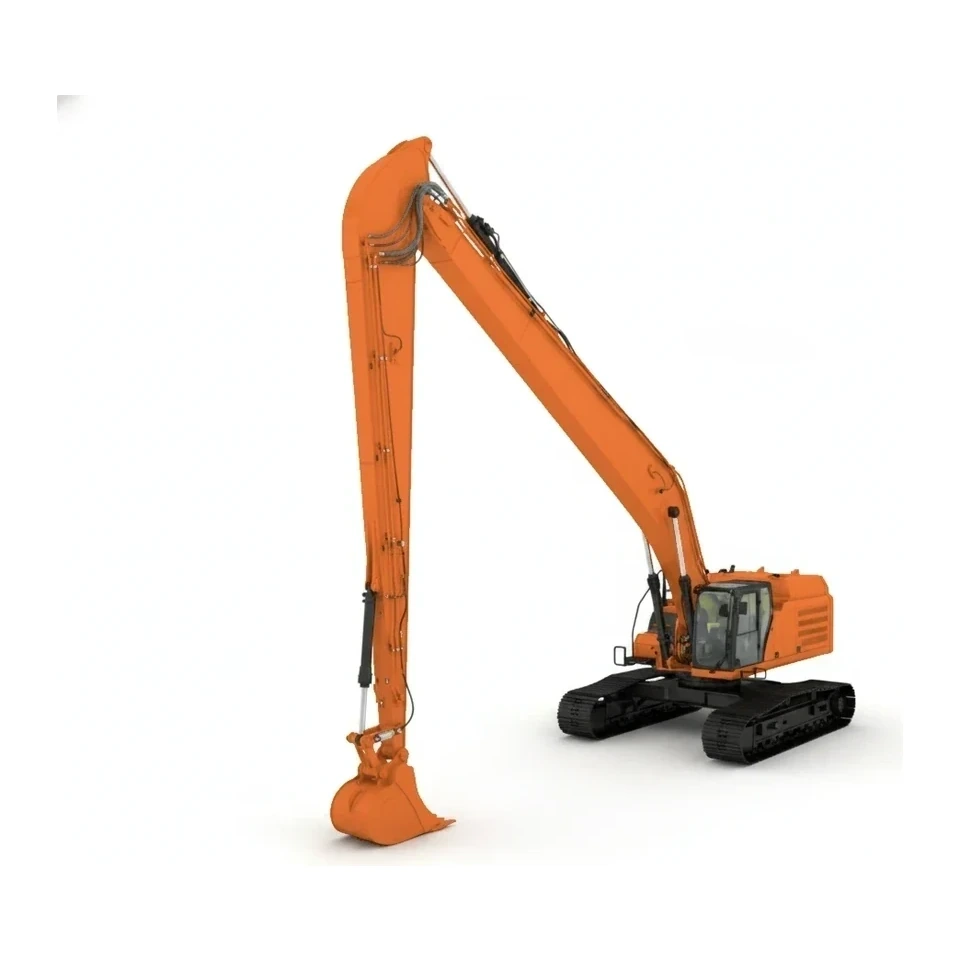
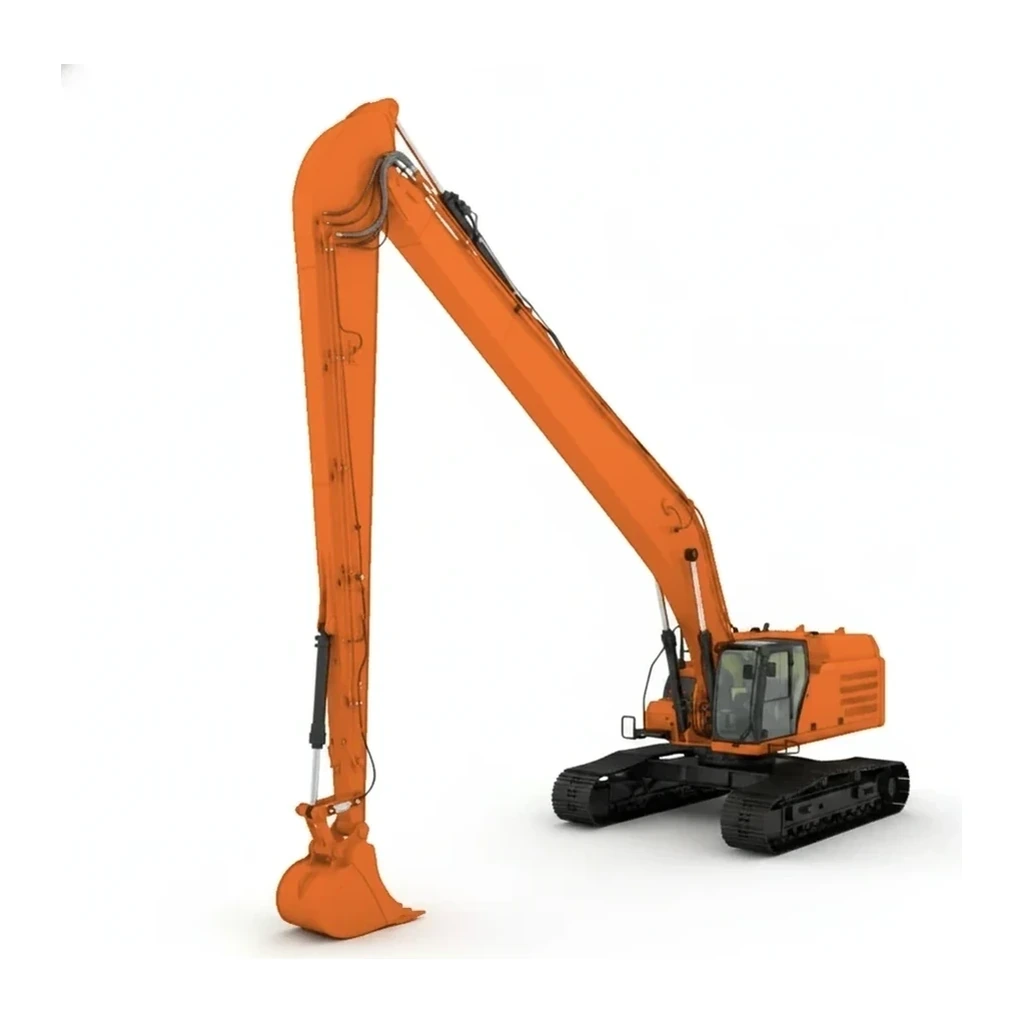
A long-reach excavator is a crawler excavator fitted with an extended boom and stick that place the bucket far beyond the working envelope of a standard front. It exists for work where the machine cannot sit close to the cut — dredging, deep excavation and slope work — trading breakout force and lift capacity for horizontal reach and vertical depth.
Cat classes
Pick a size class: capacity and reach differ across the range.
How it works
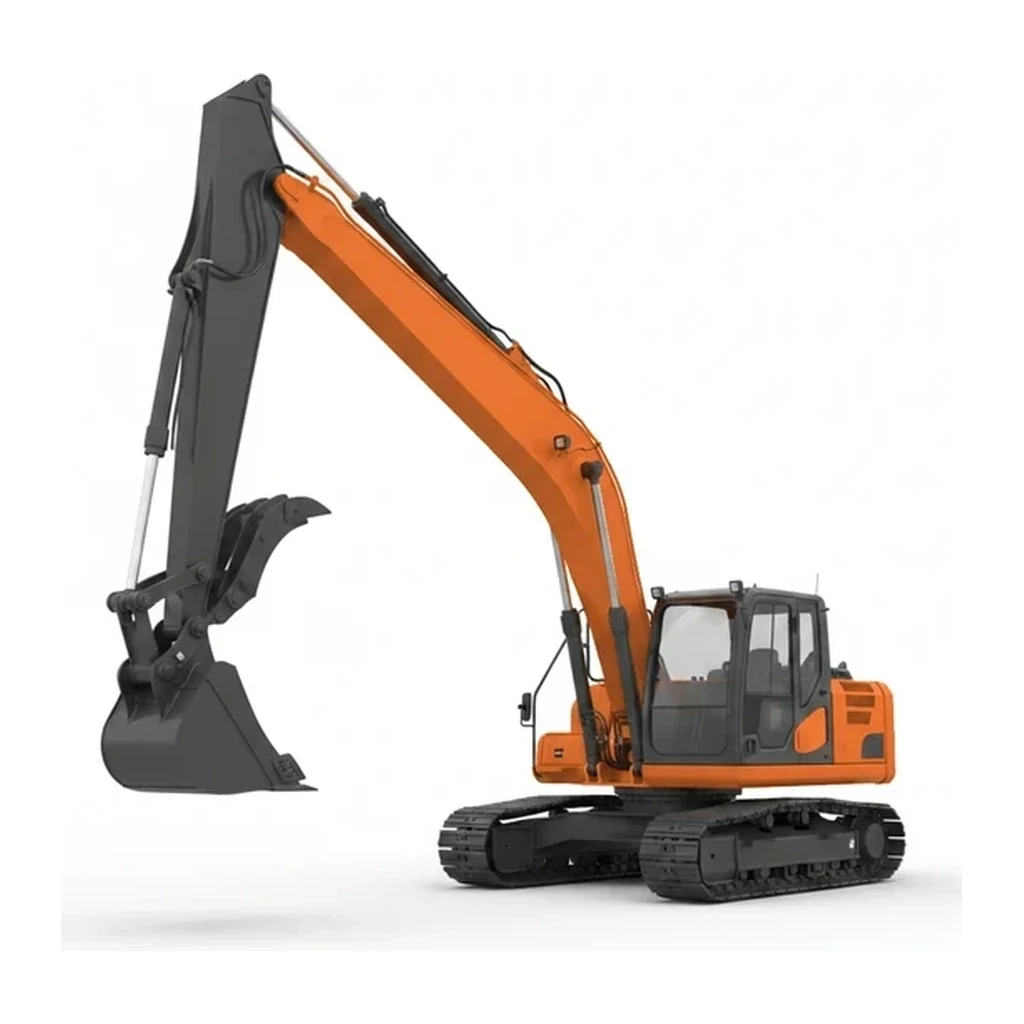
The base machine is a conventional hydraulic crawler excavator: a diesel engine drives hydraulic pumps that feed cylinders on the boom, stick and bucket, with swing and travel motors completing the circuit. The long-reach front replaces the standard boom and stick with longer, lighter fabrications, and the counterweight and undercarriage are matched to keep the machine stable at full extension. Because the load sits farther from the slew ring, hydraulic forces at the bucket are lower than on a standard machine of the same weight. Long-reach fronts therefore carry smaller, lighter buckets and are worked with smoother, lower-force cycles, typically skimming and pulling material toward the machine rather than making heavy breakout cuts.
Types & variants
- Factory long-reach crawler
- A production excavator built or converted with a matched long boom and stick, the most common configuration in the 50,000-100,000 lb bands.
- Super-long-front configuration
- An ultra-long two-piece front for extreme reach and depth, used with a small bucket and a dedicated stability package; accounts for the deepest dig-depth figures in the class.
- Interchangeable-front machine
- A base excavator with pin-and-hose provisions to swap between a standard front and a long-reach front, giving one carrier two working envelopes.
- Barge- or mat-supported long reach
- A long-reach machine worked from a pontoon barge or timber/composite mats for dredging and shoreline work where ground bearing is poor.
Key specifications
| Specification | Typical range | What it means |
|---|---|---|
| Operating weight | 50,000–100,000 lb (22,680–45,359 kg) | Base-machine weight drives stability at full extension; the catalog bands this class at 50,000-70,000 lb and 70,000-100,000 lb. |
| Maximum reach | 34–54 ft (10.4–16.5 m) | The defining spec — horizontal distance from the slew center to the bucket, roughly double a comparable standard front. |
| Maximum dig depth | 20–90 ft (6.1–27.4 m) | Vertical envelope below grade; the deepest figures come from special ultra-long fronts, while common long-reach work sits well inside the range. |
| Engine power | 68-430 hp | Hydraulic capacity for swing-heavy duty cycles; power scales with base-machine weight across the class. |
How the industry sizes it
Long-reach excavators are sized by the operating weight of the base machine, because base weight and counterweight — not engine power — determine how much front can be carried at full extension. The catalog splits the class into a 50,000-70,000 lb band and a 70,000-100,000 lb band; reach and allowable bucket size step up with each band, and the industry commonly quotes a machine as its base-weight class plus its reach figure.
Applications
- Dredging ponds, lagoons, canals and river channels from the bank or from mats
- Deep utility, foundation and shaft excavation where the machine must stay back from the cut
- Slope profiling and embankment finishing on highways and levees
- Sediment and sludge removal at treatment plants and industrial impoundments
- Demolition support work that needs stand-off distance from the structure
- Shoreline stabilization and riprap placement
Safety & operation
- Lift and dig only against the long-reach load chart — capacity is substantially lower than a standard machine of the same weight, and standard-front habits over-load the front.
- Verify ground bearing or work from mats; long-reach machines routinely sit on embankments, fills and shorelines where edge failure is the dominant hazard.
- Maintain powerline clearance across the full reach arc — the extended front covers far more overhead sky than a standard boom.
- Control the swing: a loaded bucket at full radius carries high momentum, and abrupt swing reversals destabilize the machine.
- Keep personnel clear of the extended working radius, which can sweep well beyond typical exclusion zones.
Standards & certifications
- OSHA · 29 CFR 1926.602
- Material handling equipment rules covering earthmoving machines on U.S. construction sites.
- ISO · ISO 10567
- Rated lift capacity method for hydraulic excavators, the basis of the load charts long-reach work depends on.
- EPA · Tier 4 Final (40 CFR Part 1039)
- Emissions requirements for the nonroad diesel engines powering current-production machines.
- OSHA · 29 CFR 1926 Subpart P
- Excavation and trenching requirements that govern the digs long-reach machines support.
Frequently asked
How is a long-reach excavator different from a standard excavator?
When does a job call for a long-reach machine?
Does the long front reduce what the machine can lift?
What does transporting a long-reach excavator involve?
Compare popular models
Find by spec →Normalised to the same units. A dash means the figure was not published.
| Model | Operating weight | Max dig depth | Max reach | Engine power |
|---|---|---|---|---|
| Hitachi ZX130-7 SLF | 33,951 lb (15,400 kg) | 33.3 ft (10.1 m) | 43.1 ft (13.1 m) | 99 hp |
| Hitachi ZX210-7 SLF | 56,218 lb (25,500 kg) | 37.9 ft (11.6 m) | 50.5 ft (15.4 m) | 172 hp |
| Hitachi ZX250/300/350-7 SLF | 87,083 lb (39,500 kg) | 29.1 ft (8.9 m) | - | 282 hp |
| Hitachi ZX390TC-7 Demolition | 86,421 lb (39,200 kg) | 24.2 ft (7.4 m) | 36.4 ft (11.1 m) | 282 hp |
| Hitachi ZX490-7 SLF | 116,625 lb (52,900 kg) | 39.1 ft (11.9 m) | 54.4 ft (16.6 m) | 397 hp |
| Hitachi ZX95US-7 SLF | 20,988 lb (9,520 kg) | 23 ft (7.0 m) | 33.5 ft (10.2 m) | 68 hp |
Related equipment
Browse by manufacturer
Sources
Every specification is verified against the manufacturer's published data, with the source linked for reference.