

Backhoe Loader
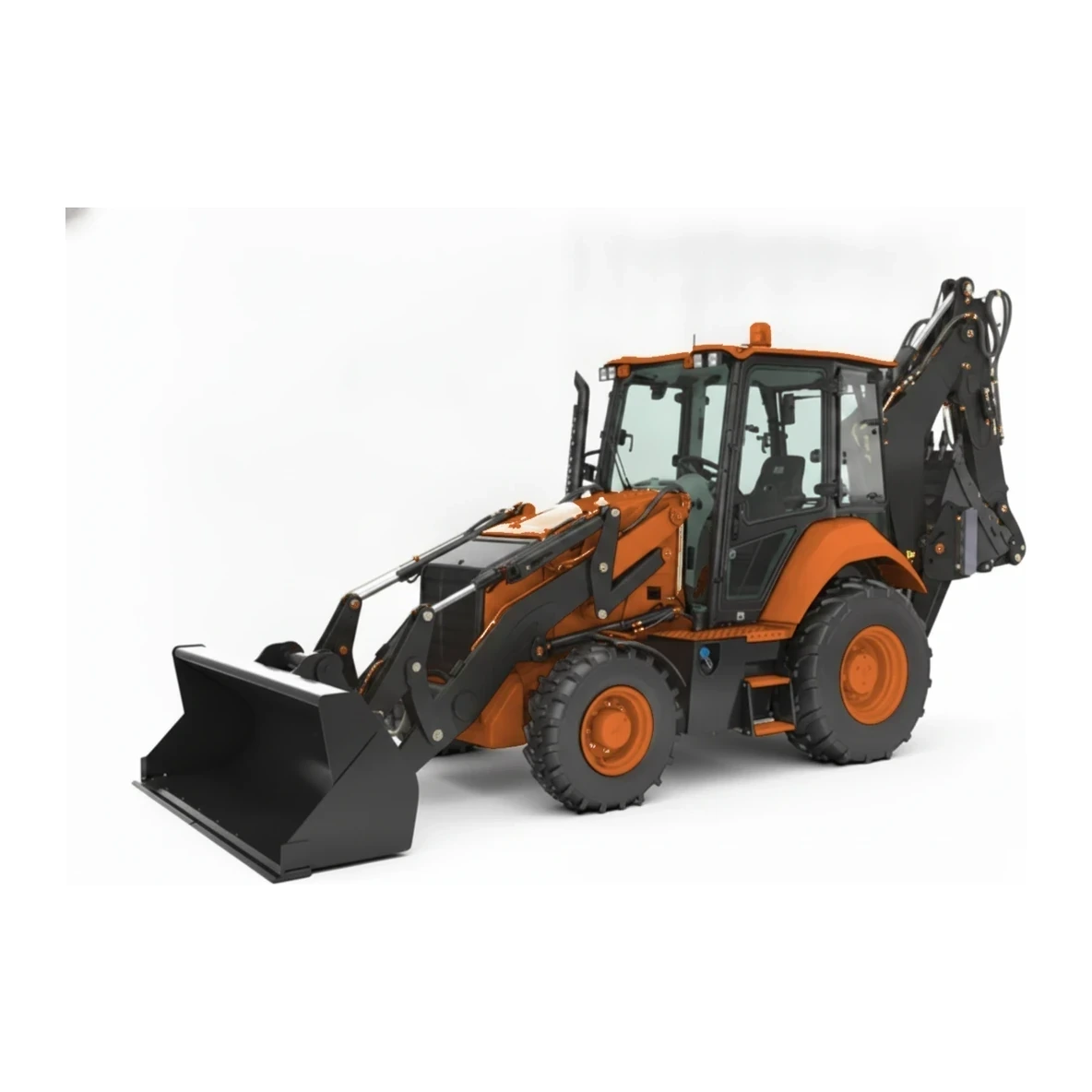
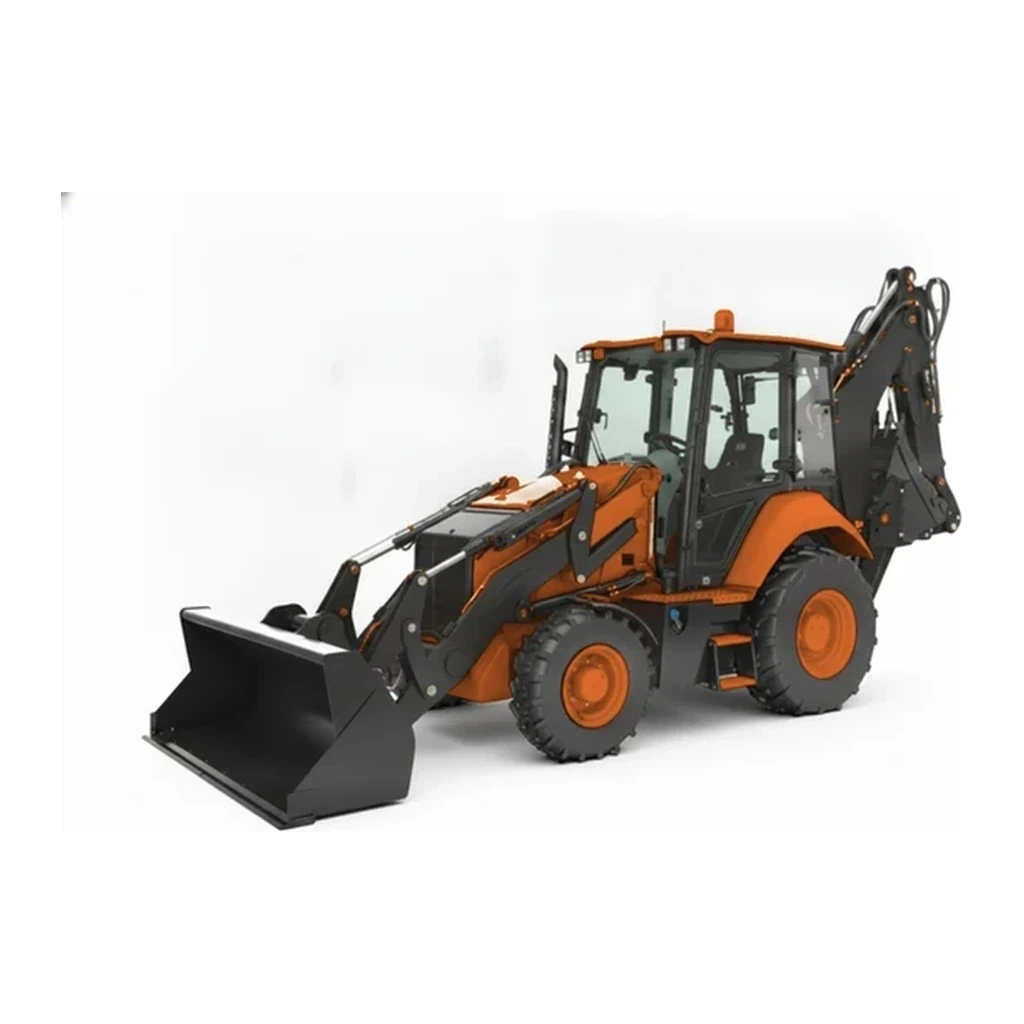
A backhoe loader is a wheeled machine with a loader bucket on the front and an excavator-style backhoe on the rear, built around a tractor-derived chassis. It is construction's general-purpose utility machine: one unit that digs trenches, loads trucks, backfills and travels between tasks on its own wheels.
Cat classes
Pick a size class: capacity and reach differ across the range.
How it works
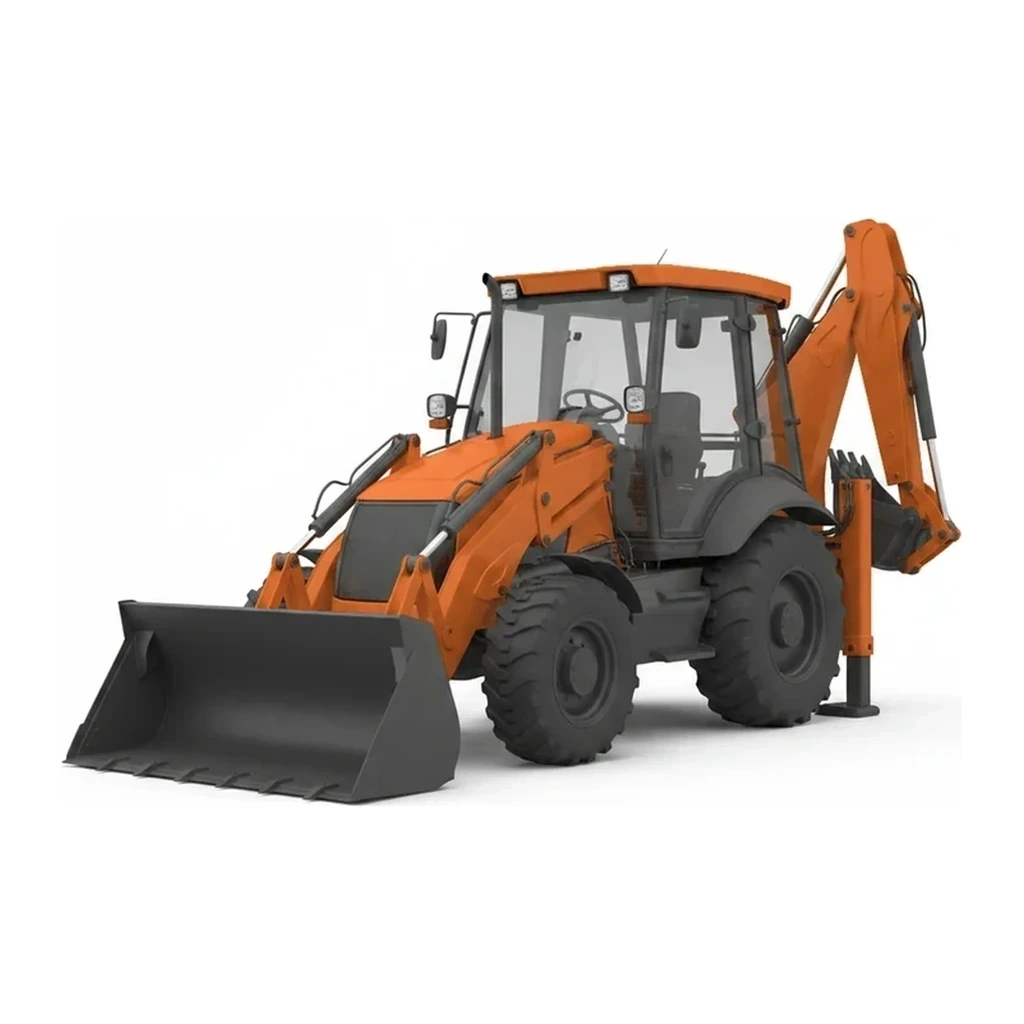
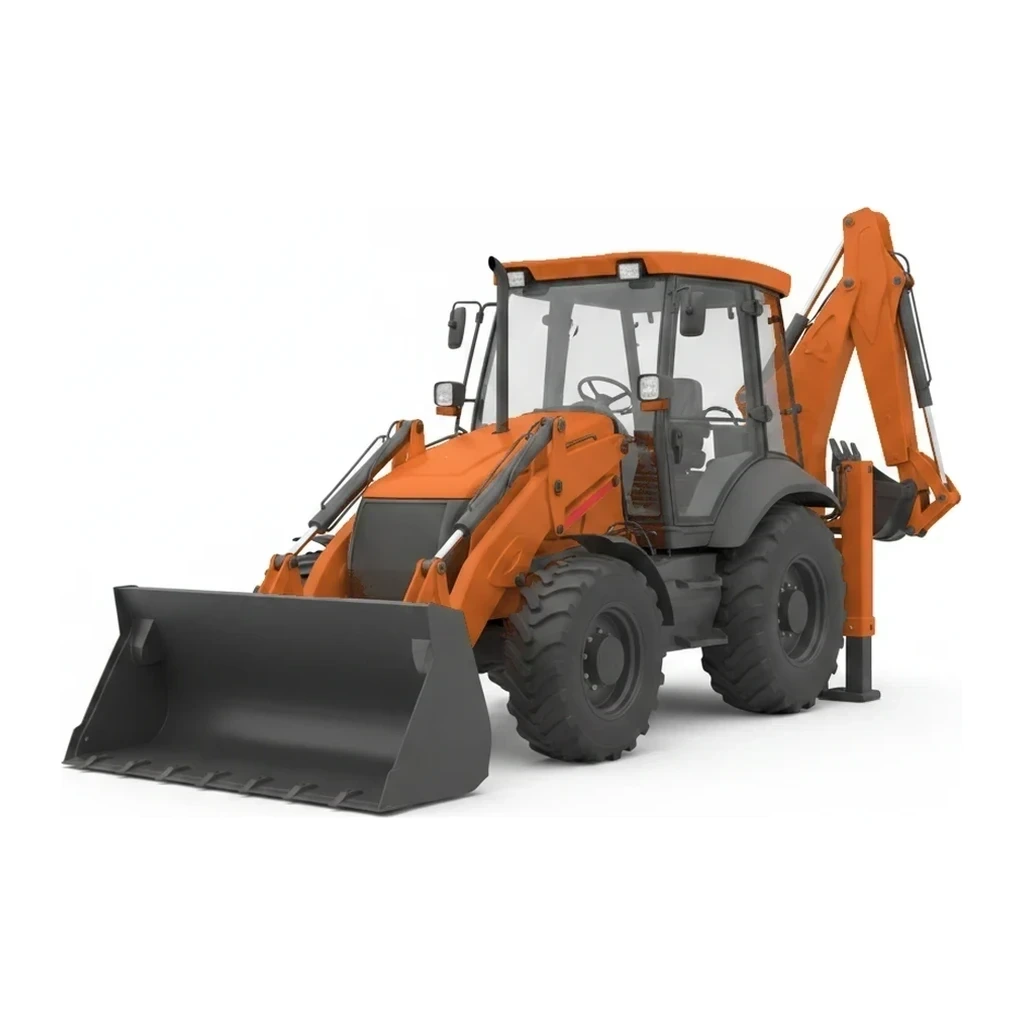
A diesel engine drives both the wheels — through a powershift or hydrostatic transmission — and a hydraulic system feeding two separate work ends. The front loader raises and dumps through a pair of lift arms and bucket cylinders, used for loading, grading and carrying. The rear backhoe is a boom-stick-bucket linkage on a swing frame, worked from a rear-facing operator position with the machine held rigid on outriggers (stabilizers). The operator alternates ends by rotating the seat. Loader work is done on the move; backhoe work is stationary with stabilizers down and the loader bucket lightly grounded for a four-point stance. Auxiliary circuits power breakers, augers and compactors on the backhoe, and many machines add side-shift carriages or extendable sticks for reach and alignment.
Types & variants
- Center-mount backhoe
- The North American convention — the backhoe pivots on the chassis centerline, favoring digging power and simplicity.
- Side-shift backhoe
- The carriage slides laterally on rails, letting the machine dig flush along walls and curb lines; standard in urban and European practice.
- Extendable-stick (extendahoe) models
- A telescoping stick section adds dig depth and reach at reduced breakout, from catalog records reaching 6.5-8.3 m.
- Compact backhoe loaders
- Sub-scale units at the bottom of the weight range for residential and light utility duty.
- Tool-carrier variants
- Loader ends with quick couplers and parallel lift for pallet-fork and attachment work.
Key specifications
| Specification | Typical range | What it means |
|---|---|---|
| Operating weight | 5,300–26,800 lb (2,404–12,156 kg) | From catalog records of 2,409-12,148 kg; the volume of the class sits in the 13,200-22,000 lb band. |
| Engine power | 49-114 hp | From catalog records of 36.3-85 kW, shared between roading, loader work and backhoe hydraulics. |
| Backhoe dig depth | 14–19 ft (4.3–5.8 m) | From records of 4.39-5.88 m — the spec that determines which utility trenches the machine can serve. |
| Backhoe reach | 21–27 ft (6.4–8.2 m) | From records of 6.53-8.27 m, measured at ground line from the swing pivot. |
| Loader lift capacity | 1,500–8,400 lb (680–3,810 kg) | From records of 665-3,822 kg — governs pallet, pipe and spoil-handling duty on the front end. |
| Fuel tank capacity | 117-250 L | Sized for a full shift of mixed roading and hydraulic work. |
How the industry sizes it
Backhoe loaders are sized primarily by operating weight and dig depth, with the industry's traditional shorthand being the '14-foot' or '15-foot' class after standard backhoe depth. The catalog bands the class by weight — with the main population in the 13,200-22,000 lb band and single records above and below — and machines step up in dig depth, loader capacity and engine power together. Because the class is roadable, sizing rarely turns on transport; it turns on required dig depth and the loader duty between digs.
Applications
- Utility trenching and service repairs for water, sewer, gas and electric
- Loading trucks and backfilling around foundations
- Small-site excavation where one machine must both dig and load
- Road and municipal maintenance with frequent on-road repositioning
- Breaker, auger and compaction work off the backhoe's auxiliary circuit
- Snow removal and material handling in the loader-forward direction
Safety & operation
- Set stabilizers and ground the loader bucket before backhoe work; digging on tires alone is the class's classic tip-over cause.
- Keep ground crews clear of the backhoe swing arc, which sweeps behind and beside the machine at speed.
- Confirm utility locates (811) before trenching, and follow OSHA Subpart P protective-system rules at depth.
- Carry the loader bucket low when roading; a raised loaded bucket lifts the rear steering axle's effective weight.
- Use the seat belt with the ROPS cab or frame — machine rollover on slopes and trench edges is the leading fatal event class-wide.
Standards & certifications
- OSHA · 29 CFR 1926.602
- Earthmoving equipment provisions, including seat belt and ROPS use.
- ISO · ISO 3471
- Roll-over protective structure performance requirements for earthmoving machines.
- OSHA · 29 CFR 1926 Subpart P
- Trench and excavation safety for the digging half of the machine's duty.
- EPA · Tier 4 Final (40 CFR Part 1039)
- Nonroad diesel emissions certification for current engines.
Frequently asked
What can a backhoe loader do that an excavator cannot?
How deep can a backhoe dig?
What is the difference between center-mount and side-shift?
Do backhoe loaders travel on public roads?
Compare popular models
Find by spec →Normalised to the same units. A dash means the figure was not published.
| Model | Operating weight | Max dig depth | Max reach | Engine power |
|---|---|---|---|---|
| Case 590SN | 20,459 lb (9,280 kg) | 16 ft (4.9 m) | - | 109 hp |
| Case 590SV | 15,267 lb (6,925 kg) | - | - | - |
| Case 580 Super N | 16,239 lb (7,366 kg) | 17.9 ft (5.5 m) | 21.9 ft (6.7 m) | 97 hp |
| John Deere 310G | - | 13 ft (4.0 m) | - | 75 hp |
| Case 580N EP Backhoe Loader | 14,905 lb (6,761 kg) | 18 ft (5.5 m) | 21.4 ft (6.5 m) | 90 hp |
| Case 580SV | 14,905 lb (6,761 kg) | 14.4 ft (4.4 m) | 21.4 ft (6.5 m) | - |
Related equipment
Browse by manufacturer
Sources
Every specification is verified against the manufacturer's published data, with the source linked for reference.