

Towable Boom Lift
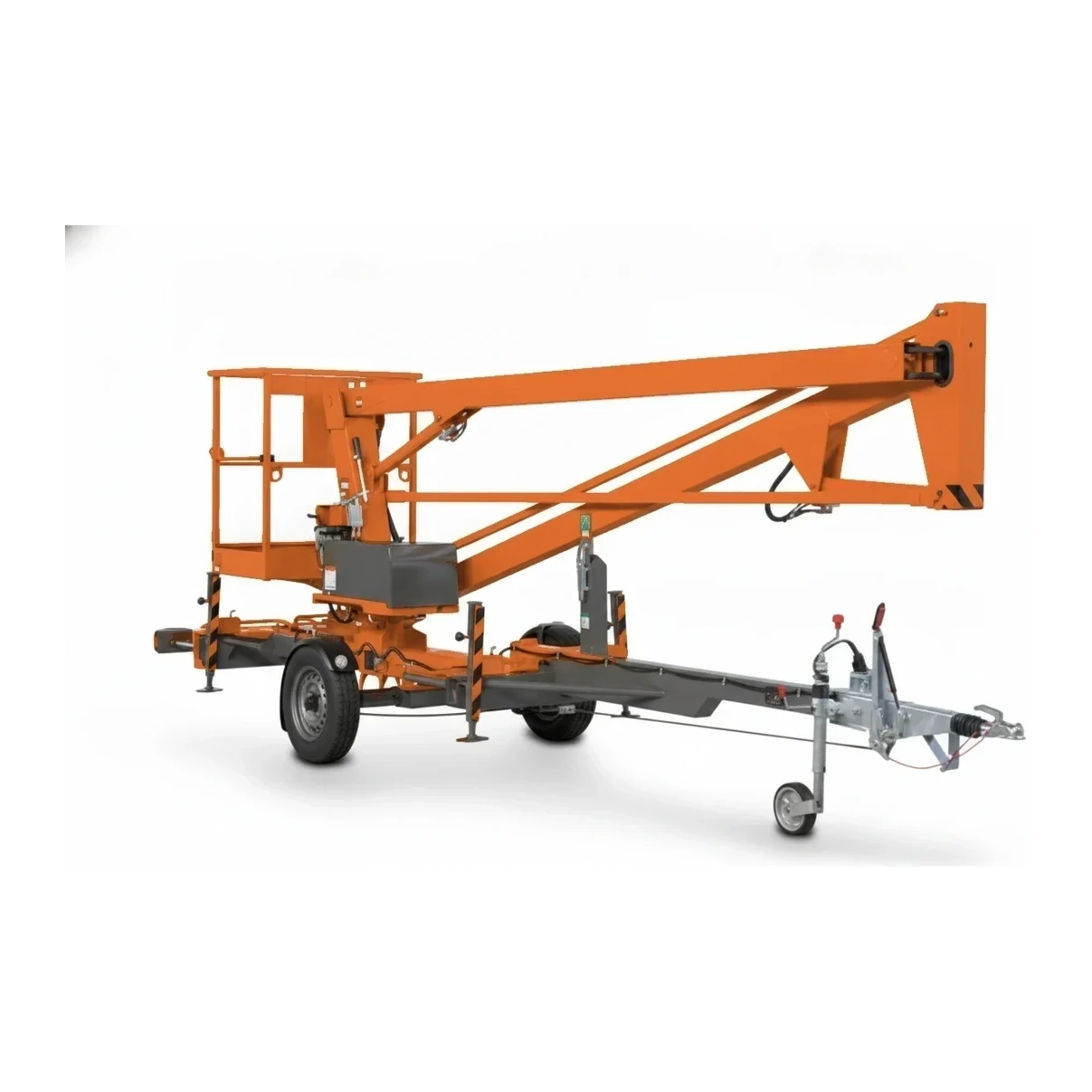
A towable boom lift is a trailer-mounted aerial work platform that hitches behind a pickup or van for road transport, then sets up on outriggers to elevate a single-basket boom. It gives crews genuine boom-lift height without the weight, cost, or specialized hauling of a self-propelled machine, which makes it a staple for maintenance contractors, facilities teams, and light exterior work.
Cat classes
Pick a size class: capacity and reach differ across the range.
How it works
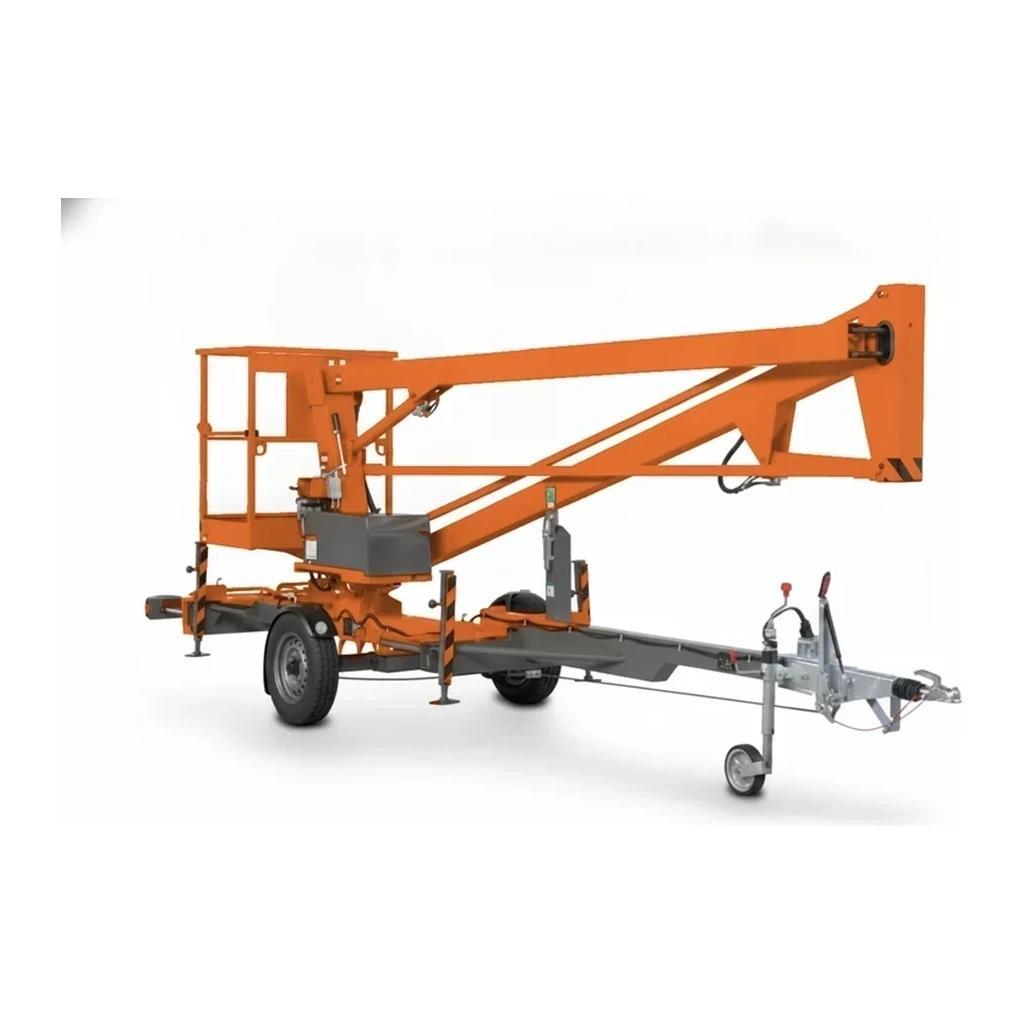
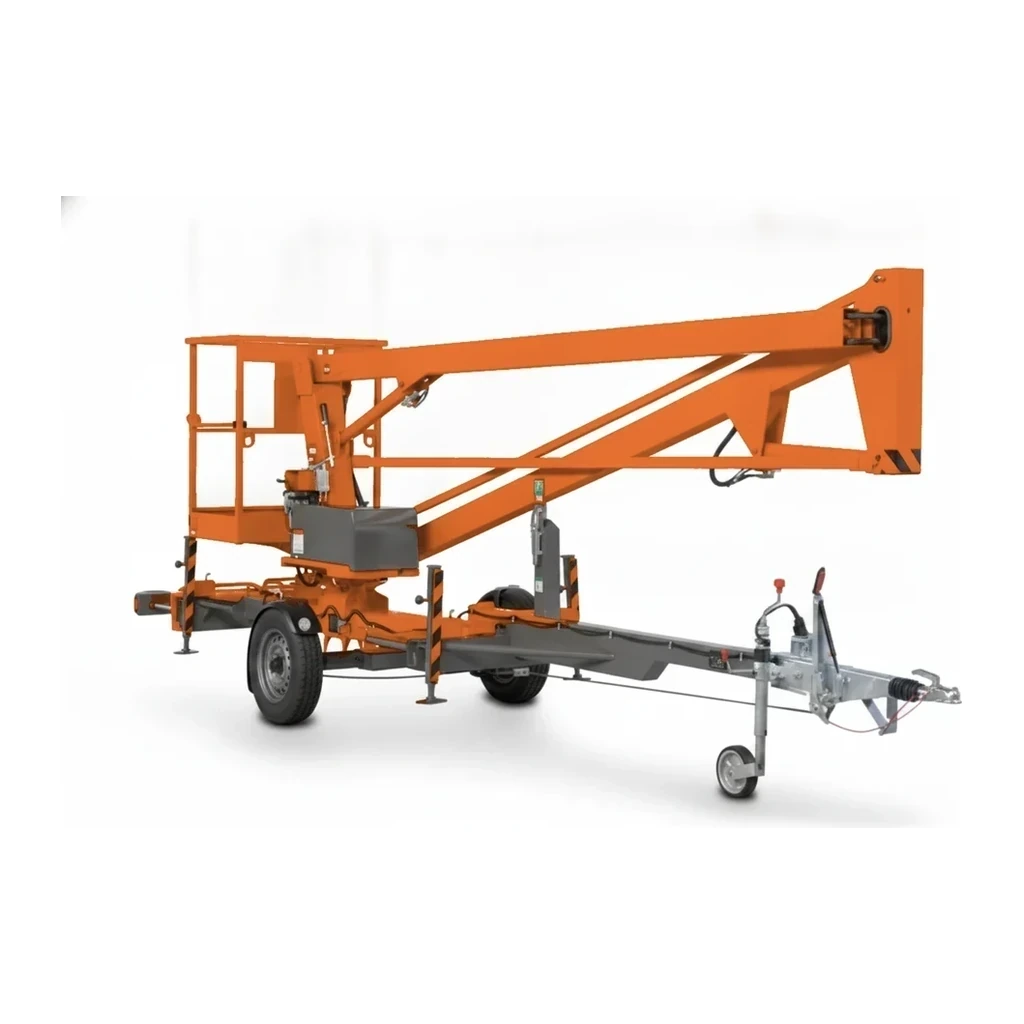
The machine is built on a road-legal trailer chassis with a standard coupler, lights, and axle running gear. On site, four manually or hydraulically deployed outriggers lift the wheels clear and level the chassis — interlocks prevent boom operation until all outriggers are set and loaded. The boom, articulating, telescoping, or both, then elevates from the stabilized base, powered by a battery pack or a small combustion engine driving a hydraulic pump. Because stability comes entirely from the outrigger footprint rather than counterweight, towables stay light enough to tow while reaching working heights of 34-61 ft across listed models. The platform does not drive; repositioning means lowering, stowing the outriggers, and re-hitching or moving the unit by hand or with a vehicle.
Types & variants
- Telescopic towable booms
- Straight-boom trailer units emphasizing maximum outreach for facade and tree-line work.
- Articulating towable booms
- Jointed-boom units that reach up and over garden walls, canopies, and single-storey roofs.
- Battery-electric models
- Quiet, emission-free power for residential neighborhoods, campuses, and indoor setup through large openings.
- Engine-powered models
- Small gas or diesel power packs for remote sites without charging access.
Key specifications
| Specification | Typical range | What it means |
|---|---|---|
| Working height | 34–61 ft (10.4–18.6 m) | The catalog bands run 34-39, 40-49, and 50-59 ft; height comes from the outrigger-stabilized boom rather than machine mass. |
| Platform capacity | 147-320 kg (325-705 lb) | Baskets carry one or two workers with hand tools; towables are not material-staging machines. |
| Maximum lift height | 6.1-17.1 m (20-56 ft) | Platform elevation across listed models; verify each model's range diagram for outreach at height. |
How the industry sizes it
Towable booms are sized by working height in bands of 34-39, 40-49, and 50-59 ft, with the tow vehicle as the second sizing constraint: the trailer's loaded weight and coupler style must match the vehicle's hitch and towing rating. Setup area matters as much as reach — the outrigger footprint must fit and the ground must carry the point loads — so site dimensions are checked alongside the height requirement.
Applications
- Exterior building maintenance, painting, and gutter or soffit work
- Sign installation and servicing on commercial frontages
- Tree trimming and pruning near structures
- Campus, municipal, and property-management maintenance rounds
- Light electrical and lighting work at height across dispersed sites
Safety & operation
- All outriggers must be deployed, loaded, and the chassis leveled before the boom elevates; the interlocks enforcing this must never be bypassed.
- Occupants wear full-body harnesses tied to the designated platform anchor, as on any boom-supported platform.
- Operators require MEWP training and model familiarization per ANSI A92.24, including outrigger sequencing and manual emergency lowering.
- Towing safety is part of the machine's use: hitch rating, coupler engagement, safety chains, lighting, and jurisdictional trailer-brake requirements are verified before every road move.
- The unit must never be towed or repositioned with the boom raised or the platform occupied.
Standards & certifications
- ANSI/SAIA · A92.20 / A92.22 / A92.24
- U.S. MEWP design, safe-use, and training standards; towables are Group B, Type 1 machines (travel only in stowed position).
- OSHA · 29 CFR 1926.453
- Aerial lift requirements for boom-supported platforms on construction sites.
- CSA · B354.6 / B354.7 / B354.8
- Canadian MEWP design, safe-use, and training standards.
Frequently asked
What vehicle can tow a towable boom lift?
Can a towable boom lift drive around a site?
How high do towable boom lifts reach?
Is a towable boom lift stable without counterweight?
Compare popular models
Find by spec →Normalised to the same units. A dash means the figure was not published.
| Model | Working height | Platform capacity |
|---|---|---|
| JLG T350 | 34.4 ft (10.5 m) | 500 lb (227 kg) |
| Haulotte HTA13 P | - | 500 lb (227 kg) |
| Haulotte HTT13 | - | 500 lb (227 kg) |
| JLG ET500J | 50 ft (15.2 m) | 500 lb (227 kg) |
| Genie HFT-70RS | - | - |
| JLG 3369LE | - | - |
Related equipment
Browse by manufacturer
Sources
Every specification is verified against the manufacturer's published data, with the source linked for reference.