

Dump Truck
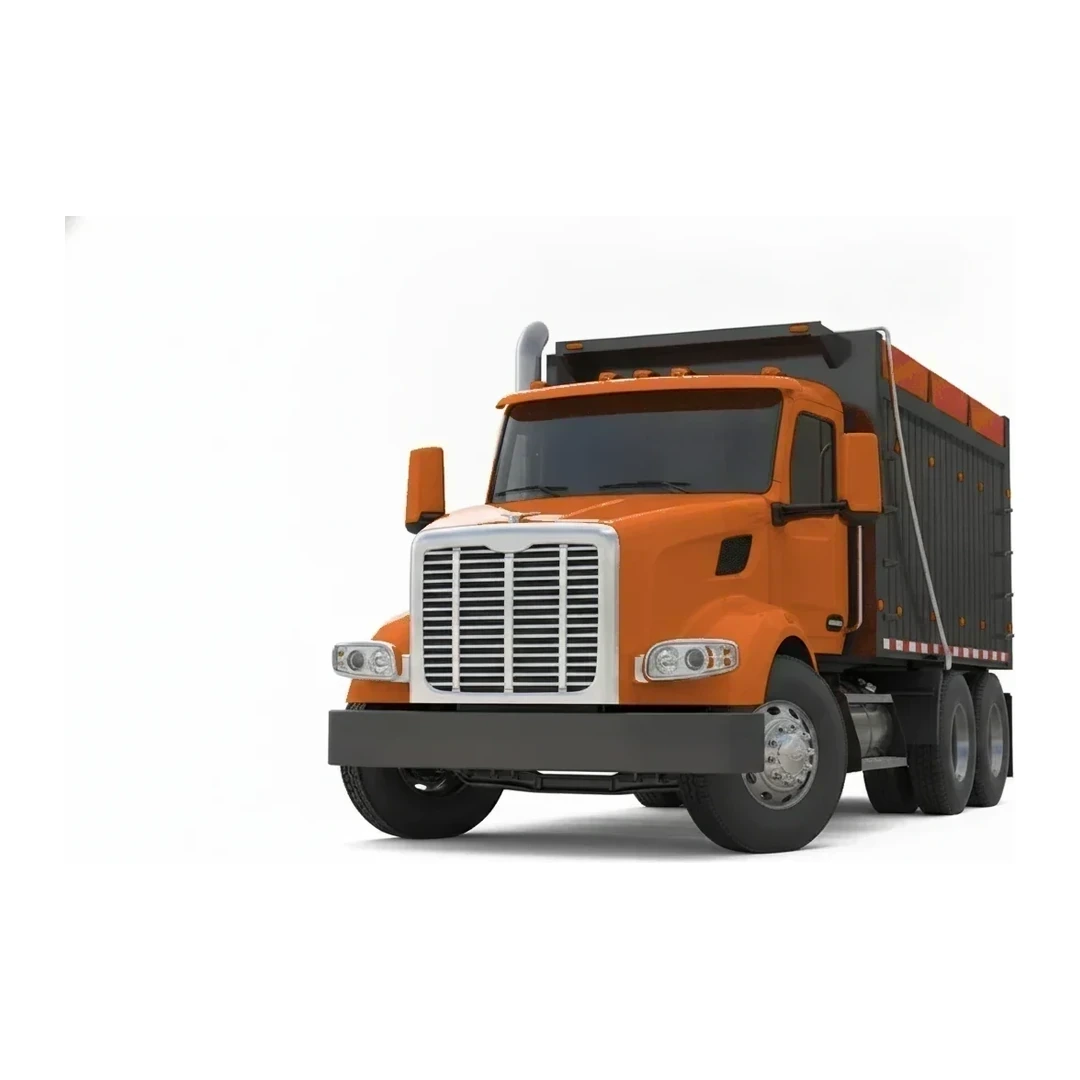
A dump truck carries loose material in an open box that tilts hydraulically to discharge its load. The class spans tracked mini dumpers, straight trucks with 3-23 cu yd boxes, and articulated off-road haulers with payloads up to roughly 55,000 kg in cataloged listings. It is the primary mover of soil, aggregate, and debris on construction sites.
How it works
A hydraulic hoist, typically a telescopic cylinder ahead of or beneath the box, raises the front of the body so material slides out through the tailgate. The tailgate swings or lifts to release the load, and spreading is controlled by driving forward as the box rises. On-road models are conventional trucks with reinforced frames and PTO-driven hydraulics; articulated haulers pivot at a center joint, keeping all wheels driving over rough terrain. Box capacity in cubic yards, payload rating, and axle configuration together define what a given truck legally and practically carries.
Types & variants
- Standard on-road dump trucks
- Single- and tandem-axle trucks with 3-23 cu yd boxes for street-legal hauling.
- Articulated dump trucks (ADTs)
- Off-road haulers with pivot steering and high payloads for mass excavation.
- Mini and tracked dumpers
- Compact carriers at the small end of the class for tight-access material moves.
- Super dumps and transfer configurations
- Added axles raise legal payload for high-volume road work.
Key specifications
| Specification | Typical range | What it means |
|---|---|---|
| Box capacity (cu yd) | Cataloged bands run 3.00-6.00 and 15.00-23.00 cu yd | Volume per trip; the working size designation for on-road trucks. |
| Payload capacity | About 300 to 55,000 kg across cataloged models, from mini dumpers to articulated haulers | The mass the truck may legally and mechanically carry. |
| Engine power (hp) | About 8.4 to 577 hp across cataloged models | Scales with class, from walk-along dumpers to loaded highway and off-road duty. |
How the industry sizes it
Dump trucks are sized by volume per trip and by the site itself: on-road hauling favors the largest legal box the routes allow, while tight urban lots and landscape work fit the 3-6 cu yd class. Off-road mass excavation moves to articulated haulers rated by payload rather than street legality. GVWR class determines licensing for on-road units.
Applications
- Hauling excavation spoil off site
- Delivering aggregate, sand, and road base
- Demolition debris removal
- Mass earthmoving with off-road haulers
- Asphalt and paving material delivery
Safety & operation
- Raise the box only on firm, level ground; a raised loaded box makes the truck unstable.
- Confirm overhead clearance, power lines and structures, before dumping.
- Never travel with the box raised.
- Use spotters when reversing; rear visibility is limited even with cameras.
Standards & certifications
- FMCSA · 49 CFR 383
- A CDL is required to operate single vehicles with GVWR over 26,000 lb, which covers most tandem-axle dump trucks.
- FHWA/DOT · GVWR Classes 1-8
- The federal weight-class system that defines light, medium, and heavy dump truck categories.
- FMCSA · 49 CFR 396
- Commercial vehicle inspection, repair, and maintenance requirements including pre-trip inspections.
Frequently asked
How much does a dump truck carry?
Does operating a dump truck require a CDL?
What distinguishes an articulated hauler from a standard dump truck?
Compare popular models
Find by spec →Normalised to the same units. A dash means the figure was not published.
| Model | Load capacity | Engine power |
|---|---|---|
| Altrad Belle DX 1000HT | 2,205 lb (1,000 kg) | 24 hp |
| Bell B30E 4x4 ADT | 61,729 lb (28,000 kg) | 322 hp |
| Bell B45E 4x4 ADT | 90,390 lb (41,000 kg) | 523 hp |
| Bell B60E 4x4 ADT | 121,254 lb (55,000 kg) | 577 hp |
| Belle DX 1000HT | 2,205 lb (1,000 kg) | 24 hp |
| Caterpillar 725 | 52,911 lb (24,000 kg) | 334 hp |
Related equipment
Browse by manufacturer
Sources
Every specification is verified against the manufacturer's published data, with the source linked for reference.
All models
103 models · Page 3 of 3 · Every spec cited to source