

Walk-Behind Vibratory Roller
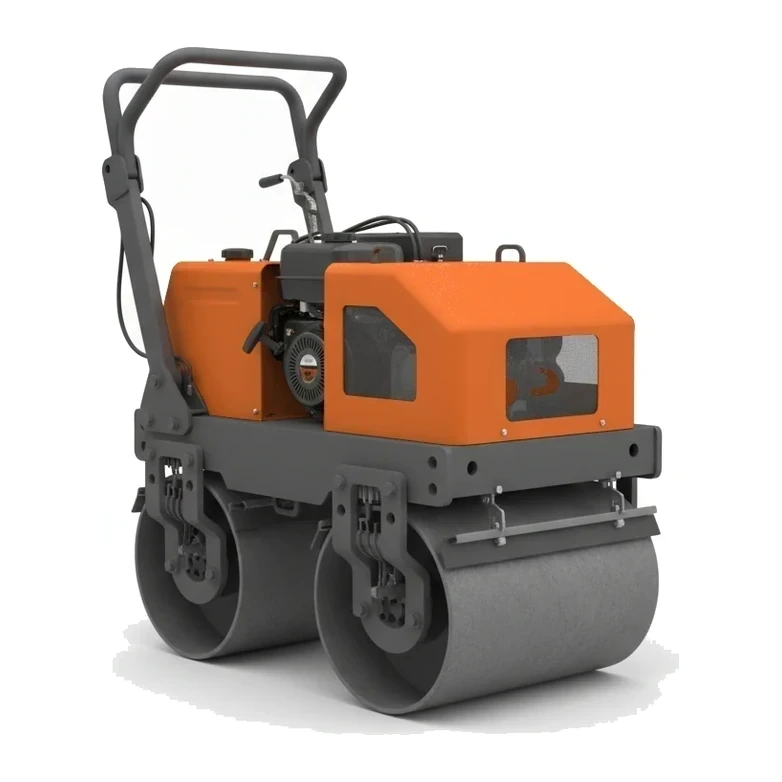
A walk-behind vibratory roller is a pedestrian-operated compaction machine featuring one or two vibrating drums that consolidate soil, asphalt, and base materials in confined spaces. These compact rollers are designed for areas inaccessible to ride-on equipment, such as sidewalks, trenches, driveways, and patch work. The operator walks behind the machine, guiding it through manual controls while the vibratory mechanism delivers compactive force.
Cómo funciona
Walk-behind vibratory rollers use an eccentric weight or shaft inside the drum that rotates at high speed, generating vertical vibrations that penetrate the surface material. These vibrations reduce air voids and increase particle density, while the drum's static weight provides additional compactive pressure. Most units feature a reversible vibration system allowing the operator to change direction without turning the machine. The engine drives both the vibratory mechanism and, in most models, a hydrostatic transmission that propels the roller forward or reverse. Operators control speed, vibration on/off, and direction via handlebar-mounted levers. Water spray systems keep the drum surface clean and prevent asphalt adhesion during hot-mix applications.
Tipos y variantes
- Single-Drum Walk-Behind Roller
- Features one vibratory drum at the front with a set of wheels or a smooth plate at the rear, providing good maneuverability and visibility of the compaction edge.
- Double-Drum (Tandem) Walk-Behind Roller
- Equipped with two vibratory drums in tandem configuration, delivering uniform compaction across the full width and eliminating wheel marks on finished surfaces.
- Trench Roller
- Narrow-profile design optimized for utility trenches and confined linear excavations, typically featuring narrow drum widths and compact overall dimensions.
- Remote-Controlled Walk-Behind Roller
- Operated via wireless remote control rather than direct handlebar guidance, allowing compaction in hazardous areas or steep slopes while the operator maintains safe distance.
Especificaciones clave
| Especificación | Rango típico | Qué significa |
|---|---|---|
| Drum Width | 24–36 in (61.0–91.4 cm) | Determines coverage per pass and access capability; the industry sizes walk-behind rollers primarily by drum width in inches. |
| Operating Weight | 209–27,955 lb (95–12,680 kg) | Provides static compactive force; heavier models suit base materials while lighter units prevent over-compaction of thin lifts. |
| Engine Power | 3.6-20 hp | Drives the vibratory system and propulsion; higher horsepower supports larger drums and heavier operating weights. |
| Vibration Frequency | 3,000-4,000 vpm | Affects compaction depth and efficiency; higher frequencies suit granular soils while lower frequencies work better in cohesive materials. |
| Centrifugal Force | Up to 3 t | The dynamic force generated by the eccentric weight; higher amplitude increases compaction effectiveness in base layers. |
Cómo la industria lo dimensiona
The industry sizes walk-behind vibratory rollers primarily by drum width measured in inches, as this dimension determines both coverage area and the machine's ability to access confined spaces. Narrowest units under 24 inches serve sidewalks, paths, and patches where no ride-on equipment can operate. The everyday 24-32 inch range handles driveways, trench caps, and small asphalt repairs. Widest models over 32 inches tackle parking-lot patches and shoulder work with fewer passes. Operating weight provides secondary classification, ranging from lightweight units around 95 kg for delicate surface work to heavy-duty models exceeding 12,000 kg for deep-lift base compaction.
Aplicaciones
- Utility trench backfill compaction above buried pipes, conduit, and cables
- Asphalt patching and repair in parking lots, driveways, and roadway shoulders
- Sidewalk and pathway base preparation and finish rolling
- Compaction around structures, curbs, and obstacles inaccessible to ride-on equipment
- Driveway and residential paving projects requiring precise edge work
- Landscaping and hardscaping projects involving pavers, aggregate paths, and retaining wall backfill
Seguridad y operación
- Operators must maintain secure footing and avoid working on slopes exceeding the manufacturer's maximum grade rating to prevent loss of control or machine rollover
- Hearing protection is required due to engine and vibration noise levels that typically exceed 85 dBA during operation
- The machine must not be operated in reverse without first ensuring the path is clear, as the operator's view behind the equipment is limited
- Vibration exposure should be monitored and limited according to occupational health standards to prevent hand-arm vibration syndrome (HAVS)
- Hot asphalt applications require heat-resistant gloves and awareness of surface temperatures that can cause burns on contact with the drum
Normas y certificaciones
- OSHA · 29 CFR 1926.602
- Establishes requirements for compaction equipment operation on construction sites, including operator training and equipment inspection.
- ISO 2631 · ISO 2631-1:1997
- Defines whole-body vibration exposure limits and measurement methods applicable to walk-behind roller operators.
- EPA · Tier 4
- Sets emission standards for off-road diesel engines; newer walk-behind roller models comply with applicable tier requirements based on engine size.
- ANSI · ANSI/ASSE A10.32
- Provides fall protection and safety requirements for construction and demolition operations involving compaction equipment.
Preguntas frecuentes
What determines whether a project requires a walk-behind versus a ride-on roller?
How does drum width affect compaction performance and application suitability?
What is the difference between single-drum and double-drum walk-behind rollers?
What factors influence the selection of operating weight for a walk-behind roller?
Comparar modelos populares
Buscar por especificación →Normalizado a las mismas unidades. Un guion significa que el valor no fue publicado.
| Modelo | Peso operativo | Potencia del motor |
|---|---|---|
| Multiquip RX1510 | - | 20 hp |
| Multiquip MVC88VTHW | 229 lb (104 kg) | 5 hp |
| Multiquip MVC88VTH | 207 lb (94 kg) | 5 hp |
| Multiquip MVC82VH | - | - |
Equipos relacionados
Explorar por fabricante
Fuentes
Cada especificación se verifica con los datos publicados por el fabricante, con la fuente enlazada como referencia.
Todos los modelos
25 modelos · Cada especificación citada a la fuente